Level:
Correct: 0
Incorrect: 0
Marks: 0/0
Exam Practice
Course:
Topics:
Avg
score:
–
Topics
done:
0/35

Maintaining biodiversity

Practise 14 exam-style questions on Maintaining biodiversity for AQA GCSE Combined Science (Biology Paper 2). Write your answer as you would in the exam and get it marked in seconds against the mark scheme, point by point, with the Study Helper on hand if you get stuck.

  • 14 questions
  • 1–6 marks each
  • Instant marking
  • No sign-up needed
14 questions, marked as you go

Sample questions with model answers

Here are 4 of the questions in this topic, each with a model answer, an explanation of why it earns the marks and the mark scheme an examiner would use.

Question 1

2 marks

Explain how captive breeding programmes in zoos can help to save endangered species.

Model answer

Animals of the endangered species are bred in zoos, where they are safe, to increase their numbers. Some of the offspring can then be released into the wild to increase or restore wild populations, so the species does not become extinct.

Explanation

Breeding programmes for endangered species are one of the ways humans try to maintain biodiversity. They work best when combined with protecting the habitat the animals will be released into.

Mark scheme
  1. 1 mark

    animals are bred in captivity to increase the number of individuals

    allow protects them from predators / hunting while numbers increase

  2. 1 mark

    they can be released into the wild to increase / restore wild populations

    allow prevents the species becoming extinct

Question 2

3 marks

On many farms, only one type of crop is grown over large areas. Some farmers are now replanting hedgerows and leaving strips of wild plants, called field margins, around their fields.

Explain how this can increase biodiversity.

Model answer

Hedgerows and field margins contain many different species of plant, which provide food such as nectar and seeds for insects and birds. They also provide shelter and nesting sites. This allows many more species to live on the farm than in a field containing only one crop, and hedgerows link areas of habitat so animals can move between them.

Explanation

A field of one crop supports very few species. Reintroducing field margins and hedgerows adds variety of plants and habitats, which supports many more species of insects, birds and mammals.

Mark scheme
  1. 1 mark

    hedgerows and margins provide habitats / shelter / nesting sites for animals

    max 3

  2. 1 mark

    they contain a variety of plants, which provide food (e.g. nectar, seeds) for insects and birds

  3. 1 mark

    so more species of plant and animal can live on the farm than in a field of one crop

  4. 1 mark

    hedgerows link areas of habitat, so animals can move between them

    allow act as corridors

Question 3

3 marks

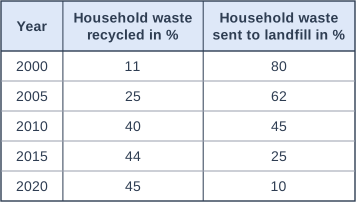
The table shows what happened to household waste in one country between 2000 and 2020.

Describe the changes shown and explain how they could help to maintain biodiversity.

Table with columns "Year", "Household waste recycled in %", "Household waste sent to landfill in %". Year: 2000; Household waste recycled in %: 11; Household waste sent to landfill in %: 80 | Year: 2005; Household waste recycled in %: 25; Household waste sent to landfill in %: 62 | Year: 2010; Household waste recycled in %: 40; Household waste sent to landfill in %: 45 | Year: 2015; Household waste recycled in %: 44; Household waste sent to landfill in %: 25 | Year: 2020; Household waste recycled in %: 45; Household waste sent to landfill in %: 10.

Model answer

Between 2000 and 2020 the percentage of household waste recycled increased from 11% to 45%, and the percentage sent to landfill fell from 80% to 10%. Less land is needed for landfill sites, so fewer habitats are destroyed and less land and water are polluted by toxic chemicals. Recycling also means fewer raw materials need to be quarried, mined or cut down, which protects more habitats.

Explanation

Recycling resources rather than dumping waste in landfill is one of the programmes that help maintain biodiversity. It reduces both the land used for waste and the land disturbed to obtain new materials.

Mark scheme
  1. 1 mark

    the percentage recycled increased (from 11% to 45%) and the percentage sent to landfill decreased (from 80% to 10%)

    must use data

  2. 1 mark

    less land is needed for landfill, so fewer habitats are destroyed / less pollution of land and water by toxic chemicals

  3. 1 mark

    recycling means fewer raw materials are extracted (e.g. by quarrying, mining or cutting down trees), so fewer habitats are destroyed

Question 4

6 marks

A town needs 500 new homes. A developer wants to build them on a rare wildflower meadow at the edge of the town. Two other options have been suggested:
Option B: build on nearby farmland, where wheat is grown.
Option C: build on the meadow, but create a new wildflower meadow on farmland a few kilometres away.

Evaluate the three options.

Model answer

The town needs homes for its growing population, so the homes must be built somewhere. Building on the meadow would destroy a rare habitat with a high biodiversity; many of its plant and insect species may be found nowhere else nearby, and they would be lost.

Option B, building on the wheat field, would destroy far fewer species, because a field of one crop has very low biodiversity. However, it would reduce the land available to grow food.

Option C would regenerate some habitat, but a new meadow takes many years to develop, and the rare species may not move to it, so biodiversity would still be lost in the meantime.

Overall, option B is the best for biodiversity, because the loss of a little farmland is easier to replace than the loss of a rare habitat.

Explanation

Maintaining biodiversity often conflicts with other human needs, such as housing and food production. A good evaluation compares the options using biodiversity, considers drawbacks of each and reaches a justified conclusion.

Mark scheme
  1. 1 mark

    there is a need for homes for the growing population (conflicting pressure)

    Level of response question: credit a coherent, logically linked answer; max 6. Max 4 if fewer than three options are evaluated or there is no conclusion.

  2. 1 mark

    building on the meadow destroys a rare habitat with high biodiversity / species found nowhere else nearby

  3. 1 mark

    the farmland has low biodiversity (one crop), so building there destroys fewer species

  4. 1 mark

    but building on farmland reduces the land available for food production

  5. 1 mark

    creating a new meadow (regeneration) replaces some habitat

  6. 1 mark

    but a new meadow takes many years to develop and may not support the same species

    allow rare species may not move to the new site

  7. 1 mark

    a justified conclusion, e.g. option B is best for biodiversity

Ready to try the rest? Every answer you write is marked against the mark scheme, so you can see exactly where the marks are.

Revision notes

Maintaining biodiversity

The big idea

Biodiversity is the variety of all the different species in an ecosystem, or on Earth. A high biodiversity makes an ecosystem more stable, because species depend less on any one other species for food, shelter and the maintenance of the physical environment. Humans depend on it too, for food, materials and medicines. Many human activities reduce biodiversity, so scientists and concerned citizens have put programmes in place to protect it.

Negative human interactions

Most damage comes from destroying habitats or killing organisms directly:

  • Deforestation and the destruction of peat bogs remove whole habitats.
  • Building, quarrying, farming and dumping waste reduce the land available for other animals and plants.
  • Removing hedgerows to make huge fields of one crop leaves little food or shelter for wildlife.
  • Pollution of water (sewage, fertiliser, toxic chemicals), air (smoke, acidic gases) and land (landfill, toxic chemicals) kills plants and animals.
  • Burning fossil fuels releases carbon dioxide, which causes global warming and changes habitats.
  • Hunting and overfishing remove animals faster than they can breed.

In each case organisms lose their food or shelter, fewer species survive and some become extinct.

Programmes that protect biodiversity

ProgrammeHow it helps biodiversity
Breeding programmes for endangered speciesAnimals breed safely in captivity, for example in zoos, so their numbers rise; offspring can be released into the wild
Protection and regeneration of rare habitatsHabitats such as peat bogs, heathland and wildflower meadows are protected from building and farming, and restored (for example by clearing invading scrub and replanting native plants), so the rare species adapted to them survive
Reintroducing field margins and hedgerows where farmers grow only one cropHedgerows give shelter, nesting sites and safe corridors between habitats; wildflower margins give nectar, pollen and seeds, so far more species can live on the farm
Reducing deforestation and carbon dioxide emissions (by some governments)Forest habitats are kept, and the trees keep absorbing carbon dioxide; lower emissions slow global warming, so fewer habitats are lost
Recycling rather than dumping waste in landfillLess land is used for landfill, and fewer raw materials are quarried, mined or cut down, so more habitats are kept; less pollution leaks into the surroundings

Breeding programmes in more detail

An endangered species is one whose numbers are so low that it is at risk of becoming extinct. Zoos keep records of every animal and avoid breeding close relatives. Inbreeding reduces genetic variation and makes inherited disorders more likely; with little variation, a new disease or a change in the environment could wipe out the whole population.

Breeding programmes have limits. Animals raised in captivity may never learn to find food or avoid predators, and releasing them only works if the original threats, such as habitat loss or hunting, have been dealt with. They work best alongside habitat protection.

Why programmes can be difficult

Conservation often conflicts with people's needs. Hedgerows and margins take up land that could grow crops, although they can also help the farmer: they support bees that pollinate crops, and predators such as ladybirds that eat pests. Some countries earn money from timber, beef and crops grown on cleared forest, and local people may depend on it for jobs and land, so reducing deforestation is hard.

Comparing biodiversity with quadrats

A student placed five quadrats at random in a wildflower margin and five in the middle of a wheat field, and counted the number of plant species in each.

Quadrat12345
Wildflower margin12914119
Middle of the field21313

Mean for the margin: \(\dfrac{12 + 9 + 14 + 11 + 9}{5} = \dfrac{55}{5} = 11\) species per quadrat

Mean for the middle of the field: \(\dfrac{2 + 1 + 3 + 1 + 3}{5} = \dfrac{10}{5} = 2\) species per quadrat

\(11 \div 2 = 5.5\), so the margin has 5.5 times as many plant species per quadrat. More plant species provide food and shelter for more species of insects and birds.

Remember

  • The five programmes: breeding programmes for endangered species; protecting and regenerating rare habitats; reintroducing field margins and hedgerows; reducing deforestation and carbon dioxide emissions; recycling instead of landfill.
  • Negative interactions destroy habitats or kill organisms, so biodiversity falls.
  • An endangered species is at risk of extinction; an extinct species has no individuals left.

Common mistakes

  • Naming a programme without explaining its effect. Link it to biodiversity: "hedgerows provide nesting sites, so more species of bird can live on the farm".
  • Writing that recycling is "better for the environment". Be specific: less land for landfill, fewer raw materials extracted, less pollution.
  • Saying breeding programmes solve the problem on their own. Released animals need a safe habitat to return to.
  • Confusing endangered with extinct.
  • Comparing totals from different numbers of quadrats. Compare means.

Exam tip

Questions that ask for "positive and negative human interactions" need both sides, and each example must be linked to its effect: habitat lost or gained, organisms harmed or protected, so biodiversity falls or is maintained. A list of examples with no effects will not reach the top level.

Study Helper Hints first, answers after you try

Stuck on this one? Ask for a hint and I’ll point you in the right direction, without giving the answer away. Once you’ve checked your answer, I’ll show you how the marks are awarded.