Practise 16 exam-style questions on Selective breeding for AQA GCSE Combined Science (Biology Paper 2). Write your answer as you would in the exam and get it marked in seconds against the mark scheme, point by point, with the Study Helper on hand if you get stuck.
16 questions
1–6 marks each
Instant marking
No sign-up needed
16 questions, marked as you go
Sample questions with model answers
Here are 4 of the questions in this topic, each with a model answer, an explanation of why it earns the marks and the mark scheme an examiner would use.
Question 1
2 marks
What is meant by selective breeding?
Model answer
Selective breeding is the process by which humans breed plants and animals for particular genetic characteristics.
Explanation
In selective breeding, humans choose the parents with the characteristics they want. Only genetic (inherited) characteristics can be passed on, so only these can be selected for.
Mark scheme
1 mark
humans choose which plants or animals breed
allow humans breed plants and animals
1 mark
for particular (desired) genetic characteristics
allow inherited characteristics
Question 2
2 marks
A farmer notices that some of her sheep have thicker wool because they were given a better diet.
Explain why selectively breeding these sheep will not necessarily produce lambs with thicker wool.
Model answer
The thicker wool was caused by the better diet, which is an environmental factor, not by the sheep's genes. Only genetic characteristics are passed on to offspring, so the lambs will not necessarily have thicker wool.
Explanation
Selective breeding selects for particular genetic characteristics. A difference caused only by the environment is not inherited, so breeding from those animals does not pass it on.
Mark scheme
1 mark
the thicker wool was caused by the environment (diet), not by their genes
1 mark
only genetic characteristics / alleles are passed on to offspring
allow characteristics caused by the environment are not inherited
Question 3
3 marks
Compare selective breeding with natural selection.
Model answer
In selective breeding, humans choose which individuals breed, whereas in natural selection the environment decides which individuals survive and reproduce. Selective breeding chooses characteristics that are useful to humans or attractive, while natural selection favours characteristics that help organisms survive in their environment. Both depend on genetic variation and both change the inherited characteristics of a population over many generations.
Explanation
The key difference is who or what does the selecting: humans (artificial selection) or the environment (natural selection). The mechanism of passing on alleles over generations is the same.
Mark scheme
1 mark
in selective breeding humans choose which individuals breed; in natural selection the environment determines which individuals survive and reproduce
max 3
1 mark
selective breeding selects characteristics useful to humans or for appearance; natural selection selects characteristics that help survival in the environment
1 mark
both change the inherited characteristics of a population over many generations
allow both depend on genetic variation
1 mark
selective breeding is usually faster / can lead to inbreeding
Question 4
5 marks
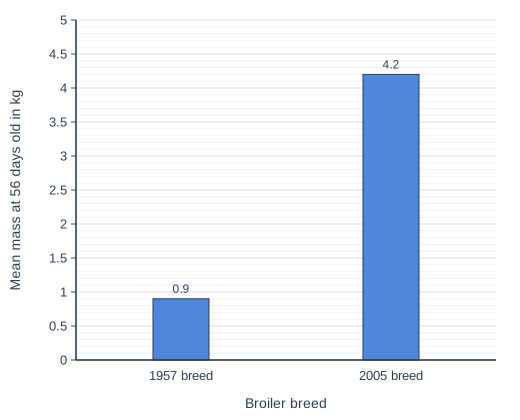
Chickens bred for meat are called broilers. The bar chart shows the mean mass of a broiler breed from 1957 and of a modern broiler breed from 2005 when both were fed the same diet and were 56 days old.
Modern broilers can suffer from leg problems and heart failure because they grow so quickly.
Evaluate the selective breeding of broiler chickens.
Model answer
Selective breeding has made broilers grow much faster: at 56 days the 2005 breed has a mean mass of 4.2 kg compared with 0.9 kg for the 1957 breed, about 4.7 times as heavy. This means more meat is produced in less time, so chicken is cheaper and more people can be fed. However, growing so quickly causes leg problems and heart failure, so many chickens suffer, which raises ethical concerns about animal welfare. Breeding from a small number of related birds may also reduce genetic variation, making the breed more prone to disease. Overall, selective breeding has greatly increased food production, but breeders should also select for health and welfare, not just for fast growth.
Explanation
An evaluation weighs benefits (more food, lower cost) against risks (health problems, inbreeding) and ethical issues (animal welfare), uses the data, and ends with a judgement.
Mark scheme
1 mark
modern broilers are much heavier at 56 days: 4.2 kg compared with 0.9 kg / about 4.7 times heavier
max 5; to reach 5 marks a justified conclusion is needed
1 mark
benefit: more meat is produced in less time, so meat is cheaper / more food for a growing population
1 mark
risk: rapid growth causes leg problems and heart failure
1 mark
ethical issue: the chickens may suffer / poor animal welfare
1 mark
risk: inbreeding / reduced genetic variation makes the breed more prone to disease or inherited defects
1 mark
justified conclusion, e.g. breeders should also select for health / welfare, not just growth
Ready to try the rest? Every answer you write is marked against the mark scheme, so you can see exactly where the marks are.
Ctrl + Enter to check
Study HelperHints first, answers after you try
Stuck on this one? Ask for a hint and I’ll point you in the right direction, without giving the answer away. Once you’ve checked your answer, I’ll show you how the marks are awarded.