Practise 15 exam-style questions on Resistant bacteria for AQA GCSE Combined Science (Biology Paper 2). Write your answer as you would in the exam and get it marked in seconds against the mark scheme, point by point, with the Study Helper on hand if you get stuck.
15 questions
1–6 marks each
Instant marking
No sign-up needed
15 questions, marked as you go
Sample questions with model answers
Here are 4 of the questions in this topic, each with a model answer, an explanation of why it earns the marks and the mark scheme an examiner would use.
Question 1
1 mark
What process produces new strains of bacterial pathogens?
Model answer
Mutation.
Explanation
Mutations are random changes in DNA. Mutations of bacterial pathogens produce new strains, and some of these strains may happen to be resistant to antibiotics. The antibiotic does not cause the mutation.
Mark scheme
1 mark
mutation
allow a change in the bacterium's DNA / genes; do not accept the antibiotic causes the change
Question 2
2 marks
Some farmers give antibiotics to healthy animals to prevent disease or to make them grow faster.
Explain why the agricultural use of antibiotics should be restricted.
Model answer
Giving antibiotics to large numbers of healthy animals exposes the bacteria in them to the antibiotic, so resistant strains survive and become common. These resistant bacteria can then spread to humans, through food or contact with animals, and cause infections that antibiotics cannot treat.
Explanation
Restricting the agricultural use of antibiotics is one of the three ways named in the specification to reduce the rate of development of resistant strains. Using antibiotics on healthy animals is unnecessary use, so it selects for resistance without curing any disease.
Mark scheme
1 mark
bacteria in the animals are exposed to antibiotics, so resistant strains survive / are selected and develop
1 mark
resistant bacteria can spread from animals to humans (e.g. in food or by contact), causing infections that are hard to treat
allow the same antibiotics may then not work in humans
Question 3
3 marks
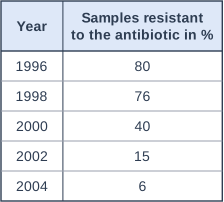
In 1998 a country banned the use of an antibiotic to make farm chickens grow faster. Scientists tested samples of bacteria from chickens to find the percentage that were resistant to this antibiotic.
The table shows their results.
Describe the effect of the ban and explain it.
Model answer
After the ban in 1998 the percentage of resistant samples fell from 76% to 6% by 2004. Without the antibiotic, the non-resistant bacteria were no longer killed, so the resistant bacteria no longer had an advantage, and the resistant strain became much less common.
Explanation
Antibiotic use selects for resistant bacteria because it kills their non-resistant competitors. When the antibiotic is no longer used, that advantage disappears, which is why restricting agricultural use can reduce resistance.
Mark scheme
1 mark
after the ban the percentage of resistant samples fell (from 76% in 1998 to 6% in 2004)
must include data for the mark
1 mark
without the antibiotic, non-resistant bacteria were no longer killed
allow resistant bacteria no longer had an advantage / were no longer selected
1 mark
so the resistant strain became less common (non-resistant bacteria survived and reproduced as well)
Question 4
6 marks
A government wants to slow down the development of antibiotic-resistant strains of bacteria. It is considering three actions:
Action 1: an advertising campaign telling people that antibiotics do not work against colds and flu. Action 2: a ban on using antibiotics to make farm animals grow faster. Action 3: giving money to companies to develop new antibiotics.
Evaluate each of the three actions.
Model answer
Action 1 would mean fewer people ask for antibiotics for colds and flu, which are caused by viruses, so fewer antibiotics would be prescribed inappropriately. Fewer bacteria would be exposed to antibiotics for no reason, so fewer resistant strains would be selected. However, some people may ignore the campaign, and it does nothing to make patients complete their courses.
Action 2 restricts the agricultural use of antibiotics, so fewer resistant strains would develop in farm animals and spread to humans. It may increase costs for farmers, and animals may grow more slowly.
Action 3 could produce antibiotics that treat resistant infections, but developing new antibiotics is costly and slow, and it is unlikely to keep up with the emergence of new resistant strains. It also does not slow down the development of resistance.
Actions 1 and 2 tackle the cause by reducing unnecessary antibiotic use, so they are the most effective ways to slow resistance; action 3 is useful but should be used alongside them.
Explanation
The three measures in the specification are: no inappropriate prescribing, completing courses, and restricting agricultural use. New antibiotics are needed, but because their development is costly and slow, reducing unnecessary use is the main way to slow resistance.
Mark scheme
1 mark
action 1: fewer people ask for antibiotics for viral infections, so fewer are prescribed inappropriately
Level of response question: credit a coherent, logically linked answer; max 6. Max 4 if only two actions are evaluated, or if there is no judgement.
1 mark
action 1: fewer bacteria are exposed to antibiotics unnecessarily, so fewer resistant strains are selected
1 mark
action 1: but people may ignore the campaign / it does not stop patients failing to complete their courses
1 mark
action 2: restricting agricultural use means fewer resistant strains develop in animals and spread to humans
1 mark
action 2: but costs to farmers may rise / animals may grow more slowly or get more diseases
1 mark
action 3: new antibiotics could treat infections caused by resistant strains
1 mark
action 3: but developing new antibiotics is costly and slow and unlikely to keep up with new resistant strains / does not slow the development of resistance
1 mark
judgement, e.g. actions 1 and 2 slow the development of resistance, while action 3 only helps after resistance has developed
Ready to try the rest? Every answer you write is marked against the mark scheme, so you can see exactly where the marks are.
Ctrl + Enter to check
Study HelperHints first, answers after you try
Stuck on this one? Ask for a hint and I’ll point you in the right direction, without giving the answer away. Once you’ve checked your answer, I’ll show you how the marks are awarded.