Level:
Correct: 0
Incorrect: 0
Marks: 0/0
Exam Practice
Course:
Topics:
Avg
score:
–
Topics
done:
0/35

Adaptations

Practise 11 exam-style questions on Adaptations for AQA GCSE Combined Science (Biology Paper 2). Write your answer as you would in the exam and get it marked in seconds against the mark scheme, point by point, with the Study Helper on hand if you get stuck.

  • 11 questions
  • 1–6 marks each
  • Instant marking
  • No sign-up needed
11 questions, marked as you go

Sample questions with model answers

Here are 4 of the questions in this topic, each with a model answer, an explanation of why it earns the marks and the mark scheme an examiner would use.

Question 1

2 marks

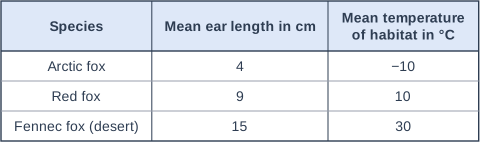
The table shows the mean ear length of three species of fox and the mean temperature of the habitat where each species lives.

Suggest an explanation for the pattern shown in the table.

Table with columns "Species", "Mean ear length in cm", "Mean temperature of habitat in °C". Species: Arctic fox; Mean ear length in cm: 4; Mean temperature of habitat in °C: −10 | Species: Red fox; Mean ear length in cm: 9; Mean temperature of habitat in °C: 10 | Species: Fennec fox (desert); Mean ear length in cm: 15; Mean temperature of habitat in °C: 30.

Model answer

The warmer the habitat, the longer the ears. Long ears have a large surface area, so the fennec fox can lose more heat to its surroundings and keep cool in the desert. The Arctic fox's short ears have a small surface area, so it loses less heat in the cold.

Explanation

Surface area affects how quickly heat is lost from the body. Ears are thin and have a large surface area, so their size is an important structural adaptation to the temperature of the habitat.

Mark scheme
  1. 1 mark

    foxes from warmer habitats have longer ears / larger ears give a larger surface area

  2. 1 mark

    large ears lose more heat to the surroundings (helping desert foxes to keep cool); small ears lose less heat (helping Arctic foxes keep warm)

    allow either half

Question 2

3 marks

Adaptations can be structural, behavioural or functional.

Give the type of adaptation shown by each of these examples.

Adders (a type of snake) hibernate through the winter.
Polar bears have a thick layer of fat under the skin.
Some Antarctic fish produce chemicals that stop their blood freezing.

Model answer

Adders hibernating is a behavioural adaptation. The polar bear's thick layer of fat is a structural adaptation. The fish producing chemicals that stop their blood freezing is a functional adaptation.

Explanation

Structural adaptations are features of the body's structure; behavioural adaptations are things the organism does; functional adaptations involve processes inside the body, such as producing particular chemicals or carrying out reactions differently.

Mark scheme
  1. 1 mark

    adders hibernating: behavioural

  2. 1 mark

    polar bear fat layer: structural

  3. 1 mark

    fish producing antifreeze chemicals: functional

Question 3

3 marks

Animals living in cold climates are often larger than related species living in warm climates. A student modelled a small animal as a cube with sides of 1 cm, which has a surface area to volume ratio of 6 : 1. She modelled a large animal as a cube with sides of 4 cm.

Calculate the surface area to volume ratio of the 4 cm cube, and use your answer to explain why a large body size is an adaptation to a cold climate.

Model answer

Surface area = 6 × (4 × 4) = 96 cm²
Volume = 4 × 4 × 4 = 64 cm³
Surface area : volume = 96 : 64 = 1.5 : 1

The large animal has a much smaller surface area to volume ratio (1.5 : 1 compared with 6 : 1), so it has less surface to lose heat from for each unit of volume. It loses heat more slowly, which helps it to survive in a cold climate.

Explanation

As an object gets bigger, its volume increases faster than its surface area, so its surface area to volume ratio falls. A smaller ratio means less heat is lost for each unit of body volume.

Mark scheme
  1. 1 mark

    surface area = 6 × 4 × 4 = 96 (cm²) and volume = 4 × 4 × 4 = 64 (cm³)

    both needed for the mark; an answer of 1.5 : 1 scores the first 2 marks

  2. 1 mark

    ratio = 96 : 64 = 1.5 : 1

    allow 3 : 2; allow ecf

  3. 1 mark

    the large animal has a smaller surface area to volume ratio, so it loses heat more slowly (relative to its size)

Question 4

4 marks

Marram grass grows on sand dunes near the sea, where it is very windy and rainwater drains quickly through the sand.

In dry, windy weather the leaves of marram grass roll up into a tube. The stomata are only on the inner surface of the leaf, which is covered in hairs. The roots can grow more than 2 metres deep.

Explain how these features help marram grass to survive on sand dunes.

Model answer

When the leaves roll up, they trap moist air inside the tube next to the stomata, so less water is lost by transpiration. The stomata are on the inner surface, sheltered from the wind, which would otherwise increase water loss, and the hairs trap a layer of moist air. The very deep roots can reach water far below the surface, because rainwater drains quickly through the sand.

Explanation

Wind increases the rate of transpiration by carrying away water vapour. Marram grass's structural adaptations keep humid air around its stomata and reach deep water, so it can survive where water is scarce.

Mark scheme
  1. 1 mark

    rolling the leaf traps moist / humid air inside the tube, next to the stomata

    max 4

  2. 1 mark

    so less water is lost by transpiration / evaporation

    allow reduces the concentration gradient for water vapour

  3. 1 mark

    the stomata on the inner surface are sheltered from the wind (which would increase water loss)

  4. 1 mark

    hairs trap a layer of moist air, reducing water loss

  5. 1 mark

    deep roots can reach water far below the surface of the sand

    allow anchor the plant in the shifting sand

Ready to try the rest? Every answer you write is marked against the mark scheme, so you can see exactly where the marks are.

Revision notes

Adaptations

The big idea

Organisms have features, called adaptations, that enable them to survive in the conditions in which they normally live. Adaptations are inherited: a species has them because of evolution by natural selection, not because an individual changes itself during its life. In the exam you are usually given information about an organism and its home and asked to explain how its features help it survive.

Three types of adaptation

TypeWhat it meansExamples
StructuralA feature of the body's shape or structureThick fur, a layer of fat, small ears, camouflaged colouring, spines instead of leaves
BehaviouralSomething the organism doesMigrating to a warmer place in winter, staying in a burrow by day, a lizard basking in the sun to warm up
FunctionalA process inside the bodyProducing small volumes of very concentrated urine, making venom, enzymes that work at very high temperatures

Keeping warm and keeping cool

Animals release heat throughout their body (their volume) by respiration, but lose it through their surface. So the surface area to volume ratio matters:

  • A large, rounded body with small ears and short legs has a smaller surface area to volume ratio, so it loses heat more slowly. This suits cold places.
  • A small body with large, thin ears has a larger surface area to volume ratio, so it loses heat more easily. This suits hot places.

Other adaptations to cold include thick fur, which traps a layer of insulating air, and a thick layer of fat. Many animals are camouflaged: a white coat in snow helps prey hide from predators and helps a predator creep up on its prey. In hot deserts, the main problem is saving water, so animals may avoid sweating, produce very concentrated urine and stay underground in the heat of the day.

Surface area to volume ratio

Model two animals as cubes with sides of 3 cm and 6 cm. Compare their surface area to volume ratios.

3 cm cube: surface area \(= 6 \times 3 \times 3 = 54\text{ cm}^2\); volume \(= 3 \times 3 \times 3 = 27\text{ cm}^3\); ratio \(= 54 : 27 = 2 : 1\)

6 cm cube: surface area \(= 6 \times 6 \times 6 = 216\text{ cm}^2\); volume \(= 6 \times 6 \times 6 = 216\text{ cm}^3\); ratio \(= 216 : 216 = 1 : 1\)

Doubling the side length halves the ratio. The larger animal has less surface for each cm³ of body, so it loses heat more slowly for its size.

Plants in dry places

Plants lose water vapour through their stomata by transpiration, so plants in deserts or on windy sand dunes have adaptations that reduce water loss or store water:

  • small leaves, or leaves reduced to spines, giving a small surface area for water loss;
  • a thick waxy cuticle, which reduces evaporation;
  • fewer stomata, or stomata hidden in rolled leaves or among hairs, which trap moist air and reduce the concentration gradient for water vapour;
  • swollen stems that store water;
  • roots that spread widely near the surface to absorb rain quickly, or grow very deep to reach water underground.

Extremophiles

Some organisms live in environments that are very extreme, such as those with a very high temperature, pressure or salt concentration. These organisms are called extremophiles, and most are microorganisms. Bacteria living in deep sea vents are extremophiles: the water is extremely hot, the pressure is enormous and there is no light. Their enzymes are not denatured at temperatures that would denature most enzymes, because their active sites keep their shape. Bacteria in very salty lakes have cytoplasm about as concentrated as the water around them, so they do not lose water by osmosis.

Explaining how features help an organism

The Arabian oryx is an antelope that lives in hot, dry desert. It has a pale coat, lets its body temperature rise during the day, produces very concentrated urine and feeds at night. Explain how these features help it to survive.

  • Pale coat (structural): reflects sunlight, so the oryx absorbs less heat.
  • Body temperature rises by day (functional): it does not need to sweat as much to stay cool, so it loses less water; the extra heat is lost in the cool night.
  • Concentrated urine (functional): very little water is lost in the urine.
  • Feeds at night (behavioural): it avoids the heat of the day, and plants contain more water at night, so it gains water from its food.

Common mistakes

  • Saying an animal "adapts" or "develops" a feature because it needs it. Adaptations are inherited and evolve over many generations.
  • Writing "a large animal has a smaller surface area". A large animal has a larger surface area but a smaller surface area to volume ratio.
  • Saying enzymes are "killed" by heat. They are denatured; an extremophile's enzymes are not denatured at the temperature where it lives.
  • Saying salt moves by osmosis. Osmosis is the movement of water.
  • Saying a polar predator's white fur is "to hide from predators". For a predator, camouflage helps it get close to its prey.

Exam tip

For "explain how this feature helps" questions, make two steps for each feature: what the feature does, and how that helps the organism survive in its environment ("thick waxy cuticle, so less water evaporates, so the plant survives the dry season"). In comparison questions, mention both organisms in each point and use the numbers you are given.

Study Helper Hints first, answers after you try

Stuck on this one? Ask for a hint and I’ll point you in the right direction, without giving the answer away. Once you’ve checked your answer, I’ll show you how the marks are awarded.