Level:
Correct: 0
Incorrect: 0
Marks: 0/0
Exam Practice
Course:
Topics:
Avg
score:
–
Topics
done:
0/35

Classification of living organisms

Practise 17 exam-style questions on Classification of living organisms for AQA GCSE Combined Science (Biology Paper 2). Write your answer as you would in the exam and get it marked in seconds against the mark scheme, point by point, with the Study Helper on hand if you get stuck.

  • 17 questions
  • 1–6 marks each
  • Instant marking
  • No sign-up needed
17 questions, marked as you go

Sample questions with model answers

Here are 4 of the questions in this topic, each with a model answer, an explanation of why it earns the marks and the mark scheme an examiner would use.

Question 1

1 mark

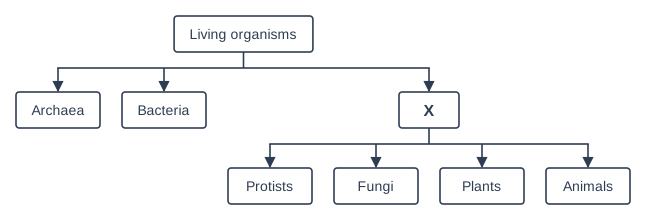
The diagram shows the three-domain system used to classify living organisms.

Name domain X.

Flow chart of 8 boxes joined by arrows, read from top to bottom. The first box is "Living organisms". From "Living organisms", 3 arrows branch out side by side: the left arrow leads to "Archaea"; the middle arrow leads to "Bacteria"; the right arrow leads to box X. From box X, 4 arrows branch out side by side: the 1st from the left arrow leads to "Protists"; the 2nd from the left arrow leads to "Fungi"; the 3rd from the left arrow leads to "Plants"; the 4th from the left arrow leads to "Animals".

Model answer

Eukaryota.

Explanation

The three domains are archaea, bacteria and eukaryota. The eukaryota include protists, fungi, plants and animals: all the organisms whose cells have a nucleus.

Mark scheme
  1. 1 mark

    Eukaryota

    allow eukaryotes; ignore spelling if recognisable

Question 2

2 marks

Describe how Carl Linnaeus classified living organisms.

Model answer

Linnaeus grouped living things depending on their structure and characteristics. He placed them in a series of groups that get smaller: kingdom, phylum, class, order, family, genus and species.

Explanation

Linnaeus's system was based on features that could be seen, because nothing was known about cells, biochemistry or DNA in the 1700s. Later developments added new evidence and led to new models of classification.

Mark scheme
  1. 1 mark

    he grouped organisms depending on their structure and characteristics

    allow by their features / what they look like

  2. 1 mark

    into a hierarchy of groups: kingdom, phylum, class, order, family, genus, species

    allow into groups that get smaller, from kingdom to species

Question 3

3 marks

Linnaeus classified organisms using features he could see. Since then, microscopes have been greatly improved.

Explain how improvements in microscopes have led to changes in the way organisms are classified.

Model answer

Better microscopes allowed scientists to see the internal structures of organisms and their cells, such as whether the cells have a nucleus. Some organisms that looked similar on the outside turned out to be very different inside, so new models of classification were proposed and some organisms were moved into different groups.

Explanation

As evidence of internal structures became more developed due to improvements in microscopes, new models of classification were proposed. Classification is a scientific model, so it changes when new evidence appears.

Mark scheme
  1. 1 mark

    microscopes showed the internal structures of organisms / cells (e.g. whether a cell has a nucleus)

    max 3

  2. 1 mark

    organisms that looked similar were found to have different internal structures (or vice versa)

  3. 1 mark

    so new models of classification were proposed / organisms were moved into different groups

    allow e.g. bacteria (prokaryotes) separated from organisms with a nucleus

  4. 1 mark

    more evidence means classification better reflects how organisms are related

Question 4

4 marks

For many years some scientists classified the giant panda in the raccoon family, because of similarities in the structure of its skull and teeth. Chemical analysis of panda DNA later showed that the giant panda is much more closely related to bears. It is now classified in the bear family.

Explain what this example shows about how organisms are classified.

Model answer

The panda was first classified using its structure, as Linnaeus did, but similar skull and teeth structures do not always mean that animals are closely related: they may be adaptations to a similar diet. Chemical analysis of DNA gives more reliable evidence of how closely organisms are related. The example shows that classification changes when new evidence becomes available, as understanding of biochemistry develops.

Explanation

As understanding of biochemical processes progressed, new models of classification were proposed. Structural features are still useful, but chemical evidence can show relationships that appearance hides.

Mark scheme
  1. 1 mark

    the panda was first classified using its structure and characteristics (as in the Linnaean system)

    max 4

  2. 1 mark

    similar structures do not always mean organisms are closely related / similar features can be adaptations to similar diets or environments

  3. 1 mark

    chemical analysis gives more reliable evidence of how closely organisms are related

  4. 1 mark

    classification changes when new evidence becomes available / classification is a model that develops over time

  5. 1 mark

    developments in biochemistry have led to new models of classification

Ready to try the rest? Every answer you write is marked against the mark scheme, so you can see exactly where the marks are.

Revision notes

Classification of living organisms

The big idea

Scientists sort living things into groups: this is called classification. The traditional system, developed by Carl Linnaeus, groups organisms by their structure and characteristics. As new evidence came from better microscopes and chemical analysis, new models were proposed, leading to the three-domain system developed by Carl Woese. Evolutionary trees show how scientists believe organisms are related.

The Linnaean system

Linnaeus classified living things into kingdom, phylum, class, order, family, genus and species, from the largest group to the smallest. Each group contains several smaller groups. The smaller the group that two organisms share, the more closely related they are.

A species is a group of similar organisms that can breed together to produce fertile offspring.

Organisms are named by the binomial system of genus and species. For example, humans are Homo sapiens: Homo is the genus (written with a capital letter) and sapiens is the species. Common names differ between countries and languages, but a binomial name is the same for scientists everywhere, so there is no confusion about which species is meant.

GroupHumanChimpanzeeBonoboRing-tailed lemur
KingdomAnimaliaAnimaliaAnimaliaAnimalia
PhylumChordataChordataChordataChordata
ClassMammaliaMammaliaMammaliaMammalia
OrderPrimatesPrimatesPrimatesPrimates
FamilyHominidaeHominidaeHominidaeLemuridae
GenusHomoPanPanLemur
Speciessapienstroglodytespaniscuscatta

Using a classification table

Use the table above.

  1. Give the binomial name of the bonobo. Write the genus, then the species: Pan paniscus.
  2. Which two animals are most closely related? The chimpanzee and the bonobo: they are in the same genus, Pan, so they share every group except the species.
  3. What is the smallest group that contains both humans and ring-tailed lemurs? Read down the two columns until the entries differ. They share the order but not the family, so the answer is the order Primates.

How developments in biology changed classification

  • Linnaeus used features he could see with the naked eye.
  • As microscopes improved, scientists gained evidence of internal structures, such as whether cells have a nucleus. New models of classification were proposed, with new groups. For example, fungi were once classed as plants, but they have no chloroplasts and feed in a different way, so they now have their own group.
  • As the understanding of biochemical processes progressed, scientists could compare chemicals such as DNA and proteins in different organisms. Due to evidence from chemical analysis, there is now a three-domain system, developed by Carl Woese.
The three-domain system. Flow chart of 8 boxes joined by arrows, read from top to bottom. The first box is "All living organisms". From "All living organisms", 3 arrows branch out side by side: the left arrow leads to "Archaea: primitive bacteria" (shaded); the middle arrow leads to "Bacteria: true bacteria" (shaded); the right arrow leads to "Eukaryota: cells with a nucleus" (shaded). From "Eukaryota: cells with a nucleus", 4 arrows branch out side by side: the 1st from the left arrow leads to "Protists"; the 2nd from the left arrow leads to "Fungi"; the 3rd from the left arrow leads to "Plants"; the 4th from the left arrow leads to "Animals".
Woese divided organisms into three domains. The eukaryota include protists, fungi, plants and animals.

Archaea are primitive bacteria, usually living in extreme environments such as hot springs and very salty lakes. Like bacteria, they are single cells with no nucleus, and under a microscope they look very similar. But chemical analysis showed that they are very different from true bacteria, so Woese gave them a domain of their own.

Evolutionary trees

Evolutionary trees are a method used by scientists to show how they believe organisms are related. They use current classification data for living organisms, such as structure and DNA, and fossil data for extinct organisms. Species that share a more recent common ancestor (a branch point nearer the tips) are more closely related. Trees can change when new fossils are found or new chemical evidence appears (see also: Fossils).

Remember

  • The groups from largest to smallest: kingdom, phylum, class, order, family, genus, species.
  • A binomial name is the genus followed by the species, such as Homo sapiens.
  • The three domains are archaea, bacteria and eukaryota, proposed by Woese from chemical analysis.
  • Linnaeus classified organisms by their structure and characteristics.

Common mistakes

  • Putting the groups in the wrong order. Make up a memory sentence whose words start with K, P, C, O, F, G, S.
  • Using the family in a binomial name. It is always the genus followed by the species.
  • Giving the first group where two organisms differ as the smallest group they share. Read down the table: the answer is the last group in which their entries are still the same.
  • Thinking archaea are just a type of bacteria. They look alike, but chemical analysis puts them in a separate domain.
  • Mixing up the scientists: Linnaeus developed the traditional system, and Woese developed the three-domain system.

Exam tip

"Describe the impact of developments in biology" questions want the link between new evidence and change: better microscopes revealed internal structures, and chemical analysis led to the three-domain system.

Study Helper Hints first, answers after you try

Stuck on this one? Ask for a hint and I’ll point you in the right direction, without giving the answer away. Once you’ve checked your answer, I’ll show you how the marks are awarded.