Practise 9 exam-style questions on Deforestation for AQA GCSE Combined Science (Biology Paper 2). Write your answer as you would in the exam and get it marked in seconds against the mark scheme, point by point, with the Study Helper on hand if you get stuck.
9 questions
1–6 marks each
Instant marking
No sign-up needed
9 questions, marked as you go
Sample questions with model answers
Here are 4 of the questions in this topic, each with a model answer, an explanation of why it earns the marks and the mark scheme an examiner would use.
Question 1
2 marks
Much of the land cleared by deforestation in tropical areas is used to graze cattle and to grow rice.
Explain why these uses of the land add to global warming, even after the forest has been cleared.
Model answer
Cattle and rice fields both release methane into the atmosphere. Methane is a greenhouse gas, so it adds to global warming.
Explanation
Levels of carbon dioxide and methane in the atmosphere are increasing, and both contribute to global warming. Deforestation releases carbon dioxide, and the cattle and rice that replace the forest release methane.
Mark scheme
1 mark
cattle and rice fields produce / release methane
1 mark
methane is a greenhouse gas, so it contributes to global warming
Question 2
2 marks
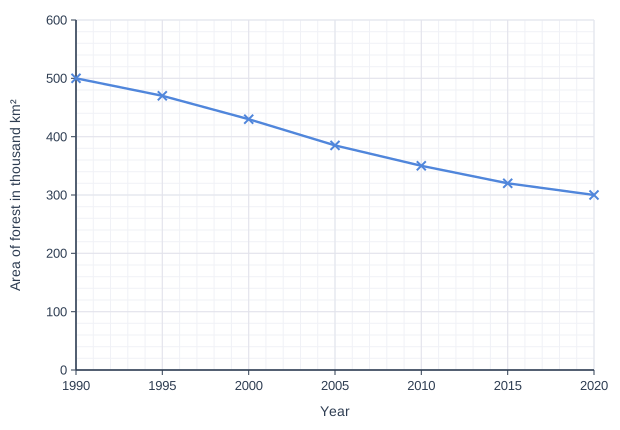
The graph shows the area of forest in a tropical country between 1990 and 2020.
Calculate the percentage of the 1990 forest area that was lost between 1990 and 2020.
Model answer
Area lost = 500 − 300 = 200 thousand km² Percentage lost = 200 ÷ 500 × 100 = 40%
Explanation
Find the area lost, then divide by the original (1990) area and multiply by 100. Dividing by the 2020 area instead is a common mistake.
Mark scheme
1 mark
(500 − 300) ÷ 500 × 100
an answer of 40 (%) scores 2 marks; allow 200 ÷ 500 × 100
1 mark
40 (%)
allow ecf from misread values
Question 3
3 marks
Explain how large-scale deforestation increases the concentration of carbon dioxide in the atmosphere.
Model answer
With fewer trees, less carbon dioxide is removed from the air by photosynthesis. The trees are often burned to clear the land, and combustion releases the carbon stored in the wood as carbon dioxide. Any wood and roots left behind are decayed by microorganisms, which release carbon dioxide as they respire.
Explanation
Deforestation affects the carbon cycle in two ways: it removes a process that takes carbon dioxide out of the air, and it adds carbon dioxide through burning and decay. Both increase the concentration of carbon dioxide, which contributes to global warming.
Mark scheme
1 mark
fewer trees means less carbon dioxide is removed from the air by photosynthesis
1 mark
trees are often burned to clear the land, and combustion releases carbon dioxide
1 mark
wood and roots left behind are decayed by microorganisms, which release carbon dioxide by respiration
Question 4
4 marks
Trees take up large amounts of water from the soil and release water vapour from their leaves by transpiration. Their roots hold the soil in place.
Explain how large-scale deforestation can affect the local rainfall and the soil.
Model answer
With fewer trees there is much less transpiration, so less water vapour enters the air. Fewer clouds form, so less rain falls in the area and it becomes drier. Without tree roots to hold it, the soil is washed away by heavy rain, and water runs off the land quickly, causing flooding and carrying soil into rivers. The soil that remains loses its mineral ions and becomes less fertile.
Explanation
Forests are an important part of the water cycle because of transpiration, and tree roots protect the soil. These effects are part of the environmental implications of deforestation, alongside the loss of biodiversity and the increase in carbon dioxide.
Mark scheme
1 mark
fewer trees means less transpiration, so less water vapour enters the air
max 4
1 mark
so fewer clouds form and there is less rainfall locally
allow the area may become drier
1 mark
without roots to hold it, the soil is washed away by rain (soil erosion)
1 mark
rain runs off the land more quickly, which can cause flooding / carries soil into rivers
1 mark
the mineral ions in the soil are washed away, so the soil becomes less fertile
Ready to try the rest? Every answer you write is marked against the mark scheme, so you can see exactly where the marks are.
Ctrl + Enter to check
Study HelperHints first, answers after you try
Stuck on this one? Ask for a hint and I’ll point you in the right direction, without giving the answer away. Once you’ve checked your answer, I’ll show you how the marks are awarded.