Level:
Correct: 0
Incorrect: 0
Marks: 0/0
Exam Practice
Course:
Topics:
Avg
score:
–
Topics
done:
0/35

The human nervous system

Practise 16 exam-style questions on The human nervous system for AQA GCSE Combined Science (Biology Paper 2). Write your answer as you would in the exam and get it marked in seconds against the mark scheme, point by point, with the Study Helper on hand if you get stuck.

  • 16 questions
  • 1–6 marks each
  • Instant marking
  • No sign-up needed
16 questions, marked as you go

Sample questions with model answers

Here are 4 of the questions in this topic, each with a model answer, an explanation of why it earns the marks and the mark scheme an examiner would use.

Question 1

2 marks

A doctor taps a patient's leg just below the kneecap. The patient's lower leg immediately kicks forward.

Give two reasons why this response is described as a reflex action.

Model answer

The response is automatic - the patient does not decide to kick - and it is very rapid. It does not involve the conscious part of the brain.

Explanation

Reflex actions are automatic and rapid and do not involve the conscious part of the brain. The knee-jerk happens before the patient has time to think about it, so it fits all three features.

Mark scheme
  1. 1 mark

    it is automatic / involuntary

    any two from these three points; max 2. Allow the patient does not decide to kick

  2. 1 mark

    it is rapid

    allow it happens immediately

  3. 1 mark

    it does not involve the conscious part of the brain

    allow no conscious thought is involved
Question 2

3 marks

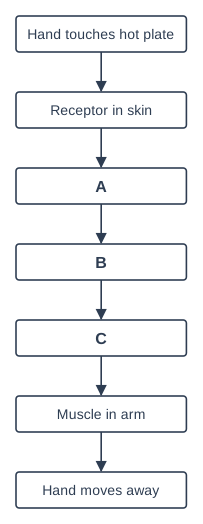
A person touches a hot plate and quickly pulls their hand away. The flow chart shows the pathway taken by nerve impulses in this response.

Name the types of neurone A, B and C.

Flow chart of 7 boxes joined by arrows, read from top to bottom. The first box is "Hand touches hot plate", which leads to "Receptor in skin", which leads to box A, which leads to box B, which leads to box C, which leads to "Muscle in arm", which leads to "Hand moves away".

Model answer

A is a sensory neurone.
B is a relay neurone.
C is a motor neurone.

Explanation

In a reflex arc, the sensory neurone carries impulses from the receptor to the spinal cord, the relay neurone in the spinal cord passes them on, and the motor neurone carries them to the effector. Synapses link one neurone to the next.

Mark scheme
  1. 1 mark

    A: sensory neurone

  2. 1 mark

    B: relay neurone

    allow connector neurone / intermediate neurone

  3. 1 mark

    C: motor neurone

Question 3

3 marks

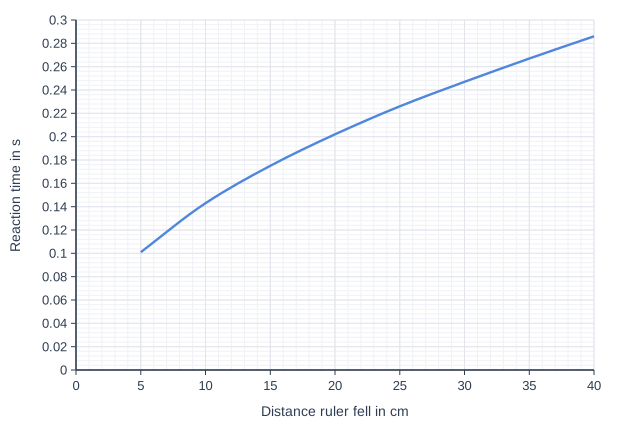
In a ruler drop test, the distance the ruler falls can be converted into a reaction time. The graph shows how reaction time is related to the distance the ruler falls.

Student A caught the ruler after it fell 12 cm. Student B caught the ruler after it fell 30 cm.

Use the graph to find how much longer Student B's reaction time was than Student A's.

Line graph of reaction time in s (y-axis, 0 to 0.3) against distance ruler fell in cm (x-axis, 0 to 40). The line is a smooth curve through (5, 0.101), (10, 0.143), (15, 0.175), (20, 0.202), (25, 0.226), (30, 0.247), (35, 0.267), (40, 0.286).

Model answer

From the graph, 12 cm gives a reaction time of 0.16 s.
30 cm gives a reaction time of 0.25 s.
Difference = 0.25 − 0.16 = 0.09 s

Explanation

Read up from each distance to the curve and across to the reaction time axis. The curve is not a straight line, so the reaction time is not directly proportional to the distance: you must read each value from the graph rather than scaling.

Mark scheme
  1. 1 mark

    Student A: 0.16 s

    allow 0.15-0.17 s; an answer of 0.09 s scores 3 marks

  2. 1 mark

    Student B: 0.25 s

    allow 0.24-0.26 s

  3. 1 mark

    difference = 0.09 s

    allow 0.07-0.11 s; allow ecf from incorrect readings

Question 4

6 marks

A person accidentally touches a very hot iron and immediately pulls their hand away.

Explain how a reflex arc brings about this response.

Model answer

Receptors in the skin of the hand detect the heat, which is the stimulus. They send electrical impulses along a sensory neurone to the spinal cord. At the synapse at the end of the sensory neurone a chemical is released, which diffuses across the gap and starts an impulse in a relay neurone in the spinal cord. The relay neurone passes the impulse across another synapse to a motor neurone. The motor neurone carries impulses to the effector, a muscle in the arm, which contracts and pulls the hand away from the iron. The conscious part of the brain is not involved, so the response is automatic and very rapid, which reduces damage to the hand.

Explanation

A full answer follows the reflex arc in order: receptor, sensory neurone, synapse, relay neurone, synapse, motor neurone, effector, response. Explain what happens at synapses (a chemical diffuses across the gap) and why skipping the conscious brain makes the reflex fast.

Mark scheme
  1. 1 mark

    receptors in the skin detect the heat (the stimulus)

    Level of response question: credit a coherent, logically linked answer; max 6.

  2. 1 mark

    electrical impulses travel along a sensory neurone to the spinal cord / CNS

  3. 1 mark

    at a synapse a chemical is released and diffuses across the gap

    allow chemical crosses the synapse and triggers an impulse in the next neurone

  4. 1 mark

    impulse passes along a relay neurone in the spinal cord

  5. 1 mark

    impulse passes (across another synapse) to a motor neurone

  6. 1 mark

    motor neurone carries impulses to the effector, a muscle (in the arm)

  7. 1 mark

    the muscle contracts, pulling the hand away

  8. 1 mark

    the conscious part of the brain is not involved so the response is rapid / automatic

Ready to try the rest? Every answer you write is marked against the mark scheme, so you can see exactly where the marks are.

Study Helper Hints first, answers after you try

Stuck on this one? Ask for a hint and I’ll point you in the right direction, without giving the answer away. Once you’ve checked your answer, I’ll show you how the marks are awarded.