Practise 11 exam-style questions on Feedback systems (HT only) for AQA GCSE Combined Science (Biology Paper 2). Write your answer as you would in the exam and get it marked in seconds against the mark scheme, point by point, with the Study Helper on hand if you get stuck.
11 questions
1–5 marks each
Instant marking
No sign-up needed
11 questions, marked as you go
Sample questions with model answers
Here are 4 of the questions in this topic, each with a model answer, an explanation of why it earns the marks and the mark scheme an examiner would use.
Question 1
2 marks
Adrenaline prepares the body for 'flight or fight'.
Give two effects of adrenaline on the body.
Model answer
Adrenaline increases the heart rate, and it boosts the delivery of oxygen and glucose to the brain and muscles.
Explanation
Adrenaline gets the body ready to run away or fight. A faster heart rate pumps more blood, so the brain and muscles receive more oxygen and glucose.
Mark scheme
1 mark
increases heart rate
max 2
1 mark
boosts the delivery of oxygen to the brain and muscles
1 mark
boosts the delivery of glucose to the brain and muscles
allow 'oxygen and glucose to the brain and muscles' for 2 marks
Question 2
2 marks
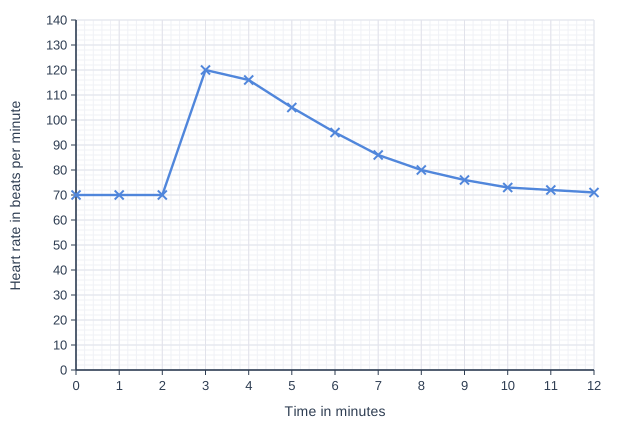
A person was sitting quietly. At 2 minutes, a sudden loud bang frightened them. The graph shows the person's heart rate over 12 minutes.
Calculate the percentage increase in heart rate between 2 minutes and 3 minutes. Give your answer to 2 significant figures.
Read the heart rate before (70) and after (120) the bang, divide the increase by the original value and multiply by 100. The large, rapid rise is caused by adrenaline released in response to fear.
Mark scheme
1 mark
(120 − 70) ÷ 70 × 100
an answer of 71 (%) scores 2 marks; allow 50 ÷ 70 × 100
1 mark
71 (%)
allow 71.4; allow ecf from incorrect readings
Question 3
3 marks
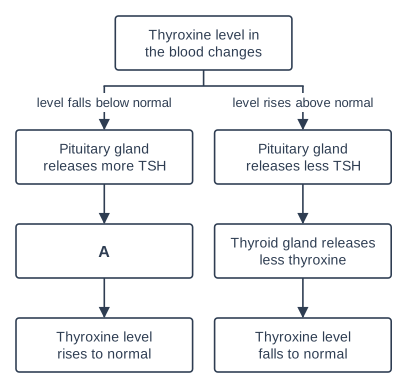
The flow chart shows how the level of thyroxine in the blood is controlled. TSH is a hormone released by the pituitary gland.
Describe what happens at stage A, and explain why this control system is an example of negative feedback.
Model answer
At stage A the thyroid gland releases more thyroxine. This is negative feedback because a change in the thyroxine level causes a response that reverses the change: a fall leads to more thyroxine being released and a rise leads to less being released, so the level is brought back to normal.
Explanation
In negative feedback the response opposes the change that caused it. That is why the flow chart has two branches that end with the level returning to normal from either direction.
Mark scheme
1 mark
A: the thyroid gland releases more thyroxine
both 'thyroid' and 'more thyroxine' needed
1 mark
a change in the thyroxine level causes a response that reverses the change
allow a fall causes a rise and a rise causes a fall
1 mark
so the thyroxine level is returned to normal / kept within narrow limits
Question 4
4 marks
The pituitary gland releases a hormone called TSH. TSH stimulates the thyroid gland to release thyroxine. A high level of thyroxine in the blood inhibits the release of TSH.
A person's thyroid gland is damaged, so it can only produce a very small amount of thyroxine.
Predict and explain what will happen to the level of TSH in the person's blood, and suggest one effect of the low thyroxine level on the person.
Model answer
The TSH level will become high. Normally a high thyroxine level inhibits TSH release, but here the thyroxine level is low, so TSH is not inhibited and the pituitary gland releases more and more TSH. However, the damaged thyroid gland cannot respond, so the thyroxine level stays low and negative feedback cannot bring it back to normal. Because thyroxine stimulates the basal metabolic rate, the person will have a low metabolic rate, so they may feel tired and gain weight.
Explanation
Apply the negative feedback loop: low thyroxine normally causes more TSH, which corrects the level. When the thyroid is damaged the loop is broken, so TSH keeps rising but thyroxine stays low, and the effects of a low metabolic rate appear.
Mark scheme
1 mark
the TSH level will be high / increase
max 4
1 mark
because the low level of thyroxine does not inhibit TSH release / the pituitary releases more TSH in response to low thyroxine
1 mark
but the damaged thyroid cannot respond, so thyroxine stays low (negative feedback cannot restore the level)
1 mark
effect: low basal metabolic rate
allow tiredness / weight gain / slower growth and development in a child
1 mark
linked consequence, e.g. less energy released by respiration so the person feels tired
Ready to try the rest? Every answer you write is marked against the mark scheme, so you can see exactly where the marks are.
Ctrl + Enter to check
Study HelperHints first, answers after you try
Stuck on this one? Ask for a hint and I’ll point you in the right direction, without giving the answer away. Once you’ve checked your answer, I’ll show you how the marks are awarded.