Level:
Correct: 0
Incorrect: 0
Marks: 0/0
Exam Practice
Course:
Topics:
Avg
score:
–
Topics
done:
0/35

Meiosis

Practise 13 exam-style questions on Meiosis for AQA GCSE Combined Science (Biology Paper 2). Write your answer as you would in the exam and get it marked in seconds against the mark scheme, point by point, with the Study Helper on hand if you get stuck.

  • 13 questions
  • 1–6 marks each
  • Instant marking
  • No sign-up needed
13 questions, marked as you go

Sample questions with model answers

Here are 4 of the questions in this topic, each with a model answer, an explanation of why it earns the marks and the mark scheme an examiner would use.

Question 1

1 mark

One cell in an ovary divides by meiosis.

How many cells are produced at the end of meiosis?

Model answer

Four.

Explanation

During meiosis the genetic information is copied once, but the cell divides twice, giving four gametes, each with a single set of chromosomes. Mitosis, by contrast, gives two identical cells.

Mark scheme
  1. 1 mark

    four

    allow 4

Question 2

2 marks

During meiosis, each gamete receives one chromosome from each pair. Which chromosome of a pair goes into a gamete is random.

An organism has 3 pairs of chromosomes.

Calculate how many different combinations of chromosomes are possible in its gametes.

Model answer

There are 2 choices for each of the 3 pairs.
Number of combinations = 2 × 2 × 2 = 8

Explanation

Each pair gives two possibilities, so the number of combinations doubles with every extra pair. With 23 pairs in humans the number is over 8 million, which is why all gametes are genetically different.

Mark scheme
  1. 1 mark

    2 × 2 × 2

    an answer of 8 scores 2 marks; allow 2³

  2. 1 mark

    8

Question 3

3 marks

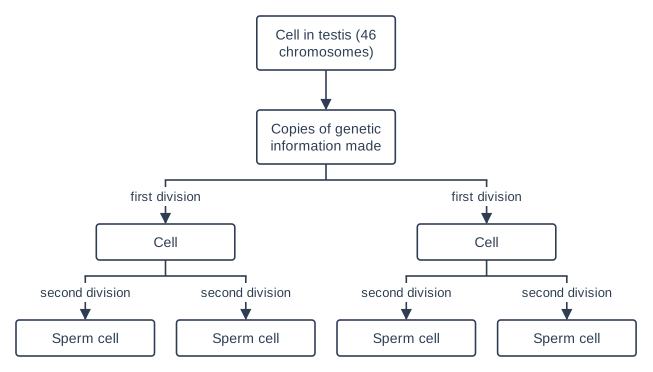
The flow chart shows a model of what happens when a cell in a man's testis divides to form sperm cells.

How many chromosomes are there in each sperm cell? Explain your answer, and state whether the four sperm cells are genetically identical.

Flow chart of 8 boxes joined by arrows, read from top to bottom. The first box is "Cell in testis (46 chromosomes)", which leads to "Copies of genetic information made". From "Copies of genetic information made", 2 arrows branch out side by side: the left arrow, labelled "first division", leads to "Cell"; the right arrow, labelled "first division", leads to "Cell". From "Cell", 2 arrows branch out side by side: the left arrow, labelled "second division", leads to "Sperm cell"; the right arrow, labelled "second division", leads to "Sperm cell". From "Cell", 2 arrows branch out side by side: the left arrow, labelled "second division", leads to "Sperm cell"; the right arrow, labelled "second division", leads to "Sperm cell".

Model answer

Each sperm cell has 23 chromosomes. The genetic information is copied once, but the cell divides twice, so each of the four sperm cells gets a single set of chromosomes - half the original 46. The four sperm cells are all genetically different from each other.

Explanation

Meiosis involves one copying of the genetic information and two divisions, so the chromosome number is halved. Each gamete gets one chromosome from each pair, and different gametes get different combinations, so they are all genetically different.

Mark scheme
  1. 1 mark

    23

  2. 1 mark

    meiosis halves the number of chromosomes / each sperm cell gets a single set (one chromosome from each pair)

    allow the genetic information is copied once but the cell divides twice

  3. 1 mark

    they are not identical / all genetically different

Question 4

4 marks

A student wrote this description of meiosis:

"In meiosis a cell divides once to make two identical gametes, each with 46 chromosomes."

Identify the mistakes in the student's description and correct them.

Model answer

The cell divides twice, not once. It makes four gametes, not two. The gametes are all genetically different, not identical. Each human gamete has 23 chromosomes (a single set), not 46.

Explanation

The student has described mitosis, which gives two identical cells with the full chromosome number. Meiosis gives four genetically different gametes with half the number of chromosomes.

Mark scheme
  1. 1 mark

    the cell divides twice, not once

    each mark needs the mistake and the correction

  2. 1 mark

    four gametes are made, not two

  3. 1 mark

    the gametes are genetically different, not identical

  4. 1 mark

    each human gamete has 23 chromosomes, not 46

    allow each gamete has half the number of chromosomes / a single set

Ready to try the rest? Every answer you write is marked against the mark scheme, so you can see exactly where the marks are.

Revision notes

Meiosis

The big idea

Your body cells contain chromosomes in pairs: one set came from your mother and one from your father. If gametes (sex cells) carried a full set of pairs, the number of chromosomes would double in every generation. Meiosis is the cell division that makes gametes with half the number of chromosomes, and fertilisation puts the full number back.

How cells divide to form gametes

Cells in the reproductive organs divide by meiosis to form gametes. In humans this happens in the testes (making sperm) and the ovaries (making egg cells). In flowering plants it happens in the flowers, making pollen and egg cells. Every other cell in the body is made by mitosis.

When a cell divides to form gametes:

  1. Copies of the genetic information are made (the chromosomes are copied).
  2. The cell divides twice.
  3. This forms four gametes, each with a single set of chromosomes (one chromosome from each pair).
  4. All the gametes are genetically different from each other.

The gametes differ because each one gets one chromosome from every pair, and which one of the pair it gets varies. There are millions of possible combinations, so two gametes are almost never the same. You do not need to learn the names of the stages of meiosis.

MitosisMeiosis
WhereAll over the body (growth and repair)Reproductive organs only
Cells made from one cellTwoFour
Chromosomes in each new cellFull number (two sets, in pairs)Half the number (a single set)
The new cells areGenetically identicalGenetically different
MakesBody cellsGametes

Halving and restoring the chromosome number

A human body cell has 46 chromosomes in 23 pairs. Meiosis gives each sperm and each egg cell 23 chromosomes: one from each pair, not 23 pairs. At fertilisation the two gametes fuse:

\[23 + 23 = 46\]

So the fertilised egg has the normal number again, with one set from each parent. Meiosis halving the number and fertilisation restoring it keep the chromosome number the same from one generation to the next.

Flow chart of 4 boxes joined by arrows, read from left to right. The first box is "Parent's body cell: 46 chromosomes", which leads (along an arrow labelled "meiosis") to "Gamete: 23 chromosomes", which leads (along an arrow labelled "fertilisation") to "Fertilised egg: 46 chromosomes", which leads (along an arrow labelled "mitosis") to "Embryo: every cell has 46".
In humans, meiosis halves the chromosome number, fertilisation restores it, and mitosis keeps it the same in every cell of the embryo.

After fertilisation

The fertilised egg (the first cell of the new individual) divides by mitosis, not meiosis. Mitosis keeps the full number of chromosomes and makes genetically identical cells, so every cell of the embryo has the same genetic information. The number of cells increases, and as the embryo develops the cells differentiate: they become specialised to do different jobs, such as nerve, muscle or blood cells.

The order to remember is meiosis, fertilisation, mitosis, differentiation. It is the same in animals and in flowering plants.

Chromosome numbers through a life cycle

The body cells of a rabbit contain 44 chromosomes. Give the number of chromosomes in (a) a sperm cell, (b) a fertilised egg cell and (c) a heart muscle cell of the embryo.

(a) Sperm are made by meiosis, which halves the number: \(44 \div 2 = 22\)

(b) At fertilisation a sperm (22) fuses with an egg cell (22): \(22 + 22 = 44\)

(c) The embryo's cells are made from the fertilised egg by mitosis, which keeps the full number: 44

Check: gametes always have half the body-cell number, and every other cell has the full number.

Remember

  • Meiosis happens in the reproductive organs (testes and ovaries in humans) to make gametes.
  • The genetic information is copied once, then the cell divides twice, giving four gametes.
  • Each gamete has a single set of chromosomes (23 in humans) and all gametes are genetically different.
  • Fertilisation restores the normal number (46 in humans); the fertilised egg then divides by mitosis and its cells later differentiate.

Common mistakes

  • Saying a human egg or sperm has "23 pairs". It has 23 chromosomes, one from each pair; 23 pairs would be 46.
  • Saying meiosis makes identical cells. Meiosis makes cells that are genetically different; mitosis makes identical cells.
  • Saying the cell divides once, or that meiosis makes two cells. It divides twice to make four gametes.
  • Saying the fertilised egg divides by meiosis. It divides by mitosis, so every cell keeps the full number.
  • Calling the cells becoming specialised "growth". The term is differentiation.

Exam tip

For "explain how meiosis halves the number of chromosomes", the two marking points are that the genetic information is copied once and the cell divides twice. Use numbers to make your answer clear, such as "23 + 23 = 46", and describe a gamete as having "a single set of chromosomes" or "half the number of chromosomes".

Study Helper Hints first, answers after you try

Stuck on this one? Ask for a hint and I’ll point you in the right direction, without giving the answer away. Once you’ve checked your answer, I’ll show you how the marks are awarded.