Practise 13 exam-style questions on DNA and the genome for AQA GCSE Combined Science (Biology Paper 2). Write your answer as you would in the exam and get it marked in seconds against the mark scheme, point by point, with the Study Helper on hand if you get stuck.
13 questions
1–6 marks each
Instant marking
No sign-up needed
13 questions, marked as you go
Sample questions with model answers
Here are 4 of the questions in this topic, each with a model answer, an explanation of why it earns the marks and the mark scheme an examiner would use.
Question 1
1 mark
What is meant by the genome of an organism?
Model answer
The genome is the entire genetic material of that organism.
Explanation
A genome includes all of an organism's DNA - every gene on every chromosome. The whole human genome has now been studied, which is expected to be very important for medicine.
Mark scheme
1 mark
the entire genetic material of that organism
allow all of the DNA / all the genes of the organism; do not accept 'a gene' or 'one chromosome'
Question 2
2 marks
Red blood cells do not have a nucleus. White blood cells do have a nucleus.
A hospital wants to test a patient's DNA from a blood sample. Explain why the test must use the white blood cells.
Model answer
The genetic material is DNA, which is contained in chromosomes in the nucleus. Red blood cells have no nucleus, so they have no DNA to test; white blood cells have a nucleus, so their DNA can be tested.
Explanation
The genetic material of a cell is in its nucleus, packed into chromosomes. Without a nucleus, a mature red blood cell contains no chromosomes and so no DNA.
Mark scheme
1 mark
DNA is found in the nucleus / in chromosomes in the nucleus
1 mark
red blood cells have no nucleus so contain no DNA (white blood cells do)
Question 3
3 marks
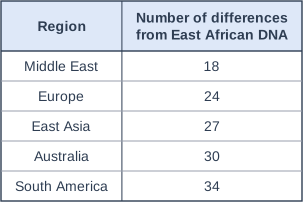
Scientists compared a section of DNA from people in five regions with the same section of DNA from people in East Africa, where modern humans first evolved. The table shows the number of differences they found.
Suggest what the data show about the route humans took as they migrated from Africa. Explain your answer.
Model answer
The number of differences from the East African DNA increases from 18 in the Middle East to 24 in Europe, 27 in East Asia, 30 in Australia and 34 in South America. Populations with fewer differences are more closely related to East Africans, so humans probably migrated from Africa to the Middle East first, then to Europe and Asia, then to Australia, and reached South America last. Differences built up each time a group moved on and became separated from the others.
Explanation
Comparing genomes is one of the ways the human genome is used to trace past migration. Treat the conclusion as a suggestion: it is based on one section of DNA, and scientists combine many sections of the genome with other evidence such as fossils.
Mark scheme
1 mark
the number of differences increases from the Middle East (18) to South America (34)
max 3; allow any correct use of data
1 mark
humans probably reached the Middle East first and South America last
allow route: Africa → Middle East → Europe / East Asia → Australia → South America
1 mark
differences in DNA build up as groups move further away / separate from other groups
allow populations with fewer differences are more closely related to East Africans
1 mark
data from one section of DNA only, so a tentative conclusion / more of the genome should be compared
Question 4
4 marks
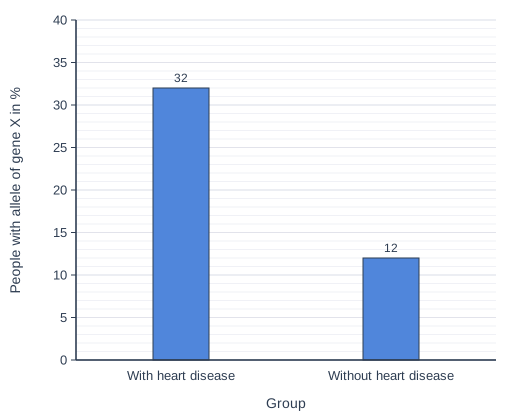
Scientists studied the genomes of 50 000 people with heart disease and 50 000 people without heart disease. The bar chart shows the percentage of people in each group who had a particular allele of gene X.
The scientists suggest that this allele increases the risk of heart disease. Evaluate this suggestion and explain how the finding could be used in medicine.
Model answer
The allele is almost three times as common in people with heart disease (32%) as in people without it (12%), and the sample of 100 000 people is large, so this supports the suggestion that the allele increases the risk. However, 68% of people with heart disease do not have the allele, and some people without heart disease do have it, so the allele is only one risk factor; other genes and lifestyle factors must also be involved. In medicine, people could be tested for the allele, and those who have it could be given regular check-ups and advice on diet and exercise to reduce their risk.
Explanation
This is an example of searching the human genome for genes linked to disease. A link in a large study is strong evidence of increased risk, but if many people with the disease lack the allele, it cannot be the only cause.
Mark scheme
1 mark
the allele is more common in people with heart disease: 32% compared with 12% / almost 3 times as common
max 4
1 mark
large sample size (100 000 people), so the results are likely to be repeatable / representative
1 mark
most people with heart disease (68%) do not have the allele, and some people without heart disease do have it
1 mark
so the allele is a risk factor, not the only cause / other factors (e.g. lifestyle, other genes) are involved
allow correlation does not prove causation
1 mark
use: people could be tested for the allele, and those at higher risk given screening / lifestyle advice / early treatment
Ready to try the rest? Every answer you write is marked against the mark scheme, so you can see exactly where the marks are.
Ctrl + Enter to check
Study HelperHints first, answers after you try
Stuck on this one? Ask for a hint and I’ll point you in the right direction, without giving the answer away. Once you’ve checked your answer, I’ll show you how the marks are awarded.