Level:
Correct: 0
Incorrect: 0
Marks: 0/0
Exam Practice
Course:
Topics:
Avg
score:
–
Topics
done:
0/35

Evidence for evolution

Practise 11 exam-style questions on Evidence for evolution for AQA GCSE Combined Science (Biology Paper 2). Write your answer as you would in the exam and get it marked in seconds against the mark scheme, point by point, with the Study Helper on hand if you get stuck.

  • 11 questions
  • 1–6 marks each
  • Instant marking
  • No sign-up needed
11 questions, marked as you go

Sample questions with model answers

Here are 4 of the questions in this topic, each with a model answer, an explanation of why it earns the marks and the mark scheme an examiner would use.

Question 1

2 marks

Describe how the fossil record provides evidence for evolution.

Model answer

Fossils show what organisms that lived millions of years ago looked like. By comparing fossils from rocks of different ages, scientists can see how organisms have gradually changed over time.

Explanation

Fossils are found in rocks, and older rocks generally contain older fossils. Arranging fossils by age shows a sequence of gradual changes, which is what the theory of evolution predicts.

Mark scheme
  1. 1 mark

    fossils show what organisms that lived millions of years ago were like

    allow fossils are the remains of organisms from long ago

  2. 1 mark

    fossils from rocks of different ages show how (much or how little) organisms have changed over time

    allow simpler organisms are found in older rocks / gradual changes can be seen in a sequence of fossils

Question 2

2 marks

When Charles Darwin proposed the theory of evolution by natural selection, he could not explain how variation arises or how characteristics are passed from parents to offspring.

Explain how our knowledge of genes now explains both of these.

Model answer

Variation arises because mutations produce new forms of genes. Characteristics are passed on to offspring in genes, so individuals that survive pass their favourable characteristics on to the next generation.

Explanation

Natural selection needs variation within a population and inheritance of characteristics. Genes explain both: mutations create new variants, and genes carry characteristics from parents to offspring. This is why the discovery of genes counts as evidence supporting Darwin's theory.

Mark scheme
  1. 1 mark

    new forms of genes / new alleles (and so new variants) arise by mutation

    allow variation is caused by differences in genes

  2. 1 mark

    characteristics are passed on to offspring in genes, so favourable characteristics are inherited

Question 3

3 marks

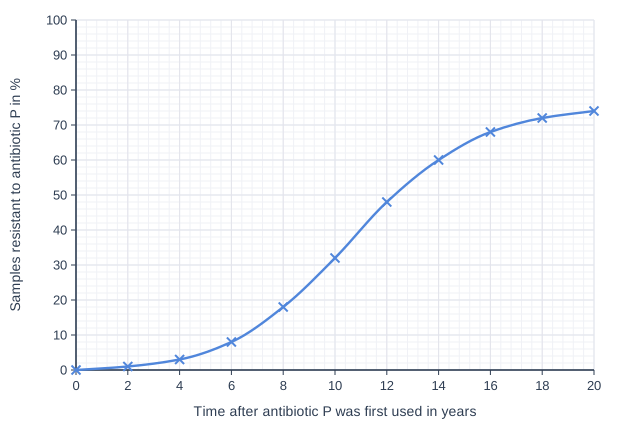
Doctors began to use a new antibiotic, P, in year 0. Scientists tested samples of a species of bacterium each year to find out whether they were resistant to antibiotic P.

The graph shows the percentage of samples that were resistant.

Explain how the change shown in the graph happened. Use ideas about natural selection.

Line graph of Samples resistant to antibiotic P in % (y-axis, 0 to 100) against Time after antibiotic P was first used in years (x-axis, 0 to 20). The line is a smooth curve through (0, 0), (2, 1), (4, 3), (6, 8), (8, 18), (10, 32), (12, 48), (14, 60), (16, 68), (18, 72), (20, 74).

Model answer

A random mutation produced some bacteria that were resistant to antibiotic P. When the antibiotic was used, it killed the non-resistant bacteria, but the resistant ones survived. They reproduced and passed the resistance on to their offspring, so the percentage of resistant samples rose from 0 to about 74% over 20 years.

Explanation

The antibiotic does not cause the mutation: the resistant bacteria arise by chance, and the antibiotic simply removes their competitors. Because bacteria reproduce so fast, this natural selection can be measured over just a few years, which makes it strong evidence for evolution.

Mark scheme
  1. 1 mark

    a mutation produced bacteria that were resistant to antibiotic P

    max 3

  2. 1 mark

    the antibiotic killed non-resistant bacteria but resistant bacteria survived

  3. 1 mark

    the resistant bacteria reproduced, passing on the resistance (gene) to their offspring

    allow so the population of the resistant strain rose

  4. 1 mark

    use of data: the percentage resistant rose from 0 to about 74% in 20 years

    allow 72-76%

Question 4

4 marks

Charles Darwin published the theory of evolution by natural selection in 1859. At first, many scientists did not accept it.

Some later discoveries are listed below.
Early 1900s: scientists showed that characteristics are passed from parents to offspring in genes.
1940s onwards: strains of bacteria resistant to each new antibiotic appeared within a few years of the antibiotic being used.
1859 to today: many more fossils have been found and dated.

Use the information to explain why the theory of evolution by natural selection is now widely accepted.

Model answer

In 1859 there was little evidence, and Darwin could not explain how characteristics were passed from parents to offspring. The discovery of genes explained how favourable characteristics are inherited. The rapid evolution of antibiotic-resistant bacteria showed natural selection actually happening: resistant bacteria survive the antibiotic and reproduce. The many fossils found since then show how organisms have changed gradually over millions of years. As more and more data supported the theory, it became widely accepted.

Explanation

A scientific theory becomes accepted when evidence from different sources supports it. Darwin's theory developed over time: genes supplied the missing explanation of inheritance, while fossils and antibiotic resistance provided data that fit the theory's predictions.

Mark scheme
  1. 1 mark

    in 1859 there was little evidence / Darwin could not explain how characteristics were passed on to offspring

    max 4

  2. 1 mark

    genes explain how favourable characteristics are inherited by the offspring

    allow genes explain how variation is passed on

  3. 1 mark

    antibiotic resistance shows natural selection happening: resistant bacteria survive the antibiotic and reproduce

    allow evolution has been observed in a short time

  4. 1 mark

    the fossils show how organisms have (gradually) changed over millions of years

    allow fossils show how much or how little organisms have changed

  5. 1 mark

    the theory developed over time as more data / evidence was found that supports it

Ready to try the rest? Every answer you write is marked against the mark scheme, so you can see exactly where the marks are.

Revision notes

Evidence for evolution

The big idea

The theory of evolution by natural selection is now widely accepted. When Darwin published it in 1859, there was too little evidence to convince many scientists. Since then, evidence has built up from three main sources: characteristics are passed on to offspring in genes, the fossil record, and the way resistance to antibiotics evolves in bacteria. You need to describe this evidence and explain how it supports the theory.

Characteristics are passed on in genes

Darwin could not explain how variation arises or how useful characteristics are inherited. It has now been shown that characteristics are passed on to offspring in genes:

  • Variation between individuals is caused by differences in their genes (different alleles), and new alleles arise by mutation.
  • Individuals with useful characteristics are more likely to survive and reproduce, and their offspring inherit the alleles for those characteristics.
  • So, over many generations, those alleles and characteristics become more common.

This supplies the mechanism that Darwin was missing. Comparing DNA also supports the theory: species with more similar DNA shared a common ancestor more recently.

The fossil record

Fossils are the remains of organisms from millions of years ago, found in rocks (see also: Fossils).

  • Older, deeper rocks contain fossils of simpler organisms; more complex organisms appear in younger rocks.
  • Series of fossils show organisms changing gradually, sometimes with intermediate forms between groups. For example, fossils of animals about 375 million years old show a mixture of fish features (scales, fins and gills) and land-animal features (a neck, and strong fins with bones like those in a leg).
  • Fossils show species that are now extinct.

The fossil record is incomplete, because fossils only form in rare conditions, so there are gaps in it. The fossils that have been found fit the theory.

Antibiotic resistance in bacteria

Bacteria reproduce very fast (in good conditions some divide every 20 minutes), so natural selection in bacteria can be observed within a few years:

  1. A mutation produces a bacterium that is resistant to an antibiotic.
  2. The antibiotic kills the bacteria that are not resistant.
  3. The resistant bacteria survive and reproduce, passing on the gene for resistance.
  4. The population of the resistant strain rises.

Every step of Darwin's theory can be seen happening. Other examples of natural selection that have been observed include insects becoming resistant to insecticides.

Remember

  • Genes explain how variation arises and how useful characteristics are inherited.
  • Fossils show that organisms have changed over millions of years.
  • Antibiotic resistance shows natural selection happening fast enough to watch.
  • These independent kinds of evidence all agree, which is why the theory is widely accepted.

How fast bacteria evolve

A species of bacterium divides every 30 minutes in good conditions. A human generation is about 25 years. Calculate the number of bacterial generations in one week, and how long the same number of human generations would take.

Minutes in one week: \(7 \times 24 \times 60 = 10\,080\) minutes

Bacterial generations: \(10\,080 \div 30 = 336\)

Time for 336 human generations: \(336 \times 25 = 8400\) years

Natural selection acts once each generation, so bacteria can show in a week the amount of change that would take humans thousands of years.

Common mistakes

  • Saying bacteria "learn" or "get used to" an antibiotic. A random mutation makes some resistant; the antibiotic only kills the others.
  • Saying the antibiotic causes the mutation. The mutation happens by chance, before the antibiotic acts.
  • Giving "fossils" when asked for evidence that Darwin did not have. Fossils were known in 1859; give genes, antibiotic resistance, DNA comparisons or the many fossils found since.
  • Writing that the evidence "proves" the theory. Scientists say evidence supports a theory.

Exam tip

For "describe the evidence" questions, name each type of evidence and say how it supports evolution. An answer that covers genes, fossils and antibiotic resistance, each with a reason, scores far more than a list of names.

Study Helper Hints first, answers after you try

Stuck on this one? Ask for a hint and I’ll point you in the right direction, without giving the answer away. Once you’ve checked your answer, I’ll show you how the marks are awarded.