Level:
Correct: 0
Incorrect: 0
Marks: 0/0
Exam Practice
Course:
Topics:
Avg
score:
–
Topics
done:
0/35

Hormones in human reproduction

Practise 15 exam-style questions on Hormones in human reproduction for AQA GCSE Combined Science (Biology Paper 2). Write your answer as you would in the exam and get it marked in seconds against the mark scheme, point by point, with the Study Helper on hand if you get stuck.

  • 15 questions
  • 1–6 marks each
  • Instant marking
  • No sign-up needed
15 questions, marked as you go

Sample questions with model answers

Here are 4 of the questions in this topic, each with a model answer, an explanation of why it earns the marks and the mark scheme an examiner would use.

Question 1

1 mark

Testosterone causes secondary sex characteristics to develop in boys during puberty.

Give one other role of testosterone.

Model answer

Testosterone stimulates sperm production in the testes.

Explanation

Testosterone is the main male reproductive hormone. It is produced by the testes and stimulates sperm production, as well as causing secondary sex characteristics at puberty.

Mark scheme
  1. 1 mark

    it stimulates sperm production

    allow causes sperm to be made (in the testes)

Question 2

2 marks

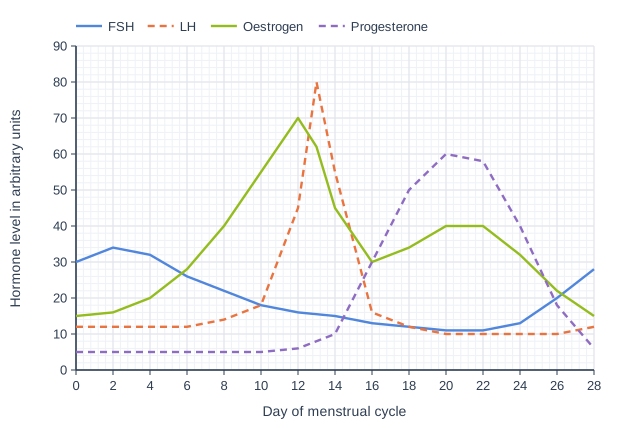
The graph shows the levels of four hormones in a woman's blood during one menstrual cycle.

One hormone shows a large, sharp peak just before ovulation. Name this hormone and give the day on which it peaks.

Line graph of hormone level in arbitrary units (y-axis, 0 to 90) against day of menstrual cycle (x-axis, 0 to 28). "FSH" joins the points (0, 30), (2, 34), (4, 32), (6, 26), (8, 22), (10, 18), (12, 16), (14, 15), (16, 13), (18, 12), (20, 11), (22, 11), (24, 13), (26, 20), (28, 28). "LH" (dashed) joins the points (0, 12), (2, 12), (4, 12), (6, 12), (8, 14), (10, 18), (12, 45), (13, 80), (14, 55), (16, 16), (18, 12), (20, 10), (22, 10), (24, 10), (26, 10), (28, 12). "Oestrogen" joins the points (0, 15), (2, 16), (4, 20), (6, 28), (8, 40), (10, 55), (12, 70), (13, 62), (14, 45), (16, 30), (18, 34), (20, 40), (22, 40), (24, 32), (26, 22), (28, 15). "Progesterone" (dashed) joins the points (0, 5), (2, 5), (4, 5), (6, 5), (8, 5), (10, 5), (12, 6), (14, 10), (16, 30), (18, 50), (20, 60), (22, 58), (24, 40), (26, 18), (28, 6).

Model answer

LH, which peaks on day 13.

Explanation

A surge of LH from the pituitary gland stimulates the release of an egg, so ovulation happens around day 14, just after the LH peak.

Mark scheme
  1. 1 mark

    LH

    allow luteinising hormone

  2. 1 mark

    day 13

    allow day 12-14

Question 3

3 marks

If a woman becomes pregnant, the level of progesterone in her blood stays high.

Explain why she does not menstruate and why no more eggs mature during the pregnancy.

Model answer

Progesterone maintains the lining of the uterus, so while its level stays high the lining does not break down and she does not menstruate. Progesterone also inhibits the release of FSH and LH from the pituitary gland, so no more eggs mature or are released.

Explanation

Menstruation happens when progesterone falls at the end of a cycle. In pregnancy progesterone stays high, so the lining stays in place and FSH stays inhibited, which stops new eggs maturing.

Mark scheme
  1. 1 mark

    progesterone maintains the uterus lining

  2. 1 mark

    so the lining does not break down / is not shed (so there is no period)

    allow so the embryo can continue to develop in the uterus

  3. 1 mark

    progesterone inhibits FSH (and LH), so no eggs mature (or are released)

    both the inhibition and the consequence are needed

Question 4

4 marks

A woman has a condition in which her pituitary gland secretes very little FSH.

Explain why she may be unable to become pregnant.

Model answer

FSH causes eggs to mature in the ovaries, so with very little FSH no egg matures. FSH also stimulates the ovaries to produce oestrogen, so little oestrogen is made and the uterus lining does not build up. Without high oestrogen the pituitary gland is not stimulated to release LH, so no egg is released. With no egg released there is nothing for a sperm to fertilise, so she cannot become pregnant.

Explanation

Because the hormones interact, a lack of one hormone affects the others. Low FSH means no mature egg and little oestrogen; little oestrogen means no LH surge and so no ovulation. This is why fertility drugs containing FSH and LH can help some women.

Mark scheme
  1. 1 mark

    FSH causes eggs to mature in the ovary, so no egg matures

    max 4

  2. 1 mark

    FSH stimulates the ovaries to produce oestrogen, so little oestrogen is made

  3. 1 mark

    so the uterus lining does not build up (an embryo could not implant)

  4. 1 mark

    low oestrogen means LH is not stimulated, so there is no ovulation / no egg is released

    allow no egg is released

  5. 1 mark

    so there is no egg to be fertilised by a sperm

Ready to try the rest? Every answer you write is marked against the mark scheme, so you can see exactly where the marks are.

Revision notes

Hormones in human reproduction

The big idea

Reproductive hormones cause the changes of puberty, control the menstrual cycle in women and stimulate sperm production in men. You need to know where each hormone is made and what it does.

Puberty

During puberty, reproductive hormones cause secondary sex characteristics to develop.

  • Oestrogen is the main female reproductive hormone, produced in the ovary. At puberty, eggs begin to mature and one is released approximately every 28 days. This is called ovulation. Other changes include breasts developing, hips widening, pubic and underarm hair growing and periods starting.
  • Testosterone is the main male reproductive hormone, produced by the testes. It stimulates sperm production and causes changes such as a deeper voice, facial and body hair and more muscle.

Like all hormones, these are carried in the blood to their target organs.

Hormones in the menstrual cycle

Several hormones are involved in the menstrual cycle:

HormoneWhere it is madeWhat it does
FSH (follicle stimulating hormone)Pituitary glandCauses an egg to mature in the ovary
LH (luteinising hormone)Pituitary glandStimulates the release of the egg (ovulation)
OestrogenOvaryBuilds up and helps maintain the uterus lining
ProgesteroneOvaryMaintains the uterus lining

FSH and LH act on the ovaries; oestrogen and progesterone act on the lining of the uterus. The lining becomes thick and rich in blood vessels, ready for an embryo to implant. If no embryo implants, progesterone falls, the lining is no longer maintained and it breaks down: this is menstruation (a period), and a new cycle begins.

Line graph of thickness of uterus lining in mm (y-axis, 0 to 7) against day of menstrual cycle (x-axis, 0 to 28). The line is a smooth curve through (0, 5.5), (1, 4.2), (2, 3), (3, 2), (4, 1.5), (6, 1.5), (8, 2.2), (10, 2.9), (12, 3.6), (14, 4.3), (17, 5), (20, 5.5), (24, 5.6), (28, 5.6).
The uterus lining during one cycle. Day 0 is the first day of menstruation; ovulation is around day 14.

Percentage change from a graph

Use the graph to calculate the percentage decrease in the thickness of the uterus lining during menstruation.

Read the values: 5.5 mm at day 0 and 1.5 mm at its thinnest, at day 4.

\[\text{percentage decrease} = \dfrac{5.5 - 1.5}{5.5} \times 100 = \dfrac{4.0}{5.5} \times 100 = 72.7\%\]

The lining breaks down and is lost during menstruation. From day 6 it builds up again, because of oestrogen. Always divide by the starting value (5.5 mm).

Higher tier only

How the four hormones interact

  1. FSH from the pituitary gland causes an egg to mature and stimulates the ovaries to produce oestrogen.
  2. Oestrogen builds up the uterus lining and inhibits the release of FSH.
  3. When the oestrogen level is high, it stimulates the pituitary to release LH.
  4. A surge of LH stimulates ovulation, around day 14.
  5. After ovulation the ovary produces progesterone, which maintains the lining and inhibits both FSH and LH, so no more eggs mature or are released.
  6. If no embryo implants, progesterone falls. The lining breaks down, FSH is no longer inhibited and the cycle starts again. In pregnancy, progesterone stays high, so there is no menstruation.

Reading hormone graphs

HormoneTypical shape over a 28-day cycle
FSHA small rise early in the cycle, then a second small peak at mid-cycle, alongside the LH surge
OestrogenRises in the first half and peaks just before ovulation
LHStays low, then a sharp surge at about day 14
ProgesteroneLow in the first half; rises after ovulation, peaks at about day 21, then falls

So a line with one sharp peak in the middle is LH, and its peak tells you the day of ovulation. A line that is only high in the second half is progesterone.

Remember

  • Oestrogen: main female hormone, made in the ovaries. Testosterone: main male hormone, made in the testes; stimulates sperm production.
  • FSH and LH come from the pituitary gland; oestrogen and progesterone come from the ovaries.
  • FSH matures an egg, LH releases it, and oestrogen and progesterone look after the uterus lining.

Common mistakes

  • Saying ovulation is when an egg matures or is fertilised. Ovulation is the release of an egg from an ovary.
  • Saying FSH or LH is made in the ovaries. They come from the pituitary gland.
  • Saying FSH or LH acts on the uterus. They act on the ovaries.
  • Saying testosterone is made in the scrotum. It is made in the testes.
  • Saying every woman releases an egg exactly every 28 days. It is approximately every 28 days; cycle length varies.

Exam tip

Learn the hormone table both ways round, because questions give the role and ask for the hormone, or give the gland and ask what it makes. In 6-mark answers cover both sexes as well as the cycle, and keep each hormone's role separate.

Study Helper Hints first, answers after you try

Stuck on this one? Ask for a hint and I’ll point you in the right direction, without giving the answer away. Once you’ve checked your answer, I’ll show you how the marks are awarded.