Level:
Correct: 0
Incorrect: 0
Marks: 0/0
Exam Practice
Course:
Topics:
AQA GCSE Maths (Foundation non-calculator) Smart practice A mixed round aimed at your weak spots
Unit 1
Number
Unit 2
Algebra
Unit 3
Ratio, proportion and rates of change
Unit 4
Geometry and measures
Unit 5
Probability
Unit 6
Statistics
Avg
score:
–
Topics
done:
0/86

Venn diagrams and sets

Practise 28 exam-style questions on Venn diagrams and sets for AQA GCSE Maths (Foundation non-calculator). Write your answer as you would in the exam and get it marked in seconds against the mark scheme, point by point, with the Study Helper on hand if you get stuck.

  • 28 questions
  • 1–5 marks each
  • Instant marking
  • No sign-up needed
20 questions, marked as you go

Sample questions with model answers

Here are 4 of the questions in this topic, each with a model answer, an explanation of why it earns the marks and the mark scheme an examiner would use.

Question 1

1 mark

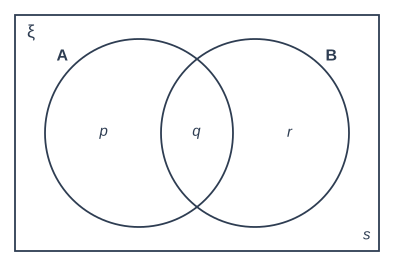
The Venn diagram shows sets A and B.
The letters p, q, r and s are in the four regions of the diagram.

Which letters are in A ∪ B?

Choose your answer.

  • q
  • p and r
  • p, q and r
  • p, q, r and s
A Venn diagram: a rectangle labelled ξ (the universal set) containing two overlapping circles labelled A and B. The numbers written in each region are: A ∩ B′ (in A only): p; A ∩ B (in both A and B): q; A′ ∩ B (in B only): r; A′ ∩ B′ (outside both circles): s.

Model answer

A ∪ B is everything in A or B or both.
This is the inside of both circles: p, q and r

Explanation

∪ (union) means in A or in B or in both, so it covers the whole of both circles. q on its own is A ∩ B, the overlap. s is outside both circles, so it is not in A ∪ B.

Mark scheme
  1. 1 mark

    B1 for p, q and r

Question 2

2 marks

40 people were asked whether they like tea and whether they like coffee.
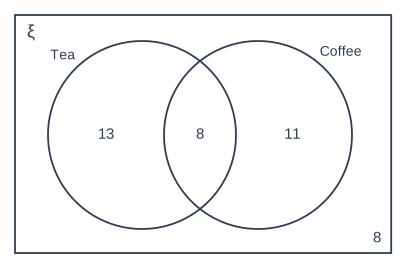
The Venn diagram shows the results.

One of the people is chosen at random.

Work out the probability that this person likes exactly one of the two drinks.

A Venn diagram: a rectangle labelled ξ (the universal set) containing two overlapping circles labelled "Tea" and "Coffee". The numbers written in each region are: in "Tea" only: 13; in both "Tea" and "Coffee": 8; in "Coffee" only: 11; outside both circles: 8.

Model answer

Tea only: 13
Coffee only: 11
Exactly one drink: 13 + 11 = 24
P(exactly one) = \(\dfrac{24}{40} = \dfrac{3}{5}\)

Explanation

'Exactly one' means tea but not coffee, or coffee but not tea, so use the two parts of the circles that are not in the overlap. The 8 people in the overlap like both drinks, so they are not included. Divide by the total of 40 people.

Mark scheme
  1. 1 mark

    M1 for 13 + 11 (= 24)

  2. 1 mark

    A1 for \(\dfrac{24}{40}\) oe

    accept \(\frac{3}{5}\), 0.6 or 60%; correct answer with no working scores full marks

Question 3

3 marks

ξ = {1, 2, 3, ..., 15}
A = {factors of 12}
B = {even numbers}

How many numbers in ξ are in neither set A nor set B?

Model answer

A = {1, 2, 3, 4, 6, 12}
B = {2, 4, 6, 8, 10, 12, 14}
Numbers in A or B: 1, 2, 3, 4, 6, 8, 10, 12, 14 (9 numbers)
Numbers in neither: 5, 7, 9, 11, 13, 15
Answer: 6

Explanation

List the members of each set, then find the numbers from 1 to 15 that are in neither list. These are the numbers that would go outside both circles on a Venn diagram. Remember that 1 and 3 are factors of 12 even though they are odd.

Mark scheme
  1. 1 mark

    M1 for A = {1, 2, 3, 4, 6, 12} or B = {2, 4, 6, 8, 10, 12, 14}

  2. 1 mark

    M1 for both sets correct, or A ∪ B = {1, 2, 3, 4, 6, 8, 10, 12, 14}, or a list of at least 4 of 5, 7, 9, 11, 13, 15

  3. 1 mark

    A1 for 6

    correct answer with no working scores full marks

Question 4

4 marks

60 people were asked whether they own a phone and whether they own a tablet.
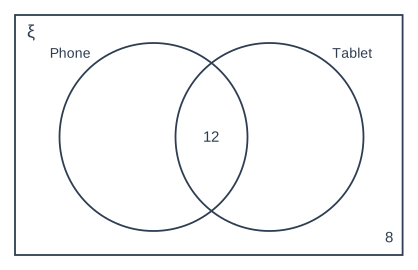
12 people own both.
8 people own neither.

The Venn diagram shows this information.

The ratio of the number of people who own only a phone to the number who own only a tablet is 3 : 2

One of the 60 people is chosen at random.

Work out the probability that this person owns a phone.

A Venn diagram: a rectangle labelled ξ (the universal set) containing two overlapping circles labelled "Phone" and "Tablet". The numbers written in each region are: in "Phone" only: empty; in both "Phone" and "Tablet": 12; in "Tablet" only: empty; outside both circles: 8.

Model answer

Only a phone or only a tablet: 60 − 12 − 8 = 40
40 ÷ 5 = 8
Only a phone: 3 × 8 = 24
Only a tablet: 2 × 8 = 16
Own a phone: 24 + 12 = 36
P(owns a phone) = \(\dfrac{36}{60} = \dfrac{3}{5}\)

Explanation

First find how many people are in the two empty regions together, then share that number in the ratio 3 : 2. Everyone inside the phone circle owns a phone, so add the 12 people who own both. Finally, divide by the 60 people.

Mark scheme
  1. 1 mark

    M1 for 60 − 12 − 8 (= 40)

  2. 1 mark

    M1 for their 40 ÷ (3 + 2) × 3 (= 24) or their 40 ÷ 5 × 2 (= 16)

  3. 1 mark

    A1 for 24 + 12 (= 36) people own a phone

  4. 1 mark

    A1 for \(\dfrac{36}{60}\) oe

    accept \(\frac{3}{5}\), 0.6 or 60%; correct answer with no working scores full marks; \(\frac{24}{60}\) (phone only) scores M1 M1 A0 A0

Ready to try the rest? Every answer you write is marked against the mark scheme, so you can see exactly where the marks are.

Study Helper Hints first, answers after you try

Stuck on this one? Ask for a hint and I’ll point you in the right direction, without giving the answer away. Once you’ve checked your answer, I’ll show you how the marks are awarded.