Practise 30 exam-style questions on Frequency trees and probability experiments for AQA GCSE Maths (Foundation non-calculator). Write your answer as you would in the exam and get it marked in seconds against the mark scheme, point by point, with the Study Helper on hand if you get stuck.
30 questions
1–5 marks each
Instant marking
No sign-up needed
20 questions, marked as you go
Sample questions with model answers
Here are 4 of the questions in this topic, each with a model answer, an explanation of why it earns the marks and the mark scheme an examiner would use.
Question 1
1 mark
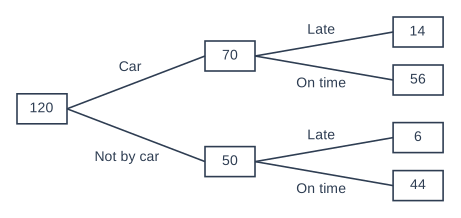
The frequency tree shows how 120 workers travelled to work on Monday and whether they were late.
One of the workers is chosen at random.
What is the probability that this worker was late?
Workers were late in two places on the tree: 14 who came by car and 6 who did not. Add them to get 20, then divide by the total of 120 workers. Using only one of the 'Late' boxes, or dividing by 70 or 50 instead of 120, gives a wrong answer.
Mark scheme
1 mark
B1 for \(\dfrac{1}{6}\)
Question 2
2 marks
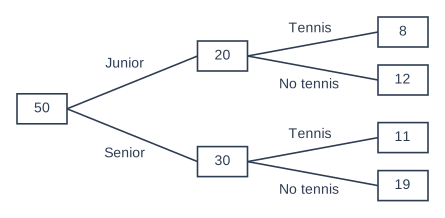
The frequency tree shows information about the 50 members of a sports club and whether they play tennis.
A member is chosen at random. Work out the probability that the member does not play tennis. Give your answer as a decimal.
Model answer
Do not play tennis: 12 + 19 = 31 Probability = \(\dfrac{31}{50} = \dfrac{62}{100}\) = 0.62
Explanation
Members who do not play tennis are in two boxes, juniors and seniors, so add them. Write the total over 50, then double the top and bottom to make a fraction out of 100, which is easy to write as a decimal.
Mark scheme
1 mark
M1 for \(\dfrac{12 + 19}{50}\) or \(\dfrac{31}{50}\)
or 1 − \(\frac{19}{50}\) where 19 = 8 + 11
1 mark
A1 for 0.62
correct answer with no working scores full marks
Question 3
3 marks
There are 72 cars in a car park. \(\frac{1}{3}\) of the cars are electric. \(\frac{1}{4}\) of the electric cars are white.
How many of the electric cars are not white?
Model answer
Electric cars: 72 ÷ 3 = 24 White electric cars: 24 ÷ 4 = 6 Not white: 24 − 6 = 18
Explanation
The \(\frac{1}{4}\) is a fraction of the electric cars, not of all 72 cars. So first find the number of electric cars, then find a quarter of that and subtract it.
Mark scheme
1 mark
M1 for 72 ÷ 3 (= 24 electric cars)
1 mark
M1 for their 24 ÷ 4 (= 6) or their 24 × \(\frac{3}{4}\)
ft their 24
1 mark
A1 for 18
correct answer with no working scores full marks
Question 4
4 marks
A factory tests 240 phones. \(\frac{1}{8}\) of the phones are faulty. \(\frac{3}{5}\) of the faulty phones have a screen fault. The rest of the faulty phones have a battery fault.
One of the 240 phones is chosen at random. Work out the probability that it has a battery fault. Give your answer as a fraction in its simplest form.
Build a frequency tree: 240 phones split into faulty and not faulty, then the faulty phones split into screen and battery faults. The phone is chosen from all 240 phones, so divide the 12 battery faults by 240 and simplify.
Mark scheme
1 mark
M1 for 240 ÷ 8 (= 30 faulty phones)
1 mark
M1 for their 30 × \(\frac{2}{5}\) or their 30 − their 30 × \(\frac{3}{5}\) (= 12)
ft their 30
1 mark
M1 for \(\dfrac{\text{their } 12}{240}\)
1 mark
A1 for \(\dfrac{1}{20}\)
correct answer with no working scores full marks
Ready to try the rest? Every answer you write is marked against the mark scheme, so you can see exactly where the marks are.
Ctrl + Enter to check
Study HelperHints first, answers after you try
Stuck on this one? Ask for a hint and I’ll point you in the right direction, without giving the answer away. Once you’ve checked your answer, I’ll show you how the marks are awarded.