Practise 30 exam-style questions on Powers and roots for AQA GCSE Maths (Foundation non-calculator). Write your answer as you would in the exam and get it marked in seconds against the mark scheme, point by point, with the Study Helper on hand if you get stuck.
30 questions
1–5 marks each
Instant marking
No sign-up needed
20 questions, marked as you go
Sample questions with model answers
Here are 4 of the questions in this topic, each with a model answer, an explanation of why it earns the marks and the mark scheme an examiner would use.
Squaring means multiplying a number by itself, so \(14^2\) is 14 × 14, not 14 × 2. Split 14 into 10 and 4 to multiply in your head or use a written method. 196 is one of the square numbers up to 15 × 15 that you should know.
Mark scheme
1 mark
B1 for 196
do not accept 28
Question 2
2 marks
Write these numbers in order of size. Start with the smallest.
Work out the value of each power before comparing them: you cannot order powers just by looking at the big numbers or the small powers. Powers of 2 go 2, 4, 8, 16, 32, 64, 128, and powers of 3 go 3, 9, 27, 81.
Mark scheme
1 mark
M1 for at least three of 128, 81, 64, 25 correct
values may be seen in working or matched to the powers
1 mark
A1 for \(5^2\), \(4^3\), \(3^4\), \(2^7\)
accept 25, 64, 81, 128 in order; ft their values for M1 only
Question 3
2 marks
Find two square numbers that add up to 130.
Model answer
Square numbers: 1, 4, 9, 16, 25, 36, 49, 64, 81, 100, 121 130 − 81 = 49, which is a square number. 49 + 81 = 130
Explanation
List the square numbers less than 130. Then take each one away from 130 and check whether the answer is also a square number. 130 − 81 = 49 works, and so does 130 − 121 = 9.
Mark scheme
1 mark
M1 for a list of square numbers up to at least 81, or a correct trial of two square numbers added together
1 mark
A1 for 49 and 81, or 9 and 121
accept either pair; correct answer with no working scores full marks
Question 4
4 marks
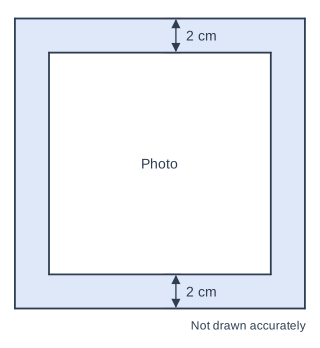
The diagram shows a square photo inside a square frame.
The photo has an area of 169 cm². The frame is 2 cm wide all the way round.
Work out the area of the frame.
Model answer
Side of the photo = \(\sqrt{169}\) = 13 cm Side of the frame = 13 + 2 + 2 = 17 cm Area of the whole square = 17 × 17 = 289 cm² Area of the frame = 289 − 169 = 120 cm²
Explanation
The photo is a square with area 169 cm², so its side is the square root of 169, which is 13 cm. The frame adds 2 cm on both sides, so the outside square is 17 cm wide. The frame is the big square take away the photo.
correct answer with no working scores full marks; 15 × 15 − 169 = 56 (adding 2 only once) scores M1 M0 M1 A0
Ready to try the rest? Every answer you write is marked against the mark scheme, so you can see exactly where the marks are.
Ctrl + Enter to check
Study HelperHints first, answers after you try
Stuck on this one? Ask for a hint and I’ll point you in the right direction, without giving the answer away. Once you’ve checked your answer, I’ll show you how the marks are awarded.