Practise 28 exam-style questions on Roots and turning points of quadratics for AQA GCSE Maths (Foundation non-calculator). Write your answer as you would in the exam and get it marked in seconds against the mark scheme, point by point, with the Study Helper on hand if you get stuck.
28 questions
1–5 marks each
Instant marking
No sign-up needed
20 questions, marked as you go
Sample questions with model answers
Here are 4 of the questions in this topic, each with a model answer, an explanation of why it earns the marks and the mark scheme an examiner would use.
Question 1
1 mark
The graph of a quadratic function crosses the x-axis at (1, 0) and (7, 0).
What is the equation of its line of symmetry?
Choose your answer.
\(x = 4\)
\(y = 4\)
\(x = 3\)
\(x = 8\)
Model answer
The line of symmetry is halfway between the roots. \(\dfrac{1 + 7}{2} = 4\) \(x = 4\)
Explanation
A quadratic graph is symmetrical, so its line of symmetry is a vertical line exactly halfway between the two roots. Add the roots and halve: (1 + 7) ÷ 2 = 4. A vertical line has an equation x = ..., not y = ...; and 3 is only half the distance between the roots.
Mark scheme
1 mark
B1 for \(x = 4\)
Question 2
2 marks
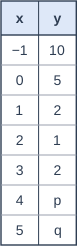
Here is a table of values for a quadratic function. The graph of the function is symmetrical.
Work out the value of p and the value of q.
Model answer
The smallest y value is 1, when \(x = 2\), so the line of symmetry is \(x = 2\). \(x = 4\) is 2 to the right of 2, so it matches \(x = 0\): \(p = 5\) \(x = 5\) is 3 to the right of 2, so it matches \(x = -1\): \(q = 10\)
Explanation
The y values go down to 1 at x = 2 and then start going back up in the same pattern (2 at x = 1 and at x = 3). So the graph is symmetrical about x = 2. Values the same distance either side of x = 2 are equal.
Mark scheme
1 mark
B1 for \(p = 5\)
1 mark
B1 for \(q = 10\)
correct answers with no working score full marks
Question 3
3 marks
Solve \(x^2 - x - 12 = 0\)
Model answer
Two numbers that multiply to −12 and add to −1: −4 and 3 \((x - 4)(x + 3) = 0\) \(x - 4 = 0\) or \(x + 3 = 0\) \(x = 4\) or \(x = -3\)
Explanation
Look for a pair of numbers that multiply to the constant, −12, and add to the coefficient of x, −1. Because the product is negative, one number is positive and one is negative. Then set each bracket equal to 0.
Mark scheme
1 mark
M1 for \((x \pm 4)(x \pm 3)\)
1 mark
A1 for \((x - 4)(x + 3)\)
1 mark
A1 for \(x = 4\) and \(x = -3\)
correct answers with no working score full marks
Question 4
4 marks
The graph of \(y = x^2 + bx + c\) crosses the x-axis at (−1, 0) and (7, 0).
Work out the coordinates of the turning point of the graph.
Model answer
The turning point is halfway between the roots: \(x = \dfrac{-1 + 7}{2} = 3\) The roots are −1 and 7, so \(y = (x + 1)(x - 7)\) When \(x = 3\): \(y = (3 + 1)(3 - 7) = 4 \times (-4) = -16\) The turning point is (3, −16).
Explanation
If the roots are −1 and 7, the brackets must be (x + 1) and (x − 7), because each bracket is 0 at a root. The turning point is on the line of symmetry halfway between the roots, at x = 3. Substitute x = 3 to find the y-coordinate.
Mark scheme
1 mark
M1 for \(x = \dfrac{-1 + 7}{2}\) oe
or x = 3 seen
1 mark
M1 for \(y = (x + 1)(x - 7)\) oe
e.g. \(y = x^2 - 6x - 7\)
1 mark
M1 for substituting their x = 3 into their equation, e.g. \((3 + 1)(3 - 7)\)
1 mark
A1 for (3, −16)
correct answer with no working scores full marks
Ready to try the rest? Every answer you write is marked against the mark scheme, so you can see exactly where the marks are.
Ctrl + Enter to check
Study HelperHints first, answers after you try
Stuck on this one? Ask for a hint and I’ll point you in the right direction, without giving the answer away. Once you’ve checked your answer, I’ll show you how the marks are awarded.