
Level:
Correct: 0
Incorrect: 0
Marks: 0/0
Exam Practice
Course:
Topics:
AQA GCSE Maths (Foundation non-calculator) Smart practice A mixed round aimed at your weak spots
Unit 1
Number
Unit 2
Algebra
Unit 3
Ratio, proportion and rates of change
Unit 4
Geometry and measures
Unit 5
Probability
Unit 6
Statistics
Avg
score:
–
Topics
done:
0/86

Scale drawings and bearings

Practise 28 exam-style questions on Scale drawings and bearings for AQA GCSE Maths (Foundation non-calculator). Write your answer as you would in the exam and get it marked in seconds against the mark scheme, point by point, with the Study Helper on hand if you get stuck.

  • 28 questions
  • 1–5 marks each
  • Instant marking
  • No sign-up needed
20 questions, marked as you go

Sample questions with model answers

Here are 4 of the questions in this topic, each with a model answer, an explanation of why it earns the marks and the mark scheme an examiner would use.

Question 1

1 mark

A plan of a classroom uses a scale of 1 cm to 2 m.
The real classroom is 12 m long.

How long is the classroom on the plan?

Model answer

Every 2 m in real life is 1 cm on the plan.
12 ÷ 2 = 6
The classroom is 6 cm long on the plan.

Explanation

The plan is smaller than the real room, so the answer must be smaller than 12. Work out how many lots of 2 m there are in 12 m: each lot is 1 cm on the plan. Multiplying (12 × 2 = 24) is a common mistake - it makes the plan bigger than the room.

Mark scheme
  1. 1 mark

    B1 for 6 cm

    units required; do not accept 24 cm
Question 2

2 marks

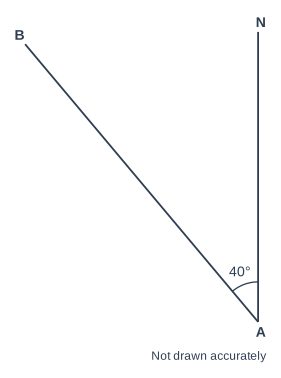
The diagram shows the position of a boat, B, from a lighthouse, A.
The line AN points north.

Ben says,
"The bearing of B from A is 040°."

Ben is wrong.
What mistake has he made?
Work out the correct bearing of B from A.

Geometry diagram, marked "Not drawn accurately". Line segments AB and AN are drawn. Angle NAB is marked 40°.

Model answer

Ben has measured the 40° anticlockwise from north. Bearings are measured clockwise from north.
Correct bearing = 360° − 40° = 320°

Explanation

A bearing always starts at north and turns clockwise until it reaches the line to the object. B is to the north-west of A, so its bearing must be between 270° and 360°. The 40° is measured the other way, so take it away from 360°.

Mark scheme
  1. 1 mark

    B1 for he has measured anticlockwise from north (bearings are measured clockwise from north) oe

    accept 'he went the wrong way round' or 'he should measure clockwise'; do not accept 'he used the wrong angle' on its own

  2. 1 mark

    B1 for 320°

    accept 320

Question 3

3 marks

A map has a scale of 1 : 50 000
On the map, a footpath is 6 cm long.

Work out the real length of the footpath.
Give your answer in kilometres.

Model answer

Real length = 6 × 50 000 = 300 000 cm
300 000 cm ÷ 100 = 3000 m
3000 m ÷ 1000 = 3 km

Explanation

A scale of 1 : 50 000 means 1 cm on the map is 50 000 cm in real life. Multiply to get the real length in centimetres, then convert: 100 cm = 1 m and 1000 m = 1 km, so divide by 100 000 altogether. Leaving the answer as 300 000 is a common mistake - always check the units asked for.

Mark scheme
  1. 1 mark

    M1 for 6 × 50 000 (= 300 000)

    or 1 cm represents 0.5 km

  2. 1 mark

    M1 for their 300 000 ÷ 100 000 oe

    e.g. ÷ 100 then ÷ 1000; or 6 × 0.5

  3. 1 mark

    A1 for 3 (km)

    correct answer with no working scores full marks

Question 4

4 marks

Point B is 6 km due north of point A.
Point C is 6 km due east of point B.

Work out the bearing of A from C.

Model answer

Triangle ABC has a right angle at B and AB = BC = 6 km.
It is isosceles, so the other two angles are (180° − 90°) ÷ 2 = 45° each.
The bearing of C from A is 045°.
The bearing of A from C is 045° + 180° = 225°

Explanation

Sketch the journey: north 6 km, then east 6 km. The triangle is right-angled and isosceles, so its other angles are 45°. A is exactly south-west of C, and south-west is 225°. Check by remembering the eight compass points: south-west is halfway between south (180°) and west (270°).

Mark scheme
  1. 1 mark

    M1 for a triangle ABC with a right angle at B and AB = BC = 6 (km)

    may be a sketch or a statement

  2. 1 mark

    M1 for angle BCA = 45° or angle BAC = 45° (isosceles right-angled triangle)

    or the bearing of C from A = 045°

  3. 1 mark

    M1 for 270 − 45 or 45 + 180 oe

  4. 1 mark

    A1 for 225°

    accept 225; correct answer with no working scores full marks

Ready to try the rest? Every answer you write is marked against the mark scheme, so you can see exactly where the marks are.

Study Helper Hints first, answers after you try

Stuck on this one? Ask for a hint and I’ll point you in the right direction, without giving the answer away. Once you’ve checked your answer, I’ll show you how the marks are awarded.