Practise 28 exam-style questions on Growth, decay and compound interest for AQA GCSE Maths (Foundation non-calculator). Write your answer as you would in the exam and get it marked in seconds against the mark scheme, point by point, with the Study Helper on hand if you get stuck.
28 questions
1–5 marks each
Instant marking
No sign-up needed
20 questions, marked as you go
Sample questions with model answers
Here are 4 of the questions in this topic, each with a model answer, an explanation of why it earns the marks and the mark scheme an examiner would use.
Question 1
1 mark
Write down the decimal number you multiply by to decrease an amount by 20%.
Model answer
100% − 20% = 80% = 0.8
Explanation
After a decrease of 20% you are left with 80% of the amount, and 80% as a decimal is 0.8. Multiplying by 0.2 would give the 20% that is taken off, not what is left.
Mark scheme
1 mark
B1 for 0.8
accept 0.80; do not accept 0.2 or 80%
Question 2
2 marks
The number of bacteria in a dish triples every 20 minutes. At the start there are 200 bacteria.
How many bacteria are there after 1 hour?
Model answer
1 hour = 3 lots of 20 minutes After 20 minutes: 200 × 3 = 600 After 40 minutes: 600 × 3 = 1800 After 60 minutes: 1800 × 3 = 5400
Explanation
There are three 20-minute periods in an hour, so multiply by 3 three times: 200 × 3 × 3 × 3 = 200 × 27 = 5400. Multiplying 200 by 9 (3 × 3) is a common mistake: it only covers 40 minutes.
Mark scheme
1 mark
M1 for repeated tripling, e.g. 200 × 3 (= 600) and their 600 × 3 (= 1800)
or 200 × 27, or \(200 \times 3^3\)
1 mark
A1 for 5400
correct answer with no working scores full marks; 1800 (tripling only twice) scores M1 A0
Question 3
3 marks
A new car costs £12 000
In the first year its value falls by 25%. In the second year its value falls by 10%.
Work out the value of the car after 2 years.
Model answer
After 1 year: 25% of £12 000 = £3000, so £12 000 − £3000 = £9000 After 2 years: 10% of £9000 = £900, so £9000 − £900 = £8100
Explanation
The 10% in the second year is a percentage of the value at the start of that year, £9000, not of the original £12 000. You cannot add the percentages: taking 35% off £12 000 gives £7800, which is wrong.
Mark scheme
1 mark
M1 for 25% of 12 000 (= 3000) or 12 000 × 0.75 (= 9000)
1 mark
M1 for 10% of their 9000 (= 900) or their 9000 × 0.9
1 mark
A1 for £8100
correct answer with no working scores full marks; SC1 for £7800 (35% of 12 000 taken off) only if no other marks are awarded
Question 4
4 marks
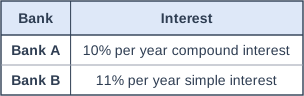
Zara has £5000 to invest for 2 years. The table shows the interest paid by two banks.
Which bank will give Zara more money after 2 years? You must show your working.
Model answer
Bank A: Year 1: 10% of £5000 = £500, so £5500 Year 2: 10% of £5500 = £550, so £6050 Bank B: 1% of £5000 = £50, so 11% = £550 each year 2 × £550 = £1100, so £5000 + £1100 = £6100 £6100 is more than £6050, so Bank B gives more money.
Explanation
Compound interest is worked out on the new amount each year; simple interest is the same amount every year. Compound interest is not always better: here the higher rate at Bank B gives £50 more over 2 years. Work out both totals before deciding.
Mark scheme
1 mark
M1 for Bank A first year: 5000 × 1.1 (= 5500) or interest 500
1 mark
M1 for Bank A second year: their 5500 × 1.1 (= 6050) or interest 550
or \(5000 \times 1.1^2\)
1 mark
M1 for Bank B: 11% of 5000 × 2 (= 1100) or total 6100
1 mark
A1 for Bank B with £6050 and £6100 (or interest £1050 and £1100)
must have correct values for both; answer only scores 0
Ready to try the rest? Every answer you write is marked against the mark scheme, so you can see exactly where the marks are.
Ctrl + Enter to check
Study HelperHints first, answers after you try
Stuck on this one? Ask for a hint and I’ll point you in the right direction, without giving the answer away. Once you’ve checked your answer, I’ll show you how the marks are awarded.