Multiplicative relationships as ratios and fractions
Practise 18 exam-style questions on Multiplicative relationships as ratios and fractions for AQA GCSE Maths (Foundation non-calculator). Write your answer as you would in the exam and get it marked in seconds against the mark scheme, point by point, with the Study Helper on hand if you get stuck.
18 questions
1–5 marks each
Instant marking
No sign-up needed
18 questions, marked as you go
Sample questions with model answers
Here are 4 of the questions in this topic, each with a model answer, an explanation of why it earns the marks and the mark scheme an examiner would use.
Question 1
1 mark
In a class, the number of girls is \(\frac{3}{4}\) of the number of boys.
What is the ratio boys : girls?
Choose your answer.
3 : 4
4 : 3
3 : 7
4 : 7
Model answer
For every 4 boys there are 3 girls. Boys : girls = 4 : 3
Explanation
If the number of girls is \(\frac{3}{4}\) of the number of boys, then for every 4 boys there are 3 girls. The question asks for boys first, so the ratio is 4 : 3. A quick check: there are fewer girls than boys, so the girls' number must be smaller.
Mark scheme
1 mark
B1 for 4 : 3
Question 2
2 marks
In a class, the ratio of girls to boys is 3 : 5
Jake says,
"\(\frac{3}{5}\) of the class are girls."
Is Jake correct? Give a reason for your answer.
Model answer
No. The class is 3 + 5 = 8 parts and the girls are 3 of them, so \(\frac{3}{8}\) of the class are girls. \(\frac{3}{5}\) is the number of girls as a fraction of the number of boys.
Explanation
A ratio compares one part with another part. To write one part as a fraction of the whole class, the denominator must be the total number of parts, 3 + 5 = 8. Jake has compared the girls with the boys instead of with the whole class.
Mark scheme
1 mark
B1 for 3 + 5 = 8 seen, or the class is 8 parts
1 mark
B1 for No with \(\frac{3}{8}\) of the class are girls
or No with a correct explanation that \(\frac{3}{5}\) is the number of girls as a fraction of the number of boys
Question 3
3 marks
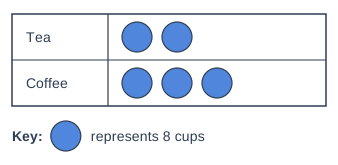
The pictogram shows the number of cups of tea and coffee sold at a café one morning.
The number of hot chocolates sold that morning was \(\frac{1}{3}\) of the number of coffees sold.
Write the ratio tea : coffee : hot chocolate in its simplest form.
Model answer
One circle = 8 cups Tea: 2 circles = 16 cups Coffee: 3 circles = 24 cups Hot chocolate: \(\frac{1}{3}\) of 24 = 8 cups Tea : coffee : hot chocolate = 16 : 24 : 8 Divide by 8: 2 : 3 : 1
Explanation
Use the key to read the numbers of teas and coffees. To find \(\frac{1}{3}\) of the coffees, divide by 3. Then write the three numbers as a ratio and divide them all by 8.
Mark scheme
1 mark
B1 for tea 16 and coffee 24
1 mark
M1 for their 24 ÷ 3 (= 8)
1 mark
A1 for 2 : 3 : 1
correct answer with no working scores full marks; 16 : 24 : 8 scores B1 M1 A0
Question 4
4 marks
Ali, Ben and Cal share £108
Ali gets twice as much as Ben. Cal gets 3 times as much as Ali.
How much does Cal get?
Model answer
Let Ben's share be 1 part. Ali = 2 parts, Cal = 3 × 2 = 6 parts Ali : Ben : Cal = 2 : 1 : 6 Total = 9 parts, so 1 part = £108 ÷ 9 = £12 Cal gets 6 × £12 = £72
Explanation
Turn the 'times as much' statements into a ratio. Ben has the smallest share, so make him 1 part: Ali is 2 parts and Cal is 3 times Ali, which is 6 parts. Then share £108 into 9 parts. Check: £24 + £12 + £72 = £108.
Mark scheme
1 mark
M1 for two of the shares in the correct ratio, e.g. Ali : Ben = 2 : 1 or Ali : Cal = 1 : 3
1 mark
A1 for Ali : Ben : Cal = 2 : 1 : 6 oe
1 mark
M1 for 108 ÷ (their 2 + 1 + 6)
their ratio must have three parts
1 mark
A1 for £72
correct answer with no working scores full marks
Ready to try the rest? Every answer you write is marked against the mark scheme, so you can see exactly where the marks are.
Ctrl + Enter to check
Study HelperHints first, answers after you try
Stuck on this one? Ask for a hint and I’ll point you in the right direction, without giving the answer away. Once you’ve checked your answer, I’ll show you how the marks are awarded.