Level:
Correct: 0
Incorrect: 0
Marks: 0/0
Exam Practice
Course:
Topics:
AQA GCSE Maths (Foundation non-calculator) Smart practice A mixed round aimed at your weak spots
Unit 1
Number
Unit 2
Algebra
Unit 3
Ratio, proportion and rates of change
Unit 4
Geometry and measures
Unit 5
Probability
Unit 6
Statistics
Avg
score:
–
Topics
done:
0/86

Expected outcomes

Practise 29 exam-style questions on Expected outcomes for AQA GCSE Maths (Foundation non-calculator). Write your answer as you would in the exam and get it marked in seconds against the mark scheme, point by point, with the Study Helper on hand if you get stuck.

  • 29 questions
  • 1–5 marks each
  • Instant marking
  • No sign-up needed
20 questions, marked as you go

Sample questions with model answers

Here are 4 of the questions in this topic, each with a model answer, an explanation of why it earns the marks and the mark scheme an examiner would use.

Question 1

1 mark

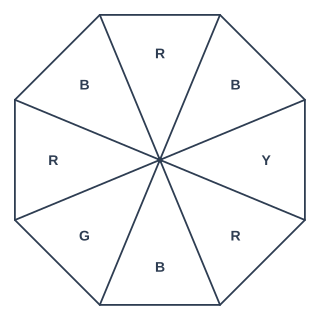
The diagram shows a fair spinner with 8 equal sections.
R = red, B = blue, G = green, Y = yellow

The spinner is spun 40 times.
How many times would you expect it to land on red?

Choose your answer.

  • 3
  • 5
  • 15
  • 25
Geometry diagram, drawn accurately to scale. A regular octagon spinner (its vertices are not labelled). A sloping line with no labelled ends is drawn. A sloping line with no labelled ends is drawn. A sloping line with no labelled ends is drawn. A sloping line with no labelled ends is drawn. A sloping line with no labelled ends is drawn. A sloping line with no labelled ends is drawn. A sloping line with no labelled ends is drawn. A sloping line with no labelled ends is drawn. The text "R" is written inside the shape. The text "B" is written inside the shape. The text "R" is written inside the shape. The text "G" is written inside the shape. The text "B" is written inside the shape. The text "R" is written inside the shape. The text "Y" is written inside the shape. The text "B" is written inside the shape.

Model answer

3 of the 8 sections are red, so P(red) = \(\frac{3}{8}\)
\(\frac{3}{8}\) × 40 = 15

Explanation

Count the red sections: 3 out of 8, so the probability of red is \(\frac{3}{8}\). Then find \(\frac{3}{8}\) of 40: 40 ÷ 8 = 5, and 5 × 3 = 15.

Mark scheme
  1. 1 mark

    B1 for 15

Question 2

2 marks

Lena scores with 70% of her shots at goal in netball.
She has 40 shots at goal in a match.

Work out an estimate for the number of goals she scores.

Model answer

10% of 40 = 4
70% of 40 = 7 × 4 = 28

Explanation

70% is the probability that a shot scores, written as a percentage. The expected number of goals is 70% of the 40 shots. Find 10% first, then multiply by 7.

Mark scheme
  1. 1 mark

    M1 for 0.7 × 40 oe

    e.g. 10% of 40 = 4 and 4 × 7

  2. 1 mark

    A1 for 28

    correct answer with no working scores full marks

Question 3

3 marks

A bag contains only red counters and blue counters.
The ratio of red counters to blue counters is 3 : 7

Hari takes a counter at random, records its colour and puts it back.
He does this 150 times.

Work out an estimate for the number of times he takes a blue counter.

Model answer

There are 3 + 7 = 10 parts, and 7 of them are blue.
P(blue) = \(\dfrac{7}{10}\)
\(\dfrac{7}{10}\) × 150 = 15 × 7 = 105

Explanation

A ratio of 3 : 7 means that out of every 10 counters, 7 are blue, so the probability of blue is \(\frac{7}{10}\), not \(\frac{7}{3}\). Multiply this probability by the 150 picks.

Mark scheme
  1. 1 mark

    M1 for P(blue) = \(\dfrac{7}{10}\) oe

    or 150 ÷ 10 (= 15)

  2. 1 mark

    M1 for their \(\dfrac{7}{10}\) × 150

    or their 15 × 7; their \(\frac{7}{10}\) must come from the ratio

  3. 1 mark

    A1 for 105

    correct answer with no working scores full marks

Question 4

4 marks

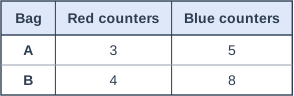
The table shows the counters in two bags, A and B.

Lily takes a counter at random from bag A, records its colour and puts it back. She does this 40 times.
Ravi takes a counter at random from bag B, records its colour and puts it back. He does this 60 times.

Lily says,

"Bag A has a greater proportion of red counters, so I should expect to get more reds than Ravi."

Is Lily correct?
You must show your working.

Table with columns "Bag", "Red counters", "Blue counters". Bag: A; Red counters: 3; Blue counters: 5 | Bag: B; Red counters: 4; Blue counters: 8.

Model answer

Bag A: P(red) = \(\dfrac{3}{8}\), expected reds = \(\dfrac{3}{8}\) × 40 = 15
Bag B: P(red) = \(\dfrac{4}{12} = \dfrac{1}{3}\), expected reds = \(\dfrac{1}{3}\) × 60 = 20
Lily expects 15 reds and Ravi expects 20 reds, so Lily is not correct.

Explanation

Lily is right that bag A has the greater proportion of red (\(\frac{3}{8}\) is more than \(\frac{1}{3}\)), but Ravi takes more counters. Work out each expected number: probability × number of goes. Ravi's 60 goes give him more expected reds.

Mark scheme
  1. 1 mark

    M1 for P(red from A) = \(\dfrac{3}{8}\) or P(red from B) = \(\dfrac{4}{12}\) oe

  2. 1 mark

    M1 for their \(\dfrac{3}{8}\) × 40 (= 15)

  3. 1 mark

    M1 for their \(\dfrac{4}{12}\) × 60 (= 20)

  4. 1 mark

    A1 for No, with 15 and 20

    must have correct values for both; answer only scores 0

Ready to try the rest? Every answer you write is marked against the mark scheme, so you can see exactly where the marks are.

Study Helper Hints first, answers after you try

Stuck on this one? Ask for a hint and I’ll point you in the right direction, without giving the answer away. Once you’ve checked your answer, I’ll show you how the marks are awarded.