Level:
Correct: 0
Incorrect: 0
Marks: 0/0
Exam Practice
Course:
Topics:
AQA GCSE Maths (Foundation non-calculator) Smart practice A mixed round aimed at your weak spots
Unit 1
Number
Unit 2
Algebra
Unit 3
Ratio, proportion and rates of change
Unit 4
Geometry and measures
Unit 5
Probability
Unit 6
Statistics
Avg
score:
–
Topics
done:
0/86

Function machines

Practise 28 exam-style questions on Function machines for AQA GCSE Maths (Foundation non-calculator). Write your answer as you would in the exam and get it marked in seconds against the mark scheme, point by point, with the Study Helper on hand if you get stuck.

  • 28 questions
  • 1–5 marks each
  • Instant marking
  • No sign-up needed
20 questions, marked as you go

Sample questions with model answers

Here are 4 of the questions in this topic, each with a model answer, an explanation of why it earns the marks and the mark scheme an examiner would use.

Question 1

1 mark

Here is a function machine.

The input is \(n\).

Write an expression, in terms of \(n\), for the output.

Flow chart of 4 boxes joined by arrows, read from left to right. The first box is "Input", which leads to "× 5", which leads to "− 3", which leads to "Output".

Model answer

\(n \times 5 = 5n\)
\(5n - 3\)
The output is \(5n - 3\).

Explanation

Put the letter n through the machine just like a number. Multiplying n by 5 gives 5n, then subtracting 3 gives 5n − 3. Writing 5(n − 3) is wrong because that subtracts 3 before multiplying.

Mark scheme
  1. 1 mark

    B1 for \(5n - 3\)

    oe, e.g. n × 5 − 3; condone Output = 5n − 3; do not accept 5(n − 3)

Question 2

2 marks

A taxi firm uses the function machine shown to work out the cost of a journey.

A journey costs £19.

How many miles long was the journey?

Flow chart of 4 boxes joined by arrows, read from left to right. The first box is "Number of miles", which leads to "× 2", which leads to "+ 3", which leads to "Cost in £".

Model answer

Work backwards through the machine.
£19 − £3 = £16
16 ÷ 2 = 8
The journey was 8 miles.

Explanation

The cost is the output, so work backwards with inverse operations: subtract 3, then divide by 2. Check: 8 × 2 + 3 = 19. Dividing 19 by 2 first is a common mistake.

Mark scheme
  1. 1 mark

    M1 for 19 − 3 (= 16)

  2. 1 mark

    A1 for 8 (miles)

    correct answer with no working scores full marks

Question 3

3 marks

Here is a function machine.

Input → × 3 → + 2 → Output

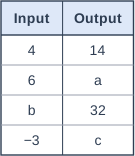
The table shows some inputs and outputs for this machine.

Work out the values of \(a\), \(b\) and \(c\).

Table with columns "Input", "Output". Input: 4; Output: 14 | Input: 6; Output: a | Input: b; Output: 32 | Input: −3; Output: c.

Model answer

\(a\): 6 × 3 + 2 = 18 + 2 = 20
\(b\): work backwards, 32 − 2 = 30, 30 ÷ 3 = 10
\(c\): −3 × 3 + 2 = −9 + 2 = −7

Explanation

For a and c, put the input through the machine. For b you know the output, so work backwards with inverse operations: subtract 2, then divide by 3. For c, −3 × 3 = −9, and adding 2 to −9 gives −7, not −11.

Mark scheme
  1. 1 mark

    B1 for \(a = 20\)

  2. 1 mark

    B1 for \(b = 10\)

  3. 1 mark

    B1 for \(c = -7\)

Question 4

4 marks

A school uses this function machine to work out the total cost of a trip.

The total cost of one trip is £570.
Each student on the trip pays the same amount.

How much does each student pay?

Flow chart of 4 boxes joined by arrows, read from left to right. The first box is "Number of students", which leads to "× 15", which leads to "+ 120", which leads to "Total cost in £".

Model answer

Work backwards to find the number of students:
£570 − £120 = £450
450 ÷ 15 = 30 students
Each student pays £570 ÷ 30 = £19

Explanation

First work backwards through the machine to find how many students went: subtract 120, then divide by 15. The £120 is shared between the students too, so divide the total cost of £570 by the number of students. Giving £15 forgets the share of the £120.

Mark scheme
  1. 1 mark

    M1 for 570 − 120 (= 450)

  2. 1 mark

    M1dep for their 450 ÷ 15 (= 30 students)

  3. 1 mark

    M1 for 570 ÷ their 30

    ft their number of students

  4. 1 mark

    A1 for £19

    correct answer with no working scores full marks

Ready to try the rest? Every answer you write is marked against the mark scheme, so you can see exactly where the marks are.

Study Helper Hints first, answers after you try

Stuck on this one? Ask for a hint and I’ll point you in the right direction, without giving the answer away. Once you’ve checked your answer, I’ll show you how the marks are awarded.