
Level:
Correct: 0
Incorrect: 0
Marks: 0/0
Exam Practice
Course:
Topics:
AQA GCSE Maths (Foundation non-calculator) Smart practice A mixed round aimed at your weak spots
Unit 1
Number
Unit 2
Algebra
Unit 3
Ratio, proportion and rates of change
Unit 4
Geometry and measures
Unit 5
Probability
Unit 6
Statistics
Avg
score:
–
Topics
done:
0/86

Sample size and theoretical probability

Practise 18 exam-style questions on Sample size and theoretical probability for AQA GCSE Maths (Foundation non-calculator). Write your answer as you would in the exam and get it marked in seconds against the mark scheme, point by point, with the Study Helper on hand if you get stuck.

  • 18 questions
  • 1–5 marks each
  • Instant marking
  • No sign-up needed
18 questions, marked as you go

Sample questions with model answers

Here are 4 of the questions in this topic, each with a model answer, an explanation of why it earns the marks and the mark scheme an examiner would use.

Question 1

1 mark

Amy throws a coin 6 times.
She gets 5 heads and 1 tail.

Amy says,
"My coin must be biased."

Give a reason why Amy may be wrong.

Model answer

6 throws is far too few to decide. A fair coin can easily give 5 heads in 6 throws just by chance. She would need to throw it many more times.

Explanation

Results from a small number of trials can be very different from the theoretical probabilities. Only with a large number of throws do the results settle close to half heads for a fair coin. So 6 throws is not enough evidence to say the coin is biased.

Mark scheme
  1. 1 mark

    B1 for a reason about the small number of throws, e.g. '6 throws is not enough to tell' or 'with only a few throws the results can be very different from the expected results'

    accept 'she needs to throw it many more times'; do not accept 'the coin is fair' or 'she should get 3 heads' with no reference to the number of throws
Question 2

2 marks

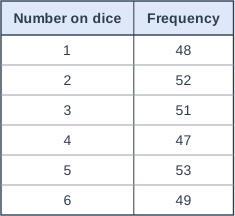
Kim rolls a dice 300 times.
The table shows her results.

Do her results suggest that the dice is fair?
You must show your working.

Table with columns "Number on dice", "Frequency". Number on dice: 1; Frequency: 48 | Number on dice: 2; Frequency: 52 | Number on dice: 3; Frequency: 51 | Number on dice: 4; Frequency: 47 | Number on dice: 5; Frequency: 53 | Number on dice: 6; Frequency: 49.

Model answer

If the dice is fair, each number is expected \(300 \div 6 = 50\) times.
The frequencies are 48, 52, 51, 47, 53 and 49.
They are all close to 50, so the results suggest that the dice is fair.

Explanation

For a fair dice each number has probability \(\frac{1}{6}\), so in 300 rolls each number is expected about 50 times. With a large number of rolls the frequencies should be close to this, but not exactly equal. All six frequencies are within 3 of 50, so there is no evidence of bias.

Mark scheme
  1. 1 mark

    M1 for 300 ÷ 6 (= 50) oe, the number of times each number is expected for a fair dice

    or \(\frac{1}{6}\) compared with relative frequencies such as \(\frac{48}{300}\) and \(\frac{53}{300}\)

  2. 1 mark

    A1 for Yes (the dice seems fair), because all the frequencies are close to 50

    must have 50 (or the equivalent comparison with \(\frac{1}{6}\)); answer only scores 0

Question 3

3 marks

A spinner has 8 equal sections.
3 of the sections are blue.

Tom spins the spinner 400 times.
It lands on blue 144 times.

Tom says,
"The spinner is biased because it should have landed on blue more often."

Is Tom correct?
You must show your working.

Model answer

If the spinner is fair, P(blue) = \(\frac{3}{8}\)
Expected number of blues = \(400 \div 8 \times 3 = 50 \times 3 = 150\)
144 is close to 150, so Tom is not correct. The results do not suggest that the spinner is biased.

Explanation

Work out the number of blues you would expect from a fair spinner: \(\frac{3}{8}\) of 400 is 150. Results from an experiment are rarely exactly equal to the expected number, even for a fair spinner. 144 is only 6 away from 150, which is close for 400 spins, so this is not evidence of bias.

Mark scheme
  1. 1 mark

    M1 for \(\frac{3}{8} \times 400\) oe, e.g. 400 ÷ 8 × 3

    alternative method: M1 for \(\frac{144}{400}\) and \(\frac{3}{8}\)

  2. 1 mark

    A1 for 150 (the expected number of blues)

    alternative method: A1 for 0.36 and 0.375 oe

  3. 1 mark

    A1 for No (the spinner does not seem biased), because 144 is close to 150

    must have correct values; accept 'not necessarily'; answer only scores 0

Question 4

4 marks

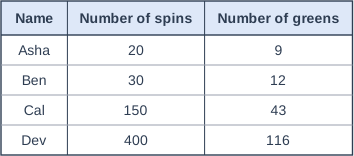
Four students each spin the same spinner.
The table shows how many times it lands on green.

The spinner has 10 equal sections.
Some of the sections are green.

Use all of the results to estimate how many of the sections are green.
You must show your working.

Table with columns "Name", "Number of spins", "Number of greens". Name: Asha; Number of spins: 20; Number of greens: 9 | Name: Ben; Number of spins: 30; Number of greens: 12 | Name: Cal; Number of spins: 150; Number of greens: 43 | Name: Dev; Number of spins: 400; Number of greens: 116.

Model answer

Total greens = 9 + 12 + 43 + 116 = 180
Total spins = 20 + 30 + 150 + 400 = 600
Estimate of P(green) = \(\dfrac{180}{600} = \dfrac{3}{10}\)
\(\frac{3}{10}\) of 10 sections = 3
About 3 of the sections are green.

Explanation

Combining all the results gives the largest number of trials, so it gives the best estimate of the probability of green. The sections are equal, so the probability of green is the fraction of the sections that are green. \(\frac{3}{10}\) of the 10 sections is 3 sections.

Mark scheme
  1. 1 mark

    M1 for 9 + 12 + 43 + 116 (= 180)

  2. 1 mark

    M1 for 20 + 30 + 150 + 400 (= 600)

  3. 1 mark

    A1 for \(\frac{180}{600}\) oe

    accept 0.3 or \(\frac{3}{10}\)

  4. 1 mark

    A1 for 3 (sections)

    answer only scores 0; SC1 for 3 from Dev's results only (0.29 × 10 = 2.9) if no other marks are awarded

Ready to try the rest? Every answer you write is marked against the mark scheme, so you can see exactly where the marks are.

Study Helper Hints first, answers after you try

Stuck on this one? Ask for a hint and I’ll point you in the right direction, without giving the answer away. Once you’ve checked your answer, I’ll show you how the marks are awarded.