Practise 28 exam-style questions on Compound units: speed, density and pressure for AQA GCSE Maths (Foundation non-calculator). Write your answer as you would in the exam and get it marked in seconds against the mark scheme, point by point, with the Study Helper on hand if you get stuck.
28 questions
1–5 marks each
Instant marking
No sign-up needed
20 questions, marked as you go
Sample questions with model answers
Here are 4 of the questions in this topic, each with a model answer, an explanation of why it earns the marks and the mark scheme an examiner would use.
Question 1
1 mark
A bag of 6 oranges costs £1.80
Work out the cost of one orange.
Model answer
£1.80 = 180p 180 ÷ 6 = 30p
Explanation
The unit price is the cost of one item: divide the total cost by the number of items. Working in pence (180p ÷ 6) makes the division easier. Do not write £0.3p or 0.30p.
Mark scheme
1 mark
B1 for 30p
accept £0.30
Question 2
2 marks
Tom works 7.5 hours each day for 5 days. He is paid £12 per hour.
Find the total number of hours, then multiply by the rate of pay. Or find his pay for one day (7.5 × £12 = £90) and multiply by 5 days.
Mark scheme
1 mark
M1 for 7.5 × 5 (= 37.5) or 7.5 × 12 (= 90)
1 mark
A1 for £450
correct answer with no working scores full marks
Question 3
3 marks
Block A has a mass of 1350 g and a volume of 150 cm³. Block B has a mass of 2 kg and a volume of 250 cm³.
Which block has the greater density? You must show your working.
Model answer
Block A: 1350 ÷ 150 = 9 g/cm³ Block B: 2 kg = 2000 g 2000 ÷ 250 = 8 g/cm³ Block A has the greater density.
Explanation
Density = mass ÷ volume. Before dividing, make sure both masses are in the same units: 2 kg = 2000 g. Block B is heavier, but it is also bigger, so its density (mass of each cm³) is less.
Mark scheme
1 mark
M1 for 1350 ÷ 150 (= 9)
1 mark
M1 for 2000 ÷ 250 (= 8)
the mass must be changed to grams (or the volume to match kg)
1 mark
A1 for Block A with 9 (g/cm³) and 8 (g/cm³)
answer only scores 0
Question 4
4 marks
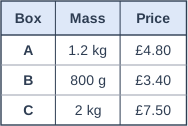
The table shows the mass and price of three boxes of washing powder.
Which box is the best value for money? You must show your working.
Model answer
Cost of 100 g: A: 1.2 kg = 1200 g, so 480p ÷ 12 = 40p B: 340p ÷ 8 = 42.5p C: 2 kg = 2000 g, so 750p ÷ 20 = 37.5p Box C is the best value because 100 g costs the least.
Explanation
Change all the masses into the same unit (grams), then work out the cost of the same amount, such as 100 g, for each box. The box where 100 g costs the least is the best value. Be careful: 800 g is less than 1.2 kg, even though 800 looks bigger than 1.2.
Mark scheme
1 mark
M1 for a correct comparable value for box A, e.g. 480 ÷ 12 = 40p per 100 g or £4 per kg
other comparable values are fine, e.g. grams per penny or cost of the same mass
1 mark
M1 for a correct comparable value for box B, e.g. 340 ÷ 8 = 42.5p per 100 g or £4.25 per kg
1 mark
M1 for a correct comparable value for box C, e.g. 750 ÷ 20 = 37.5p per 100 g or £3.75 per kg
1 mark
A1 for C with correct values for all three boxes
answer only scores 0
Ready to try the rest? Every answer you write is marked against the mark scheme, so you can see exactly where the marks are.
Ctrl + Enter to check
Study HelperHints first, answers after you try
Stuck on this one? Ask for a hint and I’ll point you in the right direction, without giving the answer away. Once you’ve checked your answer, I’ll show you how the marks are awarded.