Practise 36 exam-style questions on Calculating with integers, decimals and fractions for AQA GCSE Maths (Foundation non-calculator). Write your answer as you would in the exam and get it marked in seconds against the mark scheme, point by point, with the Study Helper on hand if you get stuck.
36 questions
1–5 marks each
Instant marking
No sign-up needed
20 questions, marked as you go
Sample questions with model answers
Here are 4 of the questions in this topic, each with a model answer, an explanation of why it earns the marks and the mark scheme an examiner would use.
Question 1
1 mark
Work out 0.045 × 1000
Model answer
Multiplying by 1000 moves each digit 3 places to the left. 0.045 × 1000 = 45
Explanation
When you multiply by 1000, every digit moves three places to the left (the number gets 1000 times bigger). The 4 hundredths become 4 tens and the 5 thousandths become 5 units. Do not just add three zeros to the end - that gives 0.045000, which is the same number.
Mark scheme
1 mark
B1 for 45
accept 45.0
Question 2
2 marks
Work out \(\frac{4}{9} \times \frac{3}{8}\)
Give your answer in its simplest form.
Model answer
\(\frac{4}{9} \times \frac{3}{8} = \frac{12}{72}\) 12 and 72 both divide by 12 \(\frac{12}{72} = \frac{1}{6}\)
Explanation
To multiply fractions, multiply the numerators and multiply the denominators. Then simplify by dividing the top and bottom by their highest common factor. You can also cancel first: 4 and 8 divide by 4, and 3 and 9 divide by 3, giving \(\frac{1}{3} \times \frac{1}{2}\).
Mark scheme
1 mark
M1 for \(\frac{12}{72}\) oe, or for cancelling correctly before multiplying, e.g. \(\frac{1}{3} \times \frac{1}{2}\)
1 mark
A1 for \(\frac{1}{6}\)
correct answer with no working scores full marks
Question 3
3 marks
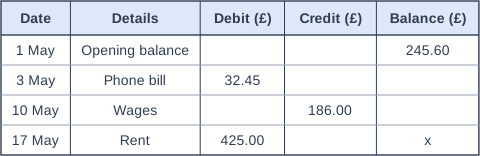
The table shows part of Sam's bank statement for May.
A debit is money going out of the account, so subtract it; a credit is money coming in, so add it. Work down the statement one line at a time. The rent is more than the money in the account, so the balance becomes negative, which means the account is overdrawn.
Mark scheme
1 mark
M1 for one correct step, e.g. 245.60 − 32.45 (= 213.15) or 245.60 + 186 (= 431.60)
1 mark
M1 for 245.60 − 32.45 + 186.00 − 425.00 oe
e.g. 431.60 − 457.45
1 mark
A1 for −25.85
accept −£25.85 or £25.85 overdrawn; do not accept 25.85 with no minus sign or statement that it is overdrawn; correct answer with no working scores full marks
Question 4
4 marks
Kai is paid £11.40 per hour for the first 35 hours he works in a week. For every hour over 35 hours, he is paid at time and a half.
Time and a half means the normal rate plus half of it again: £11.40 + £5.70 = £17.10. Only the hours over 35 are paid at this rate, so there are 6 overtime hours. Add the normal pay and the overtime pay.
Mark scheme
1 mark
M1 for 35 × 11.40 (= 399)
1 mark
M1 for 11.40 × 1.5 or 11.40 + 5.70 (= 17.10)
1 mark
M1 for 6 × their 17.10 (= 102.60)
their 17.10 must be more than 11.40; may be seen as 6 × 11.40 + 6 × 5.70
1 mark
A1 for £501.60
correct answer with no working scores full marks
Ready to try the rest? Every answer you write is marked against the mark scheme, so you can see exactly where the marks are.
Ctrl + Enter to check
Study HelperHints first, answers after you try
Stuck on this one? Ask for a hint and I’ll point you in the right direction, without giving the answer away. Once you’ve checked your answer, I’ll show you how the marks are awarded.