Practise 19 exam-style questions on Units of measure for AQA GCSE Maths (Foundation non-calculator). Write your answer as you would in the exam and get it marked in seconds against the mark scheme, point by point, with the Study Helper on hand if you get stuck.
19 questions
1–5 marks each
Instant marking
No sign-up needed
19 questions, marked as you go
Sample questions with model answers
Here are 4 of the questions in this topic, each with a model answer, an explanation of why it earns the marks and the mark scheme an examiner would use.
Question 1
1 mark
Change 4.7 metres to centimetres.
Model answer
1 m = 100 cm 4.7 × 100 = 470 cm
Explanation
There are 100 centimetres in 1 metre, so multiply by 100. The digits move two places to the left: 4.7 becomes 470. Check it makes sense - a centimetre is much smaller than a metre, so the number of centimetres should be bigger.
Mark scheme
1 mark
B1 for 470 cm
Question 2
2 marks
Ali changes 3.5 kg to grams. Here is his working.
3.5 × 100 = 350 g
Ali's answer is wrong.
What mistake has Ali made?
Work out the correct answer.
Model answer
There are 1000 g in 1 kg, but Ali has multiplied by 100. 3.5 × 1000 = 3500 g
Explanation
Kilo means a thousand, so 1 kilogram is 1000 grams. Ali has used 100, which is the number of centimetres in a metre. Multiply by 1000 to change kilograms to grams.
Mark scheme
1 mark
B1 for he multiplied by 100 instead of 1000 or there are 1000 g in 1 kg (not 100 g)
1 mark
B1 for 3500 g
Question 3
2 marks
Zoe says, "3 m² is the same as 300 cm²."
Is Zoe correct? Give a reason for your answer.
Model answer
1 m² is a square 100 cm by 100 cm, so 1 m² = 100 × 100 = 10 000 cm². 3 m² = 3 × 10 000 = 30 000 cm² Zoe is not correct.
Explanation
Zoe has used 1 m = 100 cm, which is only true for lengths. A square metre is 100 cm long and 100 cm wide, so it contains 100 × 100 = 10 000 square centimetres. Always think of the square when you change area units.
Mark scheme
1 mark
B1 for 1 m² = 10 000 cm² or 100 × 100 seen
1 mark
B1 for No, with 3 m² = 30 000 cm²
accept No, 300 cm² = 0.03 m²
Question 4
4 marks
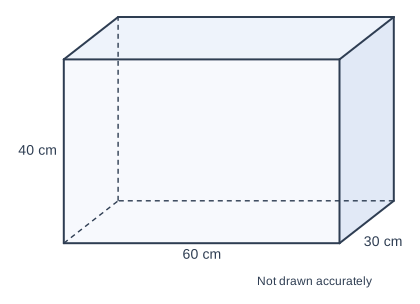
The diagram shows a fish tank in the shape of a cuboid.
Jo fills the tank with water using a 5-litre bucket.
What is the smallest number of times Jo must fill the bucket to fill the tank completely?
Model answer
Volume = 60 × 30 × 40 = 72 000 cm³ 1 litre = 1000 cm³, so the tank holds 72 000 ÷ 1000 = 72 litres. 72 ÷ 5 = 14.4 14 buckets is not enough, so Jo must fill the bucket 15 times.
Explanation
Find the volume in cm³, then change to litres: 1 litre is 1000 cm³. Divide by 5 litres to see how many buckets are needed. 14 buckets would leave the tank not quite full, so round up to 15.
Mark scheme
1 mark
M1 for 60 × 30 × 40
1 mark
A1 for 72 000 (cm³)
1 mark
M1 for their 72 000 ÷ 1000 (= 72 litres) and ÷ 5
or 72 000 ÷ 5000
1 mark
A1 for 15
correct answer with no working scores full marks; 14.4 or 14 scores M1 A1 M1 A0
Ready to try the rest? Every answer you write is marked against the mark scheme, so you can see exactly where the marks are.
Ctrl + Enter to check
Study HelperHints first, answers after you try
Stuck on this one? Ask for a hint and I’ll point you in the right direction, without giving the answer away. Once you’ve checked your answer, I’ll show you how the marks are awarded.