Level:
Correct: 0
Incorrect: 0
Marks: 0/0
Exam Practice
Course:
Topics:
AQA GCSE Maths (Foundation non-calculator) Smart practice A mixed round aimed at your weak spots
Unit 1
Number
Unit 2
Algebra
Unit 3
Ratio, proportion and rates of change
Unit 4
Geometry and measures
Unit 5
Probability
Unit 6
Statistics
Avg
score:
–
Topics
done:
0/86

Special sequences and geometric progressions

Practise 29 exam-style questions on Special sequences and geometric progressions for AQA GCSE Maths (Foundation non-calculator). Write your answer as you would in the exam and get it marked in seconds against the mark scheme, point by point, with the Study Helper on hand if you get stuck.

  • 29 questions
  • 1–5 marks each
  • Instant marking
  • No sign-up needed
20 questions, marked as you go

Sample questions with model answers

Here are 4 of the questions in this topic, each with a model answer, an explanation of why it earns the marks and the mark scheme an examiner would use.

Question 1

1 mark

Here are the first four terms of a Fibonacci-type sequence.

2   3   5   8

Each term after the first two is found by adding the two terms before it.

Write down the next term.

Model answer

The next term is the sum of the two terms before it.
5 + 8 = 13

Explanation

In a Fibonacci-type sequence you add the last two terms to get the next one: 2 + 3 = 5, 3 + 5 = 8, so the next term is 5 + 8 = 13. It is not "add 3" - the gaps 1, 2, 3, 5 change.

Mark scheme
  1. 1 mark

    B1 for 13

Question 2

2 marks

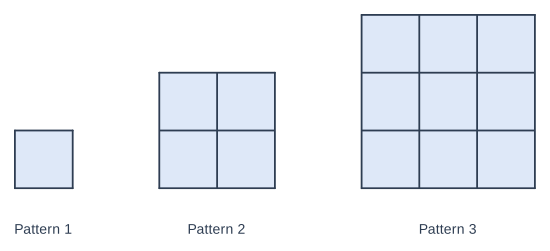
The diagram shows the first three patterns in a sequence made from square tiles.

Ali says,

"Pattern 7 will have 14 tiles."

What mistake has Ali made?
Work out the correct number of tiles in Pattern 7.

Geometry diagram, drawn accurately to scale. A 1 by 1 square of tiles (its vertices are not labelled) (shaded). A 2 by 2 square of tiles (its vertices are not labelled) (shaded). A vertical line with no labelled ends is drawn. A horizontal line with no labelled ends is drawn. A 3 by 3 square of tiles (its vertices are not labelled) (shaded). A vertical line with no labelled ends is drawn. A vertical line with no labelled ends is drawn. A horizontal line with no labelled ends is drawn. A horizontal line with no labelled ends is drawn. The text "Pattern 1" is written. The text "Pattern 2" is written. The text "Pattern 3" is written.

Model answer

The patterns have 1, 4, 9 tiles: these are the square numbers.
Pattern n is an n by n square, so it has \(n^2\) tiles.
Ali worked out 7 × 2 = 14, but he should have worked out 7 × 7.
Pattern 7: \(7 \times 7 = 49\) tiles

Explanation

Each pattern is a square of tiles with the same number of rows as columns, so the numbers of tiles are the square numbers 1, 4, 9, 16, ... Pattern 7 is a 7 by 7 square with 49 tiles. Ali has confused "squared" with "times 2".

Mark scheme
  1. 1 mark

    B1 for saying he has worked out 7 × 2 instead of 7 × 7 (or \(7^2\))

    oe, e.g. "he doubled 7 instead of squaring it"

  2. 1 mark

    B1 for 49

Question 3

3 marks

The \(n\)th term of a sequence is \(2^n\)

Work out the first term of the sequence that is greater than 500.
Which term number is it?

Model answer

\(2^1 = 2\), \(2^2 = 4\), \(2^3 = 8\), \(2^4 = 16\), \(2^5 = 32\), \(2^6 = 64\), \(2^7 = 128\), \(2^8 = 256\), \(2^9 = 512\)
256 is less than 500 and 512 is greater than 500.
The first term greater than 500 is 512, the 9th term.

Explanation

\(2^n\) means 2 multiplied by itself n times, so each term is double the one before: this is a geometric progression. Keep doubling until you pass 500 and count the terms. \(2^n\) is not 2 × n.

Mark scheme
  1. 1 mark

    M1 for at least five correct terms: 2, 4, 8, 16, 32, ...

  2. 1 mark

    A1 for 512

  3. 1 mark

    A1 for 9th term

    accept 9 or \(n = 9\); correct answers with no working score full marks

Question 4

4 marks

Sam has 118 counters.

The numbers of counters in triangle patterns are the triangular numbers 1, 3, 6, 10, ...
The numbers of counters in square patterns are the square numbers 1, 4, 9, 16, ...

Sam makes the biggest triangle pattern he can.
Then he uses some of the counters he has left to make the biggest square pattern he can.

How many counters does Sam have left at the end?

Model answer

Triangular numbers: 1, 3, 6, 10, 15, 21, 28, 36, 45, 55, 66, 78, 91, 105, 120
The biggest triangle he can make uses 105 counters (120 is too many).
Counters left: 118 − 105 = 13
Square numbers: 1, 4, 9, 16
The biggest square he can make uses 9 counters (16 is too many).
Counters left at the end: 13 − 9 = 4

Explanation

Continue the triangular numbers (add 2, 3, 4, ...) until you pass 118: 105 is the biggest that fits. That leaves 13 counters. The biggest square number that is not more than 13 is 9, so 4 counters are left.

Mark scheme
  1. 1 mark

    M1 for listing the triangular numbers as far as 91 or beyond (15, 21, 28, 36, 45, 55, 66, 78, 91, ...)

    allow one error

  2. 1 mark

    A1 for 105 (and 13 counters left)

  3. 1 mark

    M1 for the biggest square number not more than their 13 (= 9)

    ft their number of counters left

  4. 1 mark

    A1 for 4

    correct answer with no working scores full marks

Ready to try the rest? Every answer you write is marked against the mark scheme, so you can see exactly where the marks are.

Study Helper Hints first, answers after you try

Stuck on this one? Ask for a hint and I’ll point you in the right direction, without giving the answer away. Once you’ve checked your answer, I’ll show you how the marks are awarded.