
Level:
Correct: 0
Incorrect: 0
Marks: 0/0
Exam Practice
Course:
Topics:
AQA GCSE Maths (Foundation non-calculator) Smart practice A mixed round aimed at your weak spots
Unit 1
Number
Unit 2
Algebra
Unit 3
Ratio, proportion and rates of change
Unit 4
Geometry and measures
Unit 5
Probability
Unit 6
Statistics
Avg
score:
–
Topics
done:
0/86

Constructions and loci

Practise 19 exam-style questions on Constructions and loci for AQA GCSE Maths (Foundation non-calculator). Write your answer as you would in the exam and get it marked in seconds against the mark scheme, point by point, with the Study Helper on hand if you get stuck.

  • 19 questions
  • 1–5 marks each
  • Instant marking
  • No sign-up needed
19 questions, marked as you go

Sample questions with model answers

Here are 4 of the questions in this topic, each with a model answer, an explanation of why it earns the marks and the mark scheme an examiner would use.

Question 1

1 mark

The diagram shows lines BA and BC and some construction arcs.

An arc with centre B crosses BA at P and BC at Q.
Arcs with centres P and Q, with the same radius, cross at R.
A straight line is then drawn from B through R.

What has been constructed?
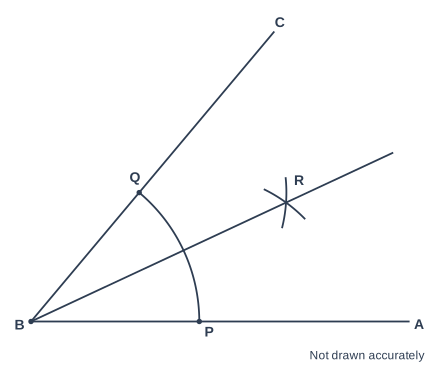
Geometry diagram, marked "Not drawn accurately". Line segments BA and BC are drawn. A minor arc from P to Q with centre B. A minor arc from an unlabelled point to an unlabelled point with centre P. A minor arc from an unlabelled point to an unlabelled point with centre Q. A line is drawn from B part of the way towards R. P lies on BA. Q lies on BC. R lies on BR.

Model answer

The bisector of angle ABC (the line BR cuts angle ABC into two equal angles).

Explanation

This is the standard construction of an angle bisector: P and Q are the same distance from B, and R is the same distance from P and from Q. So the line BR splits angle ABC exactly in half. Do not confuse it with the perpendicular bisector, which cuts a line segment in half at right angles.

Mark scheme
  1. 1 mark

    B1 for the bisector of angle ABC

    accept angle bisector, or a line that cuts angle ABC in half; do not accept perpendicular bisector
Question 2

2 marks

Explain how an angle of 30° can be made using only a ruler and compasses.

Model answer

First make a 60° angle: put the compass point on A on a line and make an arc crossing the line at B. Keep the same width, put the compass point on B and make an arc crossing the first arc at C. Angle CAB = 60° (ABC is equilateral).
Then bisect angle CAB: with the compass point on B, then on C (same width), make two arcs that cross at D. The line AD cuts the 60° angle in half, giving 30°.

Explanation

You cannot measure angles with a ruler and compasses, so build the angle from constructions you know. An equilateral triangle gives 60°, and bisecting an angle halves it, so 60° ÷ 2 = 30°.

Mark scheme
  1. 1 mark

    B1 for making an angle of 60° first, e.g. with arcs of the same radius from each end of a line to form an equilateral triangle

  2. 1 mark

    B1 for then bisecting the 60° angle

    accept a description of the angle bisector construction; do not accept 'measure 30° with a protractor'

Question 3

2 marks

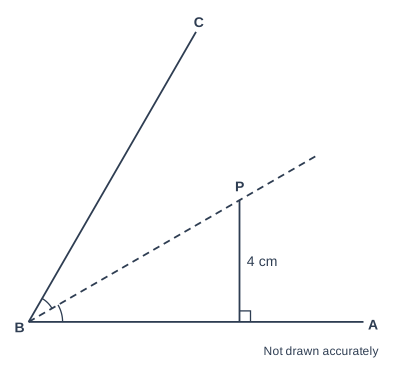
In the diagram, the dashed line from B bisects angle ABC.
P is a point on the dashed line.
P is 4 cm from the line BA, as shown.

How far is P from the line BC?
Give a reason for your answer.

Geometry diagram, marked "Not drawn accurately". Line segments BA and BC are drawn. A dashed line is drawn from B part of the way towards P. A line is drawn from P going downwards. P lies on BP. The angle at an unlabelled point between the lines to P and A is marked as a right angle (90°). The line going downwards from P is labelled 4 cm. The angle at B between BA and BP and the angle at B between BP and BC are each marked with a single arc (equal angles).

Model answer

4 cm
P is on the bisector of angle ABC, and every point on an angle bisector is the same distance from the two lines that make the angle.

Explanation

The bisector of an angle is the locus of points that are equidistant from the two lines (arms) of the angle. So the perpendicular distance from P to BC is the same as the perpendicular distance from P to BA.

Mark scheme
  1. 1 mark

    B1 for 4 cm

  2. 1 mark

    B1 for a correct reason, e.g. every point on the bisector of an angle is the same distance from both arms of the angle (BA and BC)

    do not accept 'it is in the middle' on its own

Question 4

4 marks

A square lawn has sides of length 8 m.
A sprinkler is placed at the centre of the lawn.
It waters all the points that are within 4 m of the sprinkler.

The parts of the lawn that are not watered are covered with gravel.
Gravel costs £5 per square metre.

Work out the cost of the gravel.
Use π = 3

Model answer

The watered region is a circle of radius 4 m, which just fits inside the square.
Area watered = π × 4² = 3 × 16 = 48 m²
Area of lawn = 8 × 8 = 64 m²
Area not watered = 64 − 48 = 16 m²
Cost = 16 × £5 = £80

Explanation

The locus of points within 4 m of the sprinkler is a circle of radius 4 m, and it touches the middle of each side of the square. The four corners are not watered: subtract the circle's area from the square's area. Use π = 3 as the question says, and square the radius before multiplying.

Mark scheme
  1. 1 mark

    M1 for 3 × 4² (= 48)

    area watered

  2. 1 mark

    M1 for 8 × 8 − their 48

  3. 1 mark

    A1 for 16 (m²)

  4. 1 mark

    B1ft for £80

    ft their 16 × 5; correct answer with no working scores full marks

Ready to try the rest? Every answer you write is marked against the mark scheme, so you can see exactly where the marks are.

Study Helper Hints first, answers after you try

Stuck on this one? Ask for a hint and I’ll point you in the right direction, without giving the answer away. Once you’ve checked your answer, I’ll show you how the marks are awarded.