Practise 28 exam-style questions on Direct and inverse proportion problems for AQA GCSE Maths (Foundation non-calculator). Write your answer as you would in the exam and get it marked in seconds against the mark scheme, point by point, with the Study Helper on hand if you get stuck.
28 questions
1–5 marks each
Instant marking
No sign-up needed
20 questions, marked as you go
Sample questions with model answers
Here are 4 of the questions in this topic, each with a model answer, an explanation of why it earns the marks and the mark scheme an examiner would use.
Question 1
1 mark
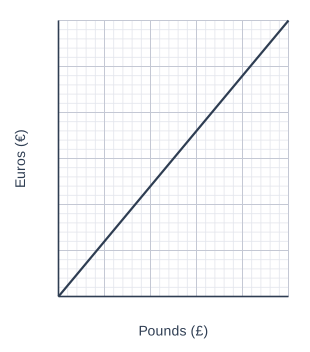
The graph can be used to change between pounds (£) and euros (€).
Use the graph to change £40 into euros.
Model answer
Go up from £40 on the horizontal axis to the line, then across to the vertical axis. £40 = €48
Explanation
Find £40 on the pounds axis, go straight up to the line, then straight across to the euros axis and read the value. Each small square on the euros axis is 2 euros, so count the small squares carefully above €40.
Mark scheme
1 mark
B1 for €48
accept [47, 49]
Question 2
2 marks
A journey takes 2 hours at an average speed of 60 mph.
How long would the same journey take at an average speed of 40 mph?
Model answer
Distance = 60 × 2 = 120 miles Time at 40 mph = 120 ÷ 40 = 3 hours
Explanation
For the same journey, a slower speed means a longer time: speed and time are inversely proportional. Find the distance first (speed × time), then divide by the new speed. Check: the speed is \(\frac{2}{3}\) of what it was, so the time is \(\frac{3}{2}\) times as long.
Mark scheme
1 mark
M1 for 2 × 60 (= 120) or 60 ÷ 40 × 2 oe
1 mark
A1 for 3 hours
correct answer with no working scores full marks
Question 3
3 marks
Printer A prints 240 pages in 8 minutes. Printer B prints 150 pages in 6 minutes. The printers start at the same time and keep printing at the same rates.
How many pages do the two printers print altogether in 20 minutes?
The number of pages is directly proportional to the time, so find each printer's rate in pages per minute. Multiply each rate by 20 minutes and add the two answers. You could also add the rates first: 30 + 25 = 55 pages per minute, and 55 × 20 = 1100.
Mark scheme
1 mark
M1 for 240 ÷ 8 (= 30) or 240 × 2.5 (= 600)
1 mark
M1 for 150 ÷ 6 (= 25) or 25 × 20 (= 500)
1 mark
A1 for 1100
correct answer with no working scores full marks
Question 4
4 marks
It takes 3 people 8 hours to pack 1200 boxes.
How long would it take 4 people to pack 2000 boxes? Assume everyone packs at the same rate.
Model answer
3 people pack 1200 boxes in 8 hours. 3 people pack 1200 ÷ 8 = 150 boxes in 1 hour. 1 person packs 150 ÷ 3 = 50 boxes in 1 hour. 4 people pack 4 × 50 = 200 boxes in 1 hour. 2000 ÷ 200 = 10 hours
Explanation
Find the rate for 1 person in 1 hour (50 boxes). Then work out how many boxes 4 people pack in an hour and divide 2000 by that. More boxes means more time (direct proportion) but more people means less time (inverse proportion), so working with '1 person, 1 hour' avoids confusion.
Mark scheme
1 mark
M1 for a correct first step, e.g. 3 × 8 (= 24) or 1200 ÷ 8 (= 150) or 1200 ÷ 3 (= 400)
1 mark
M1 for 1 person packs 50 boxes in 1 hour, e.g. 1200 ÷ 24 or 150 ÷ 3 or 400 ÷ 8
1 mark
M1 for 2000 ÷ (4 × their 50) oe
e.g. 4 people pack 200 boxes an hour, 2000 ÷ 200
1 mark
A1 for 10 (hours)
correct answer with no working scores full marks
Ready to try the rest? Every answer you write is marked against the mark scheme, so you can see exactly where the marks are.
Ctrl + Enter to check
Study HelperHints first, answers after you try
Stuck on this one? Ask for a hint and I’ll point you in the right direction, without giving the answer away. Once you’ve checked your answer, I’ll show you how the marks are awarded.