Practise 28 exam-style questions on Scale factors, scale drawings and maps for AQA GCSE Maths (Foundation non-calculator). Write your answer as you would in the exam and get it marked in seconds against the mark scheme, point by point, with the Study Helper on hand if you get stuck.
28 questions
1–5 marks each
Instant marking
No sign-up needed
20 questions, marked as you go
Sample questions with model answers
Here are 4 of the questions in this topic, each with a model answer, an explanation of why it earns the marks and the mark scheme an examiner would use.
Question 1
1 mark
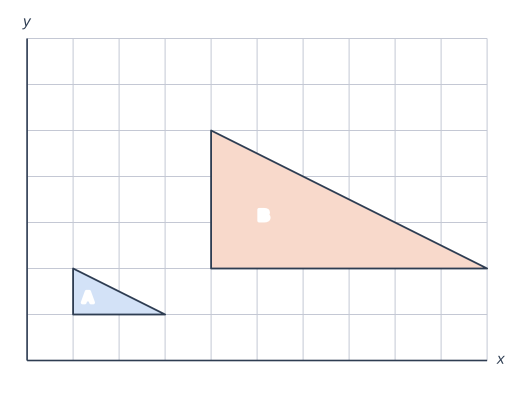
The grid shows shape A and shape B. Shape B is an enlargement of shape A.
Write down the scale factor of the enlargement.
Model answer
The bottom side of A is 2 squares long. The bottom side of B is 6 squares long. 6 ÷ 2 = 3 Scale factor 3
Explanation
Pick a side of shape A and the matching side of shape B and count the squares. Every length in B is 3 times the length in A (the vertical side goes from 1 square to 3 squares), so the scale factor is 3.
Mark scheme
1 mark
B1 for 3
Question 2
2 marks
A map has a scale of 1 : 25 000.
Two villages are 8 cm apart on the map.
Work out the real distance between the villages. Give your answer in kilometres.
Model answer
8 × 25 000 = 200 000 cm 200 000 cm = 2000 m = 2 km
Explanation
Multiply the map distance by 25 000 to get the real distance in centimetres. Then change units: divide by 100 for metres and by 1000 for kilometres, so 200 000 cm = 2 km.
Mark scheme
1 mark
M1 for 8 × 25 000 (= 200 000 cm)
or 1 cm represents 250 m, or 1 cm represents 0.25 km
1 mark
A1 for 2 (km)
correct answer with no working scores full marks
Question 3
3 marks
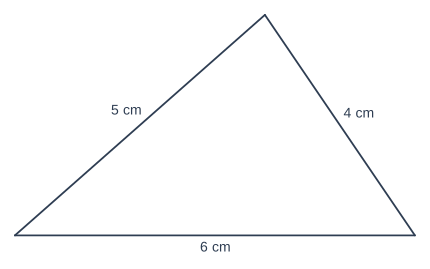
The diagram shows a scale drawing of a triangular field. The scale of the drawing is 1 : 2000.
Work out the real perimeter of the field. Give your answer in metres.
Model answer
Perimeter on the drawing = 4 + 5 + 6 = 15 cm Real perimeter = 15 × 2000 = 30 000 cm 30 000 cm = 300 m
Explanation
Add the three sides on the drawing to get the perimeter, then use the scale: every 1 cm on the drawing is 2000 cm, which is 20 m, in real life. So 15 cm on the drawing is 15 × 20 = 300 m.
Mark scheme
1 mark
M1 for 4 + 5 + 6 (= 15 cm), or one side × 2000
1 mark
M1 for their 15 × 2000 (= 30 000 cm), or 1 cm represents 20 m
1 mark
A1 for 300 (m)
correct answer with no working scores full marks
Question 4
4 marks
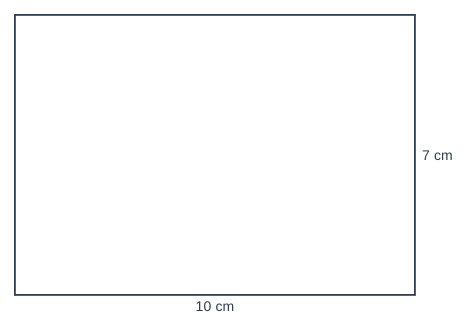
The diagram shows a plan of a rectangular room. The plan uses a scale of 1 : 50.
Carpet costs £12 per square metre.
Work out the cost of carpet to cover the whole floor of the room.
Model answer
Real length = 10 × 50 = 500 cm = 5 m Real width = 7 × 50 = 350 cm = 3.5 m Area = 5 × 3.5 = 17.5 m² Cost = 17.5 × 12 = 175 + 35 = £210
Explanation
Use the scale to find the real length and width, and change them into metres because the carpet is priced per square metre. Then find the area and multiply by £12. Working out 10 × 7 × 50 scales only one length and gives the wrong area.
Mark scheme
1 mark
M1 for 10 × 50 (= 500 cm), or 7 × 50 (= 350 cm)
1 mark
A1 for 5 m and 3.5 m
1 mark
M1 for their 5 × their 3.5 × 12, or their area 17.5 × 12
their lengths must be in metres
1 mark
A1 for £210
correct answer with no working scores full marks
Ready to try the rest? Every answer you write is marked against the mark scheme, so you can see exactly where the marks are.
Ctrl + Enter to check
Study HelperHints first, answers after you try
Stuck on this one? Ask for a hint and I’ll point you in the right direction, without giving the answer away. Once you’ve checked your answer, I’ll show you how the marks are awarded.