Level:
Correct: 0
Incorrect: 0
Marks: 0/0
Exam Practice
Course:
Topics:
AQA GCSE Maths (Foundation non-calculator) Smart practice A mixed round aimed at your weak spots
Unit 1
Number
Unit 2
Algebra
Unit 3
Ratio, proportion and rates of change
Unit 4
Geometry and measures
Unit 5
Probability
Unit 6
Statistics
Avg
score:
–
Topics
done:
0/86

Charts, tables and diagrams

Practise 37 exam-style questions on Charts, tables and diagrams for AQA GCSE Maths (Foundation non-calculator). Write your answer as you would in the exam and get it marked in seconds against the mark scheme, point by point, with the Study Helper on hand if you get stuck.

  • 37 questions
  • 1–5 marks each
  • Instant marking
  • No sign-up needed
20 questions, marked as you go

Sample questions with model answers

Here are 4 of the questions in this topic, each with a model answer, an explanation of why it earns the marks and the mark scheme an examiner would use.

Question 1

1 mark

Sam is drawing a pie chart to show the favourite drinks of 90 people.

How many degrees should he use to represent each person?

Choose your answer.

  • 90°
  • 4°
  • 0.25°
  • 270°

Model answer

A full circle is 360°.
360 ÷ 90 = 4
Each person is represented by 4°.

Explanation

The whole pie chart is 360° and it is shared equally between the 90 people, so divide 360 by 90. Dividing the other way (90 ÷ 360) gives 0.25, which is the wrong way round.

Mark scheme
  1. 1 mark

    B1 for 4°

Question 2

2 marks

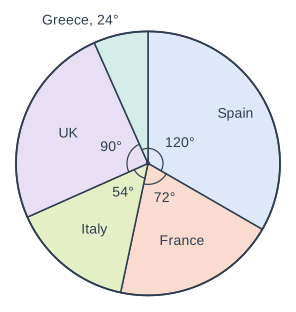
60 people were asked where they went on holiday last year.
The pie chart shows the results.

How many people went to France?

Pie chart. A circle divided into sectors, drawn clockwise from the top (12 o'clock): Spain, 120° (printed); France, 72° (printed); Italy, 54° (printed); UK, 90° (printed); Greece, 24° (printed). Each printed angle is marked with a small arc at the centre.

Model answer

Each person is represented by 360 ÷ 60 = 6°.
France: 72 ÷ 6 = 12 people

Explanation

Find how many degrees stand for one person by dividing 360° by the number of people. Then divide the angle of the sector by this. You can check by working out the other sectors: they should add up to 60 people.

Mark scheme
  1. 1 mark

    M1 for \(\frac{72}{360} \times 60\) oe, or 360 ÷ 60 (= 6) and 72 ÷ 6

  2. 1 mark

    A1 for 12

    correct answer with no working scores full marks

Question 3

3 marks

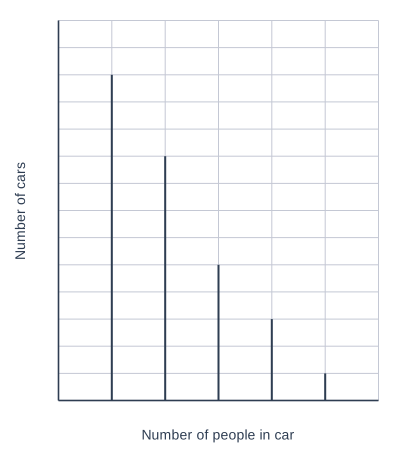
Tom counted the number of people in each of 30 cars that passed his school.
The vertical line chart shows his results.

Work out the total number of people in the 30 cars.

A graph of Number of cars (vertical axis, 0 to 14, marked every 1) against Number of people in car (horizontal axis, 0 to 6, marked every 1), on a grid. A straight line segment joins (1, 0) to (1, 12). A straight line segment joins (2, 0) to (2, 9). A straight line segment joins (3, 0) to (3, 5). A straight line segment joins (4, 0) to (4, 3). A straight line segment joins (5, 0) to (5, 1).

Model answer

1 person: 12 cars → 12 people
2 people: 9 cars → 18 people
3 people: 5 cars → 15 people
4 people: 3 cars → 12 people
5 people: 1 car → 5 people
Total: 12 + 18 + 15 + 12 + 5 = 62 people

Explanation

The height of each line is the number of cars, not the number of people. Each car with 2 people in it gives 2 people, so multiply the number of people by the number of cars for each line, then add. Just adding the heights gives 30, which is the number of cars.

Mark scheme
  1. 1 mark

    M1 for at least three correct products from 1 × 12, 2 × 9, 3 × 5, 4 × 3, 5 × 1

    or 12, 18, 15, 12, 5 seen

  2. 1 mark

    M1dep for adding all five of their products

  3. 1 mark

    A1 for 62

    correct answer with no working scores full marks

Question 4

4 marks

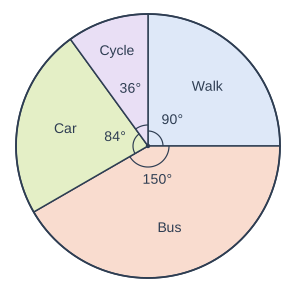
The pie chart shows how the 120 students at Hill School travel to school.

At Park School, 45 out of 200 students walk to school.

Kim says,
"A greater proportion of students walk to school at Hill School than at Park School."

Is Kim correct?
You must show your working.

Pie chart. A circle divided into sectors, drawn clockwise from the top (12 o'clock): Walk, 90° (printed); Bus, 150° (printed); Car, 84° (printed); Cycle, 36° (printed). Each printed angle is marked with a small arc at the centre.

Model answer

Hill School: the walk sector is 90°, and \(\frac{90}{360} = \frac{1}{4}\) = 25%
Park School: \(\frac{45}{200} = \frac{22.5}{100}\) = 22.5%
25% is greater than 22.5%, so Kim is correct.

Explanation

A proportion is a fraction of the whole group, so you cannot just compare 30 students with 45 students when the schools are different sizes. Write each proportion in the same form, such as a percentage, and then compare. For Hill School the angle gives the fraction straight away: 90° is a quarter of 360°.

Mark scheme
  1. 1 mark

    M1 for the proportion who walk at Hill School, e.g. \(\frac{90}{360}\) or \(\frac{1}{4}\) or 25% or \(\frac{30}{120}\)

  2. 1 mark

    M1 for the proportion who walk at Park School, e.g. \(\frac{45}{200}\)

  3. 1 mark

    M1 for writing both proportions in a form that can be compared, e.g. 25% and 22.5%, or 0.25 and 0.225, or \(\frac{1}{4}\) of 200 = 50

    or \(\frac{45}{200} \times 360\) = 81° compared with 90°

  4. 1 mark

    A1 for Yes with correct values, e.g. 25% and 22.5%, or 50 and 45, or 90° and 81°

    must have correct values for both schools; answer only scores 0

Ready to try the rest? Every answer you write is marked against the mark scheme, so you can see exactly where the marks are.

Study Helper Hints first, answers after you try

Stuck on this one? Ask for a hint and I’ll point you in the right direction, without giving the answer away. Once you’ve checked your answer, I’ll show you how the marks are awarded.