
Level:
Correct: 0
Incorrect: 0
Marks: 0/0
Exam Practice
Course:
Topics:
AQA GCSE Maths (Foundation non-calculator) Smart practice A mixed round aimed at your weak spots
Unit 1
Number
Unit 2
Algebra
Unit 3
Ratio, proportion and rates of change
Unit 4
Geometry and measures
Unit 5
Probability
Unit 6
Statistics
Avg
score:
–
Topics
done:
0/86

Systematic listing

Practise 28 exam-style questions on Systematic listing for AQA GCSE Maths (Foundation non-calculator). Write your answer as you would in the exam and get it marked in seconds against the mark scheme, point by point, with the Study Helper on hand if you get stuck.

  • 28 questions
  • 1–5 marks each
  • Instant marking
  • No sign-up needed
20 questions, marked as you go

Sample questions with model answers

Here are 4 of the questions in this topic, each with a model answer, an explanation of why it earns the marks and the mark scheme an examiner would use.

Question 1

1 mark

Two spinners are spun and their scores are added together.
Spinner A is numbered 1 to 4. Spinner B is numbered 1 to 5.

The table shows all the possible totals.
The first column shows the score on spinner A and the top row shows the score on spinner B.

How many of the possible outcomes give a total of 6?
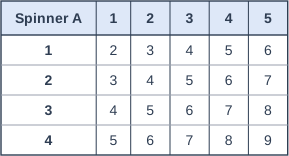
Table with columns "Spinner A", "1", "2", "3", "4", "5". Spinner A: 1; 1: 2; 2: 3; 3: 4; 4: 5; 5: 6 | Spinner A: 2; 1: 3; 2: 4; 3: 5; 4: 6; 5: 7 | Spinner A: 3; 1: 4; 2: 5; 3: 6; 4: 7; 5: 8 | Spinner A: 4; 1: 5; 2: 6; 3: 7; 4: 8; 5: 9.

Model answer

Totals of 6 in the table: 1 + 5, 2 + 4, 3 + 3, 4 + 2
There are 4 outcomes.

Explanation

A table like this lists every outcome once, so count the cells that contain 6. They run diagonally across the table: 1 + 5, 2 + 4, 3 + 3 and 4 + 2.

Mark scheme
  1. 1 mark

    B1 for 4

Question 2

2 marks

A rectangle has an area of 24 cm².
Its length and its width are both whole numbers of centimetres.

List all the possible pairs of length and width.

Model answer

Try widths of 1, 2, 3, 4, ... in order:
1 × 24 = 24
2 × 12 = 24
3 × 8 = 24
4 × 6 = 24
5 does not divide into 24, and 6 × 4 is the same as 4 × 6, so stop.
The pairs are 1 and 24, 2 and 12, 3 and 8, 4 and 6 (all in cm).

Explanation

The area of a rectangle is length × width, so you need pairs of whole numbers that multiply to 24. Go through 1, 2, 3, ... in order and check which ones divide into 24. Once the pairs start repeating the other way round you have found them all.

Mark scheme
  1. 2 marks

    B2 for 1 cm and 24 cm, 2 cm and 12 cm, 3 cm and 8 cm, 4 cm and 6 cm, and no incorrect pairs

    B1 for three correct pairs and no incorrect pairs, or all four correct with one incorrect pair; ignore a pair repeated the other way round, e.g. 6 and 4

Question 3

3 marks

Here are three number cards.

2   5   7

All three cards are used to make a three-digit number.

How many of the numbers that can be made are odd numbers greater than 500?

Model answer

All the numbers: 257, 275, 527, 572, 725, 752
Greater than 500: 527, 572, 725, 752
Odd (last digit 5 or 7): 527, 725
Answer: 2

Explanation

First list all six numbers systematically by choosing each card as the first digit. A number greater than 500 must start with 5 or 7, and an odd number must end in an odd digit. Only 527 and 725 do both - 572 and 752 end in 2, so they are even.

Mark scheme
  1. 1 mark

    M1 for a systematic list of the three-digit numbers with at least four correct: 257, 275, 527, 572, 725, 752

  2. 1 mark

    M1dep for picking out 527 and 725 (and no other numbers) as the odd numbers greater than 500

    ft their list

  3. 1 mark

    A1 for 2

    correct answer with no working scores full marks

Question 4

4 marks

Ravi has four coins: £1, 50p, 20p and 10p.
He uses one or more of the coins to make an amount of money.

Work out how many different amounts he can make.

Model answer

One coin: 10p, 20p, 50p, £1 (4 amounts)
Two coins: 30p, 60p, 70p, £1.10, £1.20, £1.50 (6 amounts)
Three coins: 80p, £1.30, £1.60, £1.70 (4 amounts)
Four coins: £1.80 (1 amount)
No amount appears twice.
4 + 6 + 4 + 1 = 15 different amounts

Explanation

Organise the list by how many coins are used: one coin, two coins, three coins, then all four. Within each group work in order so nothing is missed, e.g. 10p with each larger coin, then 20p with each larger coin. Finally check that no amount appears twice before you count.

Mark scheme
  1. 1 mark

    M1 for the four single coins and at least three correct amounts using two coins

    two coins: 30p, 60p, 70p, £1.10, £1.20, £1.50

  2. 1 mark

    M1 for all six amounts using two coins

  3. 1 mark

    M1 for at least three of the four amounts using three coins (80p, £1.30, £1.60, £1.70), or £1.80 for all four coins

  4. 1 mark

    A1 for 15

    correct answer with no working scores full marks; 10 (single coins and pairs only) scores M1 M1

Ready to try the rest? Every answer you write is marked against the mark scheme, so you can see exactly where the marks are.

Study Helper Hints first, answers after you try

Stuck on this one? Ask for a hint and I’ll point you in the right direction, without giving the answer away. Once you’ve checked your answer, I’ll show you how the marks are awarded.