Practise 28 exam-style questions on Forming and solving equations for AQA GCSE Maths (Foundation non-calculator). Write your answer as you would in the exam and get it marked in seconds against the mark scheme, point by point, with the Study Helper on hand if you get stuck.
28 questions
1–5 marks each
Instant marking
No sign-up needed
20 questions, marked as you go
Sample questions with model answers
Here are 4 of the questions in this topic, each with a model answer, an explanation of why it earns the marks and the mark scheme an examiner would use.
Question 1
1 mark
Here is a function machine.
The input is n.
Write an expression, in terms of n, for the output.
Model answer
n multiplied by 3 is \(3n\) Then add 4: \(3n + 4\)
Explanation
Follow the machine in order: first multiply n by 3 to get 3n, then add 4. Writing 3(n + 4) would mean adding 4 first, which is the wrong order.
Mark scheme
1 mark
B1 for \(3n + 4\)
accept \(n \times 3 + 4\); do not accept \(3(n + 4)\) or \(3n4\)
Question 2
2 marks
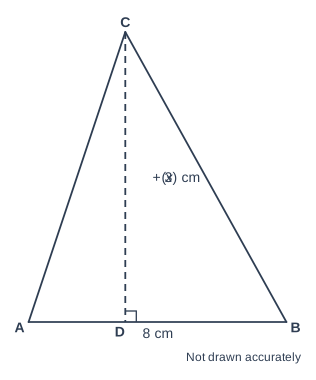
The diagram shows a triangle.
The base is 8 cm and the perpendicular height is \((x + 3)\) cm. The area of the triangle is 36 cm².
Use area of a triangle = ½ × base × height to write an equation. Half of 8 is 4, so 4(x + 3) = 36. Divide by 4 and subtract 3. Remember the question asks for x, not the height.
correct answer with no working scores full marks; 9 (the height) scores M1 A0
Question 3
3 marks
The sum of three consecutive whole numbers is 87.
Form and solve an equation to work out the three numbers.
Model answer
Let the smallest number be n. The numbers are \(n\), \(n + 1\) and \(n + 2\). \(n + n + 1 + n + 2 = 87\) \(3n + 3 = 87\) \(3n = 84\) \(n = 28\) The numbers are 28, 29 and 30.
Explanation
Consecutive whole numbers follow on one after another, so each is 1 more than the one before: n, n + 1, n + 2. Add them, set the total equal to 87 and solve. Give all three numbers. Check: 28 + 29 + 30 = 87.
Mark scheme
1 mark
M1 for \(n + (n + 1) + (n + 2) = 87\) oe
or \((n - 1) + n + (n + 1) = 87\)
1 mark
M1 for \(3n + 3 = 87\) or \(3n = 84\)
or \(3n = 87\) from the second form
1 mark
A1 for 28, 29, 30
SC1 for 28, 29, 30 with no equation
Question 4
4 marks
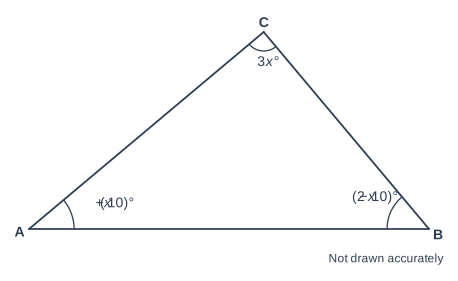
The diagram shows a triangle.
Show that the triangle is a right-angled triangle.
Model answer
Angles in a triangle add up to 180°. \((x + 10) + (2x - 10) + 3x = 180\) \(6x = 180\) \(x = 30\) The angles are \(30 + 10 = 40°\), \(2 \times 30 - 10 = 50°\) and \(3 \times 30 = 90°\). One angle is 90°, so the triangle is right-angled.
Explanation
Form an equation using the angle sum of a triangle. The + 10 and − 10 cancel, leaving 6x = 180. Then substitute x = 30 to find the angles; a right-angled triangle must have an angle of exactly 90°. In a 'show that' question you must write each step and a conclusion.
Mark scheme
1 mark
M1 for \(x + 10 + 2x - 10 + 3x = 180\) oe
1 mark
A1 for \(6x = 180\) and \(x = 30\)
1 mark
M1dep for substituting their x into 3x (or into all three expressions)
1 mark
A1 for 3x = 90° with a conclusion that the triangle is right-angled
accept the angles 40°, 50° and 90° with a conclusion; answer only scores 0
Ready to try the rest? Every answer you write is marked against the mark scheme, so you can see exactly where the marks are.
Ctrl + Enter to check
Study HelperHints first, answers after you try
Stuck on this one? Ask for a hint and I’ll point you in the right direction, without giving the answer away. Once you’ve checked your answer, I’ll show you how the marks are awarded.