Practise 18 exam-style questions on Geometric notation, polygons and symmetry for AQA GCSE Maths (Foundation non-calculator). Write your answer as you would in the exam and get it marked in seconds against the mark scheme, point by point, with the Study Helper on hand if you get stuck.
18 questions
1–5 marks each
Instant marking
No sign-up needed
18 questions, marked as you go
Sample questions with model answers
Here are 4 of the questions in this topic, each with a model answer, an explanation of why it earns the marks and the mark scheme an examiner would use.
Question 1
1 mark
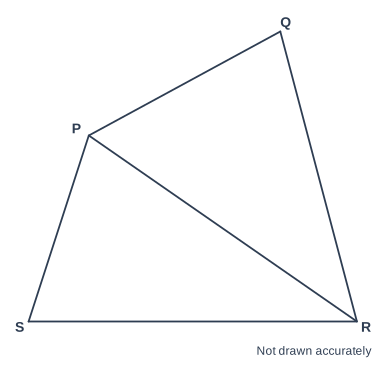
The diagram shows a quadrilateral PQRS with the diagonal PR drawn.
Angle PRQ = 40° Angle PRS = 35°
Work out the size of angle QRS.
Model answer
Angle PRQ and angle PRS are both at R, either side of the diagonal PR. Together they make angle QRS. Angle QRS = 40 + 35 = 75°
Explanation
In a three-letter angle name, the middle letter is the vertex where the angle is. All three angles here are at R: angle PRQ is between RP and RQ, angle PRS is between RP and RS, and angle QRS is between RQ and RS, so it is made of the other two. A common mistake is to read angle PRQ as an angle at P or Q.
Mark scheme
1 mark
B1 for 75°
Question 2
2 marks
Triangle ABC has sides a = 5 cm, b = 7 cm and c = 9 cm (side a is opposite angle A, side b is opposite angle B and side c is opposite angle C).
Which angle of the triangle is the largest? Give a reason for your answer.
Model answer
Angle C (angle ACB) The largest angle is opposite the longest side, and the longest side is c = 9 cm, which is opposite angle C.
Explanation
In any triangle the largest angle is opposite the longest side, and the smallest angle is opposite the shortest side. Side c is opposite angle C, so angle C is the largest. Angle C is the angle at vertex C, between sides a and b.
Mark scheme
1 mark
B1 for angle C
accept angle ACB or angle BCA
1 mark
B1 for a correct reason, e.g. it is opposite the longest side, c = 9 cm
do not accept 'c is the biggest number' without reference to the side being opposite the angle
Question 3
3 marks
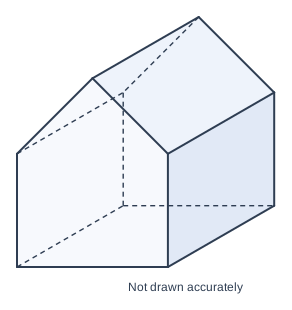
The diagram shows a prism. The cross-section of the prism is a pentagon.
Write down the number of faces of the prism. Write down the number of edges of the prism. Write down the number of vertices of the prism.
Model answer
Faces: 2 pentagons (front and back) + 5 rectangles = 7 Edges: 5 on the front + 5 on the back + 5 joining them = 15 Vertices: 5 on the front + 5 on the back = 10
Explanation
A prism has the same cross-section all the way through. It has two end faces, plus one rectangular face for each side of the cross-section. Remember to count the hidden (dashed) edges and the vertices at the back too.
Mark scheme
1 mark
B1 for 7 (faces)
1 mark
B1 for 15 (edges)
1 mark
B1 for 10 (vertices)
Question 4
4 marks
PQRS is a parallelogram. Angle PQR is 40° bigger than angle QRS.
T is a point on the side RS so that QT = QR.
Work out the size of angle TQR.
Model answer
PQ is parallel to SR, so angles PQR and QRS are co-interior angles and add up to 180°. Let angle QRS = x. Then x + x + 40 = 180, so 2x = 140 and x = 70° Triangle QRT is isosceles with QT = QR, so angle QTR = angle QRT = 70° Angle TQR = 180 − 70 − 70 = 40°
Explanation
Two angles next to each other in a parallelogram add up to 180°, because they are co-interior angles between parallel sides. Then QT = QR makes triangle QRT isosceles, with equal angles at R and T. A clear sketch of the parallelogram with T on RS makes the angles easier to see.
Mark scheme
1 mark
M1 for x + x + 40 = 180 or (180 − 40) ÷ 2
1 mark
A1 for angle QRS = 70°
accept angle PQR = 110° and angle QRS = 70°
1 mark
M1 for 180 − 2 × their 70
their 70 must be angle QRS (= angle QTR)
1 mark
A1 for 40°
correct answer with no working scores full marks
Ready to try the rest? Every answer you write is marked against the mark scheme, so you can see exactly where the marks are.
Ctrl + Enter to check
Study HelperHints first, answers after you try
Stuck on this one? Ask for a hint and I’ll point you in the right direction, without giving the answer away. Once you’ve checked your answer, I’ll show you how the marks are awarded.