Practise 37 exam-style questions on Estimation and approximation for AQA GCSE Maths (Foundation non-calculator). Write your answer as you would in the exam and get it marked in seconds against the mark scheme, point by point, with the Study Helper on hand if you get stuck.
37 questions
1–5 marks each
Instant marking
No sign-up needed
20 questions, marked as you go
Sample questions with model answers
Here are 4 of the questions in this topic, each with a model answer, an explanation of why it earns the marks and the mark scheme an examiner would use.
Question 1
1 mark
Write down an estimate for \(9.86^2\).
Model answer
\(9.86 \approx 10\) \(10^2 = 100\)
Explanation
Round 9.86 to 1 significant figure, which is 10, then square it: 10 × 10 = 100. Squaring means multiplying a number by itself, not multiplying by 2.
Mark scheme
1 mark
B1 for 100
accept 98 from \(9.9^2\); do not accept 20 (9.86 × 2)
Question 2
2 marks
Raj uses a calculator to work out \(\dfrac{4.92 \times 61.3}{0.198}\) He gets the answer 152.3
Use approximations to show that Raj's answer is wrong.
Model answer
4.92 ≈ 5, 61.3 ≈ 60, 0.198 ≈ 0.2 \(\dfrac{5 \times 60}{0.2} = \dfrac{300}{0.2} = 1500\) The answer should be about 1500, so 152.3 is wrong (about 10 times too small).
Explanation
Round every number to 1 significant figure and work out the easier calculation. 300 ÷ 0.2 = 3000 ÷ 2 = 1500. Raj's answer is about a tenth of this, so he probably typed one of the numbers in wrongly.
Mark scheme
1 mark
M1 for \(\dfrac{5 \times 60}{0.2}\)
1 mark
A1 for 1500 with a conclusion, e.g. 152.3 is much too small (it should be about 1500)
answer only scores 0
Question 3
3 marks
Use approximations to show that \(\dfrac{\sqrt{99.2} \times 6.1}{0.29}\) is about 200
Round 99.2 to 100 because it is close to a square number, then take the square root. To divide by 0.3, multiply the top and bottom by 10 to get 600 ÷ 3. Show each rounded value: answer-only work gets no marks in a 'show that' question.
Mark scheme
1 mark
B1 for \(\sqrt{100}\) = 10 or \(\sqrt{99.2}\) ≈ 10
1 mark
M1 for \(\dfrac{10 \times 6}{0.3}\) (6.1 ≈ 6 and 0.29 ≈ 0.3)
ft their value for the square root
1 mark
A1 for 60 ÷ 0.3 = 200 shown
answer only scores 0
Question 4
4 marks
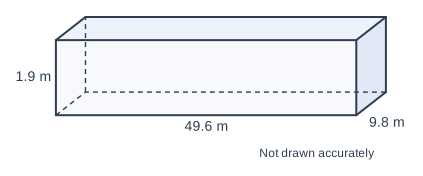
The diagram shows a swimming pool in the shape of a cuboid.
It costs £1.85 to fill 1 m³ of the pool with water.
Use approximations to show that it costs about £2000 to fill the pool with water.
Round every number to 1 significant figure. The volume of a cuboid is length × width × depth, and each cubic metre costs about £2. In a 'show that' question you must write down the rounded numbers and each calculation.
Mark scheme
1 mark
M1 for 50, 10, 2 and 2 seen (all four numbers rounded to 1 significant figure)
1 mark
M1 for 50 × 10 × 2 (= 1000 m³)
1 mark
M1 for their 1000 × 2
1 mark
A1 for 2000 from correct working
answer only scores 0
Ready to try the rest? Every answer you write is marked against the mark scheme, so you can see exactly where the marks are.
Ctrl + Enter to check
Study HelperHints first, answers after you try
Stuck on this one? Ask for a hint and I’ll point you in the right direction, without giving the answer away. Once you’ve checked your answer, I’ll show you how the marks are awarded.