Practise 28 exam-style questions on Recognising and sketching graphs for AQA GCSE Maths (Foundation non-calculator). Write your answer as you would in the exam and get it marked in seconds against the mark scheme, point by point, with the Study Helper on hand if you get stuck.
28 questions
1–4 marks each
Instant marking
No sign-up needed
20 questions, marked as you go
Sample questions with model answers
Here are 4 of the questions in this topic, each with a model answer, an explanation of why it earns the marks and the mark scheme an examiner would use.
Question 1
1 mark
Write down the equation of the line of symmetry of the graph of \(y = x^2 + 3\)
Model answer
\(x = 0\) The graph is a U shape with its lowest point at (0, 3), on the y-axis, so it is symmetrical about the y-axis.
Explanation
y = x² + 3 is the graph of y = x² moved up by 3, so it is still symmetrical about the y-axis. The y-axis is the vertical line x = 0. Remember that a vertical line of symmetry has an equation x = a number.
Mark scheme
1 mark
B1 for \(x = 0\)
accept 'the y-axis'; do not accept \(y = 3\) or \(y = 0\)
Question 2
2 marks
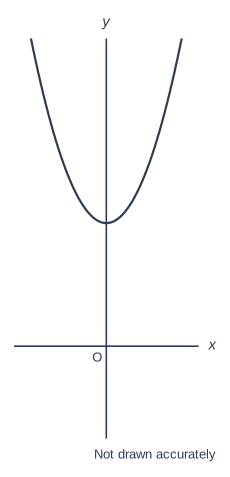
Ben has drawn a sketch of the graph of \(y = x^2 - 4\) Here is the sketch.
The sketch is wrong.
Give two things that are wrong with it.
Model answer
When \(x = 0\), \(y = -4\), so the graph should cross the y-axis at (0, −4), below the origin. Ben's crosses above the origin. When \(y = 0\), \(x^2 = 4\), so \(x = -2\) or \(x = 2\). The graph should cross the x-axis twice, but Ben's does not cross it at all.
Explanation
y = x² − 4 is the U shape of y = x² moved down by 4, so its lowest point is (0, −4) and it crosses the x-axis where x² = 4. Ben has drawn the U shape moved up instead, which is y = x² + 4.
Mark scheme
1 mark
B1 for the graph should cross the y-axis below the origin, at (0, −4), but his crosses above the origin
accept 'the minimum point should be at (0, −4)' or 'his graph is y = x² + 4'
1 mark
B1 for the graph should cross the x-axis (at −2 and 2), but his does not meet the x-axis
Question 3
2 marks
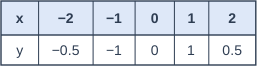
Kai makes a table of values for \(y = \dfrac{1}{x}\) Here is his table.
He plots the points and joins them all with one smooth curve.
Kai has made two mistakes. What are they?
Model answer
Mistake 1: when \(x = 0\), \(y = 1 \div 0\), which cannot be worked out. It is not 0, so (0, 0) should not be in the table. Mistake 2: the graph of \(y = \frac{1}{x}\) has two separate parts, so the points for negative x and positive x should not be joined to each other.
Explanation
You cannot divide by 0, so y = 1/x has no value at x = 0. The graph has a break there: one part for negative x (below the x-axis) and one part for positive x (above it). Kai's other values are correct.
Mark scheme
1 mark
B1 for y is not 0 when x = 0: \(1 \div 0\) cannot be worked out, so there is no point with x = 0
accept 'x cannot be 0' or '1/0 is undefined'
1 mark
B1 for the graph should be in two separate parts, so he should not join the points through x = 0 (the origin)
accept 'the curve should not cross the y-axis'
Question 4
3 marks
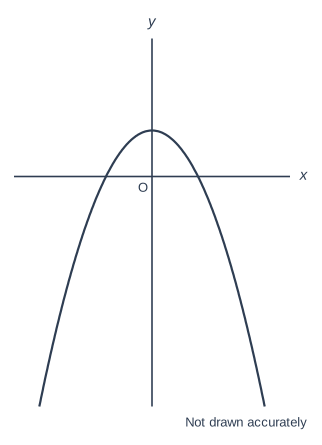
Here is a sketch of a graph. Its equation is one of these.
Which equation is it? Explain how you know it is not any of the other three.
Model answer
It is \(y = 1 - x^2\). It is a parabola, symmetrical about the y-axis, so it is not the cubic \(y = x^3 - 1\) (S-shaped) or \(y = \frac{1}{x}\) (two separate parts). It is ∩-shaped, so the \(x^2\) term is negative. \(y = x^2 - 1\) would be U-shaped and cross the y-axis at −1, below the origin.
Explanation
First decide the type of graph from its shape: one curve with a single turning point and a line of symmetry is a quadratic. Then use the sign of x²: positive gives a U shape, negative gives a ∩ shape. Here y = 1 − x² has its highest point at (0, 1).
Mark scheme
1 mark
B1 for \(y = 1 - x^2\)
1 mark
B1 for a reason that rules out \(y = x^2 - 1\), e.g. that graph is U-shaped (has a minimum point), but this one is ∩-shaped
accept 'y = x² − 1 crosses the y-axis at −1, but this crosses above the origin'
1 mark
B1 for a reason that rules out both \(y = x^3 - 1\) and \(y = \frac{1}{x}\), e.g. the graph is a parabola (symmetrical, one smooth curve with a turning point), not an S-shaped cubic or a curve in two parts
both must be ruled out
Ready to try the rest? Every answer you write is marked against the mark scheme, so you can see exactly where the marks are.
Ctrl + Enter to check
Study HelperHints first, answers after you try
Stuck on this one? Ask for a hint and I’ll point you in the right direction, without giving the answer away. Once you’ve checked your answer, I’ll show you how the marks are awarded.