Practise 29 exam-style questions on Exact calculation with fractions and π for AQA GCSE Maths (Foundation non-calculator). Write your answer as you would in the exam and get it marked in seconds against the mark scheme, point by point, with the Study Helper on hand if you get stuck.
29 questions
1–5 marks each
Instant marking
No sign-up needed
20 questions, marked as you go
Sample questions with model answers
Here are 4 of the questions in this topic, each with a model answer, an explanation of why it earns the marks and the mark scheme an examiner would use.
Question 1
1 mark
A circle has a diameter of 9 cm.
Write down the circumference of the circle in terms of \(\pi\).
Model answer
Circumference = \(\pi d = \pi \times 9 = 9\pi\) cm
Explanation
The circumference of a circle is π × diameter. With a diameter of 9 cm the circumference is 9π cm. Writing it 'in terms of π' means leaving π as a symbol instead of using a value for it.
Mark scheme
1 mark
B1 for \(9\pi\) (cm)
do not accept 18π or 81π
Question 2
2 marks
Ravi works out \(\dfrac{1}{2} + \dfrac{2}{5}\) Here is his working.
\(\dfrac{1}{2} + \dfrac{2}{5} = \dfrac{3}{7}\)
Ravi is wrong. What mistake has he made? Work out the correct answer.
Model answer
Ravi has added the tops (1 + 2) and the bottoms (2 + 5). He needs a common denominator. \(\dfrac{1}{2} + \dfrac{2}{5} = \dfrac{5}{10} + \dfrac{4}{10} = \dfrac{9}{10}\)
Explanation
Fractions can only be added when they have the same denominator. 10 is a multiple of 2 and 5, so change both fractions into tenths and add the numerators. A quick check shows Ravi is wrong: \(\frac{3}{7}\) is less than \(\frac{1}{2}\), but the answer must be more than \(\frac{1}{2}\).
Mark scheme
1 mark
B1 for he has added the numerators and added the denominators oe
accept "he has not used a common denominator"
1 mark
B1 for \(\dfrac{9}{10}\)
accept 0.9
Question 3
3 marks
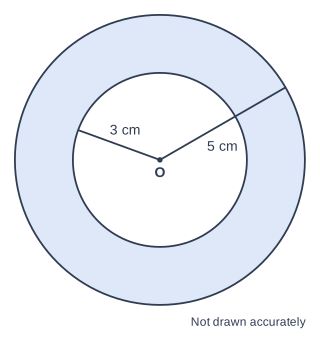
The diagram shows two circles with the same centre O. The radius of the large circle is 5 cm. The radius of the small circle is 3 cm.
Work out the area of the shaded region. Give your answer in terms of \(\pi\).
Model answer
Area of the large circle = \(\pi \times 5^2 = 25\pi\) cm² Area of the small circle = \(\pi \times 3^2 = 9\pi\) cm² Shaded area = \(25\pi - 9\pi = 16\pi\) cm²
Explanation
The shaded ring is the large circle with the small circle taken away. Work out both areas in terms of π and subtract. You cannot subtract the radii first: a ring 2 cm wide is not the same as a circle of radius 2 cm.
Mark scheme
1 mark
M1 for \(\pi \times 5^2\) or \(25\pi\)
1 mark
M1 for their \(25\pi\) − \(\pi \times 3^2\) or \(25\pi - 9\pi\)
1 mark
A1 for \(16\pi\) (cm²)
correct answer with no working scores full marks; \(4\pi\) (from \(\pi \times 2^2\)) scores 0
Question 4
4 marks
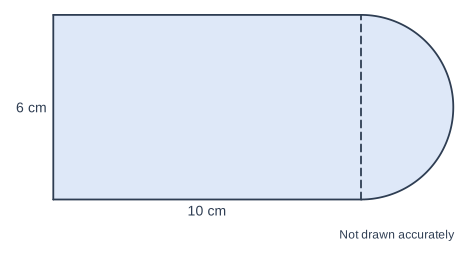
The diagram shows a shape made from a rectangle and a semicircle. The rectangle is 10 cm long and 6 cm wide. The diameter of the semicircle is the 6 cm side of the rectangle.
Work out the area of the shape. Give your answer in terms of \(\pi\).
Model answer
Area of the rectangle = 10 × 6 = 60 cm² Radius of the semicircle = 6 ÷ 2 = 3 cm Area of the semicircle = \(\pi \times 3^2 \div 2 = 9\pi \div 2 = 4.5\pi\) cm² Area of the shape = \(60 + 4.5\pi\) cm²
Explanation
Split the shape into the rectangle and the semicircle and find each area. The semicircle's diameter is 6 cm, so its radius is 3 cm, and its area is half of π × 3². The answer is left as 60 + 4.5π because a number and a multiple of π cannot be combined.
Mark scheme
1 mark
M1 for 10 × 6 (= 60)
1 mark
M1 for radius = 3 used, e.g. \(\pi \times 3^2\) or \(9\pi\)
1 mark
M1 for their \(9\pi \div 2\) (= \(4.5\pi\))
1 mark
A1 for \(60 + 4.5\pi\) (cm²)
accept \(60 + \frac{9}{2}\pi\) or \(60 + \frac{9\pi}{2}\); do not accept \(64.5\pi\); correct answer with no working scores full marks
Ready to try the rest? Every answer you write is marked against the mark scheme, so you can see exactly where the marks are.
Ctrl + Enter to check
Study HelperHints first, answers after you try
Stuck on this one? Ask for a hint and I’ll point you in the right direction, without giving the answer away. Once you’ve checked your answer, I’ll show you how the marks are awarded.