Practise 29 exam-style questions on Equations, identities and algebraic arguments for AQA GCSE Maths (Foundation non-calculator). Write your answer as you would in the exam and get it marked in seconds against the mark scheme, point by point, with the Study Helper on hand if you get stuck.
29 questions
1–5 marks each
Instant marking
No sign-up needed
20 questions, marked as you go
Sample questions with model answers
Here are 4 of the questions in this topic, each with a model answer, an explanation of why it earns the marks and the mark scheme an examiner would use.
Question 1
1 mark
\(n\) is a whole number.
Explain why \(2n\) is always an even number.
Model answer
\(2n = 2 \times n\). Any whole number multiplied by 2 is a multiple of 2, so \(2n\) is always even.
Explanation
Even numbers are the multiples of 2. Since 2n means 2 × n, it is always 2 times a whole number. Trying a few values of n does not explain why it is always true - you need a reason that works for every n.
Mark scheme
1 mark
B1 for a correct explanation, e.g. \(2n = 2 \times n\) so it is a multiple of 2
oe, e.g. 'it is in the 2 times table', 'it divides exactly by 2'; do not accept examples only, e.g. 'n = 3 gives 6'
Because it is an identity, both sides must match term by term. Expanding the bracket gives 4x + 4a, so 4a must equal 20. A common mistake is a = 20, which forgets that a is multiplied by 4.
Mark scheme
1 mark
M1 for \(4x + 4a\) or \(4a = 20\)
1 mark
A1 for \(a = 5\)
correct answer with no working scores full marks
Question 3
3 marks
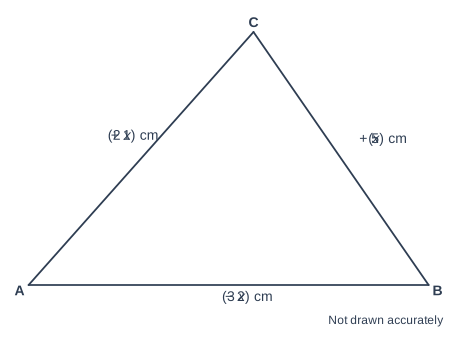
The diagram shows a triangle ABC. The lengths of the sides are in centimetres.
Show that the perimeter of the triangle is \(2(3x + 2)\) cm.
The perimeter is the total length of all the sides, so add the three expressions and collect like terms: 2x + x + 3x = 6x and 1 + 5 − 2 = 4. Then factorise 6x + 4 by taking out the common factor 2 to match the given form.
Mark scheme
1 mark
M1 for \(2x + 1 + x + 5 + 3x - 2\)
the three sides added
1 mark
A1 for \(6x + 4\)
1 mark
A1 for \(6x + 4 = 2(3x + 2)\)
oe, e.g. expanding 2(3x + 2) = 6x + 4 and stating they are the same; answer only scores 0
Question 4
4 marks
Amy is \(x\) years old. Ben is 3 years older than Amy. Cara is twice as old as Ben.
\(x\) is a whole number.
Show that the total of their three ages is always an odd number.
Model answer
Amy: \(x\) Ben: \(x + 3\) Cara: \(2(x + 3) = 2x + 6\) Total: \(x + x + 3 + 2x + 6 = 4x + 9\) \(4x = 2 \times 2x\) is always even, and 9 is odd. Even + odd = odd, so the total is always odd.
Explanation
Write each age in terms of x, remembering that Cara's age is double the whole of Ben's age, so use a bracket. Add the ages to get 4x + 9. Since 4x is a multiple of 2 it is even, and adding an odd number to an even number always gives an odd number.
Mark scheme
1 mark
M1 for Ben's age \(x + 3\)
1 mark
M1 for Cara's age \(2(x + 3)\) or \(2x + 6\)
ft their expression for Ben's age
1 mark
A1 for total \(4x + 9\)
1 mark
A1 for a correct explanation, e.g. \(4x\) is even, so \(4x + 9\) is even + odd, which is odd
oe, e.g. 4x + 9 = 2(2x + 4) + 1, or 4x + 8 is even so 4x + 9 is odd; examples only score 0
Ready to try the rest? Every answer you write is marked against the mark scheme, so you can see exactly where the marks are.
Ctrl + Enter to check
Study HelperHints first, answers after you try
Stuck on this one? Ask for a hint and I’ll point you in the right direction, without giving the answer away. Once you’ve checked your answer, I’ll show you how the marks are awarded.