
Level:
Correct: 0
Incorrect: 0
Marks: 0/0
Exam Practice
Course:
Topics:
Edexcel GCSE Maths (Foundation non-calculator) Smart practice A mixed round aimed at your weak spots
Unit 1
Number
Unit 2
Algebra
Unit 3
Ratio, proportion and rates of change
Unit 4
Geometry and measures
Unit 5
Probability
Unit 6
Statistics
Avg
score:
–
Topics
done:
0/86

Using and rearranging formulae

Practise 31 exam-style questions on Using and rearranging formulae for Edexcel GCSE Maths (Foundation non-calculator). Write your answer as you would in the exam and get it marked in seconds against the mark scheme, point by point, with the Study Helper on hand if you get stuck.

  • 31 questions
  • 1–5 marks each
  • Instant marking
  • No sign-up needed
20 questions, marked as you go

Sample questions with model answers

Here are 4 of the questions in this topic, each with a model answer, an explanation of why it earns the marks and the mark scheme an examiner would use.

Question 1

1 mark

Make \(k\) the subject of the formula \(m = k - 3n\)

Model answer

\(m = k - 3n\)
Add \(3n\) to both sides:
\(m + 3n = k\)
\(k = m + 3n\)

Explanation

\(3n\) is being subtracted from \(k\), so add \(3n\) to both sides to leave \(k\) on its own. A common mistake is to write \(k = m - 3n\), doing the same operation instead of the inverse.

Mark scheme
  1. 1 mark

    B1 for \(k = m + 3n\)

    accept \(k = 3n + m\)
Question 2

2 marks

Ali is asked to make \(x\) the subject of the formula \(y = 4x + 3\)

Here is his answer.

\(x = \dfrac{y}{4} - 3\)

Ali's answer is wrong.
Describe his mistake and write down the correct answer.

Model answer

Ali divided by 4 first but only divided the \(y\), not the 3.
Correct method:
\(y - 3 = 4x\)
\(x = \dfrac{y - 3}{4}\)

Explanation

Undo the operations in reverse order: the formula multiplies by 4 and then adds 3, so subtract 3 first and then divide by 4. If you divide first, every term must be divided by 4, which gives \(\frac{y}{4} - \frac{3}{4}\), not \(\frac{y}{4} - 3\).

Mark scheme
  1. 1 mark

    B1 for describing the mistake, e.g. "he divided \(y\) by 4 but did not divide the 3 by 4" or "he should have subtracted 3 before dividing by 4"

  2. 1 mark

    B1 for \(x = \dfrac{y - 3}{4}\)

    accept \(x = \frac{y}{4} - \frac{3}{4}\)

Question 3

3 marks

Make \(n\) the subject of the formula \(m = \dfrac{3n - 1}{2}\)

Model answer

\(m = \dfrac{3n - 1}{2}\)
Multiply both sides by 2: \(2m = 3n - 1\)
Add 1 to both sides: \(2m + 1 = 3n\)
Divide both sides by 3: \(n = \dfrac{2m + 1}{3}\)

Explanation

Remove the fraction first by multiplying both sides by 2. Then undo the −1 by adding 1, and undo the multiplication by 3 by dividing. Do one step at a time and do the same thing to both sides each time.

Mark scheme
  1. 1 mark

    M1 for \(2m = 3n - 1\)

    correct answer with no working scores full marks

  2. 1 mark

    M1 for \(2m + 1 = 3n\)

    ft their first step

  3. 1 mark

    A1 for \(n = \dfrac{2m + 1}{3}\)

    accept \(n = (2m + 1) \div 3\)

Question 4

4 marks

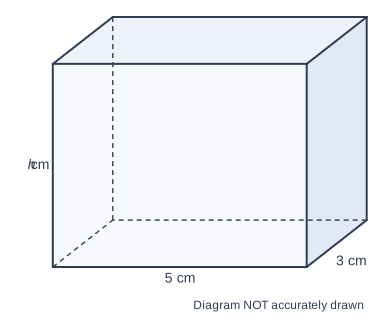
The diagram shows a cuboid.
The cuboid is 5 cm long, 3 cm wide and \(h\) cm high.

The surface area, \(S\), of a cuboid is given by the formula

\(S = 2(lw + lh + wh)\)

where \(l\) is the length, \(w\) is the width and \(h\) is the height.

The surface area of the cuboid is 94 cm².

Work out the value of \(h\).

A cuboid drawn in 3D with hidden edges shown as dashed lines. The length is labelled 5 cm (along the front bottom edge). The width (the edge going back) is labelled 3 cm (along the bottom edge going back on the right). The height is labelled h cm (along the front left vertical edge). The diagram is labelled "Diagram NOT accurately drawn".

Model answer

\(94 = 2(5 \times 3 + 5h + 3h)\)
\(94 = 2(15 + 8h)\)
\(47 = 15 + 8h\)
\(32 = 8h\)
\(h = 4\)

Explanation

Substitute the length and the width into the formula, then simplify the bracket: \(5h + 3h = 8h\). Divide both sides by 2, subtract 15, and divide by 8. Check: \(2(15 + 20 + 12) = 2 \times 47 = 94\).

Mark scheme
  1. 1 mark

    M1 for \(94 = 2(5 \times 3 + 5h + 3h)\)

    correct answer with no working scores full marks

  2. 1 mark

    M1 for \(47 = 15 + 8h\) or \(94 = 30 + 16h\)

  3. 1 mark

    M1 for \(32 \div 8\) or \(64 \div 16\)

    ft their equation of the form \(a = bh\)

  4. 1 mark

    A1 for 4

    cao

Ready to try the rest? Every answer you write is marked against the mark scheme, so you can see exactly where the marks are.

Study Helper Hints first, answers after you try

Stuck on this one? Ask for a hint and I’ll point you in the right direction, without giving the answer away. Once you’ve checked your answer, I’ll show you how the marks are awarded.