Level:
Correct: 0
Incorrect: 0
Marks: 0/0
Exam Practice
Course:
Topics:
Edexcel GCSE Maths (Foundation non-calculator) Smart practice A mixed round aimed at your weak spots
Unit 1
Number
Unit 2
Algebra
Unit 3
Ratio, proportion and rates of change
Unit 4
Geometry and measures
Unit 5
Probability
Unit 6
Statistics
Avg
score:
–
Topics
done:
0/86

Transformations

Practise 28 exam-style questions on Transformations for Edexcel GCSE Maths (Foundation non-calculator). Write your answer as you would in the exam and get it marked in seconds against the mark scheme, point by point, with the Study Helper on hand if you get stuck.

  • 28 questions
  • 1–5 marks each
  • Instant marking
  • No sign-up needed
20 questions, marked as you go

Sample questions with model answers

Here are 4 of the questions in this topic, each with a model answer, an explanation of why it earns the marks and the mark scheme an examiner would use.

Question 1

1 mark

The grid shows two rectangles, A and B.

Rectangle B is an enlargement of rectangle A.

Write down the scale factor of the enlargement.
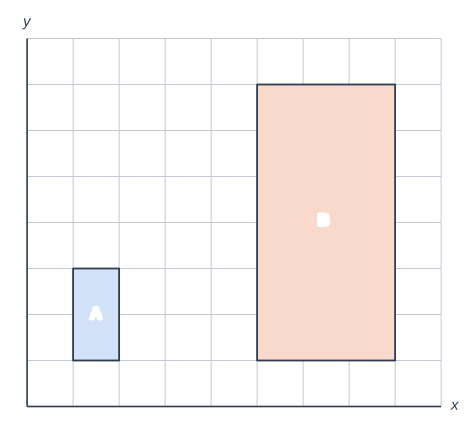
A coordinate grid with x from 0 to 9 and y from 0 to 8; each grid square is 1 unit across, and the axes cross at the origin O. Shape A is a shaded quadrilateral with vertices (1, 1), (2, 1), (2, 3) and (1, 3). Shape B is a shaded quadrilateral with vertices (5, 1), (8, 1), (8, 7) and (5, 7).

Model answer

A is 1 by 2 squares and B is 3 by 6 squares.
3 ÷ 1 = 3 and 6 ÷ 2 = 3
Scale factor 3

Explanation

The scale factor is how many times longer each side of the image is than the matching side of the original. Divide a length of B by the matching length of A: 6 ÷ 2 = 3. Check with the other pair of sides: 3 ÷ 1 = 3.

Mark scheme
  1. 1 mark

    B1 for 3

    accept ×3

Question 2

2 marks

Triangle T has vertices P(1, 2), Q(3, 1) and R(1, 1).

Triangle T is enlarged by scale factor 3 with centre (0, 0).

Write down the coordinates of the images of P, Q and R.

Model answer

With centre (0, 0) and scale factor 3, multiply each coordinate by 3.
P(1, 2) → (3, 6)
Q(3, 1) → (9, 3)
R(1, 1) → (3, 3)

Explanation

When the centre of enlargement is the origin, each image point is 3 times as far from O in the same direction, so both coordinates are multiplied by the scale factor. This only works for centre (0, 0); for any other centre, count from the centre instead.

Mark scheme
  1. 2 marks

    B2 for (3, 6), (9, 3) and (3, 3)

    B1 for two correct images

Question 3

3 marks

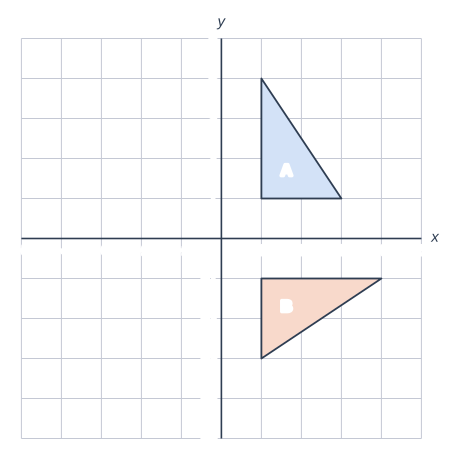
The grid shows triangle A and triangle B.

Describe fully the single transformation that maps triangle A onto triangle B.

A coordinate grid with x from −5 to 5 and y from −5 to 5; each grid square is 1 unit across, and the axes cross at the origin O. Shape A is a shaded triangle with vertices (1, 1), (1, 4) and (3, 1). Shape B is a shaded triangle with vertices (1, −1), (4, −1) and (1, −3).

Model answer

Rotation, 90° clockwise, centre (0, 0)

Explanation

Triangle B is the same shape and size as A but turned, so it is a rotation. To describe a rotation fully you need three things: the angle, the direction and the centre. The vertical side of A has become horizontal and the triangle has turned a quarter turn clockwise about the origin.

Mark scheme
  1. 1 mark

    B1 for rotation

    accept rotate, rotated, turn; B0 B0 B0 if more than one transformation is given

  2. 1 mark

    B1 for 90° clockwise

    accept a quarter turn clockwise, 270° anticlockwise or −90°

  3. 1 mark

    B1 for (centre) (0, 0)

    accept 'about the origin' or 'centre O'

Question 4

3 marks

Triangle A is a right-angled triangle.
The two shorter sides are 6 cm and 8 cm and the longest side is 10 cm.

Triangle A is enlarged by scale factor \(\frac{1}{2}\) to give triangle B.

Work out the area of triangle B.

Model answer

Lengths of B: 6 × ½ = 3 cm, 8 × ½ = 4 cm (and 10 × ½ = 5 cm)
The right angle is between the two shorter sides, so they are the base and height.
Area of B = ½ × 3 × 4 = 6 cm²

Explanation

A scale factor of ½ halves every length, so triangle B has sides 3 cm, 4 cm and 5 cm. B is still right-angled, so use ½ × base × height with the two shorter sides. Do not use the 5 cm side as the height - it is not perpendicular to the base.

Mark scheme
  1. 1 mark

    M1 for 6 × ½ (= 3) and 8 × ½ (= 4)

  2. 1 mark

    M1 for ½ × 3 × 4

    ft their lengths, provided they are the two shorter sides

  3. 1 mark

    A1 for 6 (cm²)

    cao; correct answer with no working scores full marks

Ready to try the rest? Every answer you write is marked against the mark scheme, so you can see exactly where the marks are.

Study Helper Hints first, answers after you try

Stuck on this one? Ask for a hint and I’ll point you in the right direction, without giving the answer away. Once you’ve checked your answer, I’ll show you how the marks are awarded.