Practise 30 exam-style questions on Forming and solving equations for Edexcel GCSE Maths (Foundation non-calculator). Write your answer as you would in the exam and get it marked in seconds against the mark scheme, point by point, with the Study Helper on hand if you get stuck.
30 questions
1–5 marks each
Instant marking
No sign-up needed
20 questions, marked as you go
Sample questions with model answers
Here are 4 of the questions in this topic, each with a model answer, an explanation of why it earns the marks and the mark scheme an examiner would use.
Question 1
1 mark
An adult ticket for a museum costs £\(a\). A child ticket costs £\(c\).
Write an expression for the total cost, in pounds, of 2 adult tickets and 3 child tickets.
Model answer
\(2a + 3c\)
Explanation
2 adult tickets cost \(2 \times a = 2a\) pounds and 3 child tickets cost \(3 \times c = 3c\) pounds. Add them for the total. \(2a\) and \(3c\) are not like terms, so they cannot be combined into one term.
Mark scheme
1 mark
B1 for \(2a + 3c\)
oe, e.g. a + a + c + c + c
Question 2
2 marks
Zara thinks of a number. She multiplies her number by 4 and then adds 7. Her answer is 31.
Work out the number Zara thought of.
Model answer
\(4n + 7 = 31\) \(4n = 24\) \(n = 6\)
Explanation
Call the number \(n\) and write the steps as an equation: \(4n + 7 = 31\). Solve by subtracting 7, then dividing by 4. Check: 6 × 4 + 7 = 31.
Mark scheme
1 mark
M1 for \(4n + 7 = 31\) or (31 − 7) ÷ 4
1 mark
A1 for 6
cao; correct answer with no working scores full marks
Question 3
3 marks
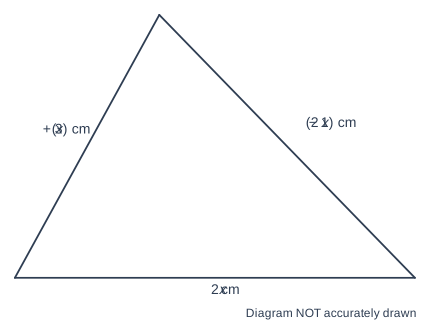
The diagram shows a triangle. The lengths of the sides are \((x + 3)\) cm, \(2x\) cm and \((2x - 1)\) cm.
The perimeter of the triangle is 32 cm. Work out the length of the longest side of the triangle.
Model answer
\(x + 3 + 2x + 2x - 1 = 32\) \(5x + 2 = 32\) \(5x = 30\) \(x = 6\) The sides are 6 + 3 = 9 cm, 2 × 6 = 12 cm and 2 × 6 − 1 = 11 cm. The longest side is 12 cm.
Explanation
Add the three sides to get an expression for the perimeter and set it equal to 32. Solve to find \(x\), then substitute into each expression to find the side lengths. Check: 9 + 12 + 11 = 32.
Mark scheme
1 mark
P1 for \(x + 3 + 2x + 2x - 1 = 32\) or \(5x + 2 = 32\)
correct answer with no working scores full marks
1 mark
P1 for \(5x = 30\) leading to \(x = 6\)
1 mark
A1 for 12 (cm)
cao
Question 4
4 marks
A farmer has some chickens and some sheep. There are 20 animals altogether. Each chicken has 2 legs and each sheep has 4 legs. The animals have 56 legs altogether.
Work out how many sheep the farmer has.
Model answer
Let there be \(c\) chickens and \(s\) sheep. \(c + s = 20\) \(2c + 4s = 56\) Multiply the first equation by 2: \(2c + 2s = 40\) Subtract from the second: \(2s = 16\) \(s = 8\) The farmer has 8 sheep (and 12 chickens). Check: 12 × 2 + 8 × 4 = 24 + 32 = 56
Explanation
Write one equation for the number of animals and one for the number of legs. Double the first equation so the \(c\) terms match, then subtract. Answer the question asked: the number of sheep.
Mark scheme
1 mark
P1 for one correct equation, \(c + s = 20\) or \(2c + 4s = 56\)
any letters; correct answer with no working scores full marks
1 mark
P1 for both equations
1 mark
P1 for a correct method to eliminate one variable, e.g. \(2c + 2s = 40\) and subtracting to get \(2s = 16\)
1 mark
A1 for 8 (sheep)
cao
Ready to try the rest? Every answer you write is marked against the mark scheme, so you can see exactly where the marks are.
Ctrl + Enter to check
Study HelperHints first, answers after you try
Stuck on this one? Ask for a hint and I’ll point you in the right direction, without giving the answer away. Once you’ve checked your answer, I’ll show you how the marks are awarded.