Level:
Correct: 0
Incorrect: 0
Marks: 0/0
Exam Practice
Course:
Topics:
Edexcel GCSE Maths (Foundation non-calculator) Smart practice A mixed round aimed at your weak spots
Unit 1
Number
Unit 2
Algebra
Unit 3
Ratio, proportion and rates of change
Unit 4
Geometry and measures
Unit 5
Probability
Unit 6
Statistics
Avg
score:
–
Topics
done:
0/86

Congruent triangles

Practise 18 exam-style questions on Congruent triangles for Edexcel GCSE Maths (Foundation non-calculator). Write your answer as you would in the exam and get it marked in seconds against the mark scheme, point by point, with the Study Helper on hand if you get stuck.

  • 18 questions
  • 1–4 marks each
  • Instant marking
  • No sign-up needed
18 questions, marked as you go

Sample questions with model answers

Here are 4 of the questions in this topic, each with a model answer, an explanation of why it earns the marks and the mark scheme an examiner would use.

Question 1

1 mark

The diagram shows triangle ABC and triangle DEF.

The two triangles are congruent.

Write down the condition of congruence that shows this.
Choose from SSS, SAS, ASA or RHS.
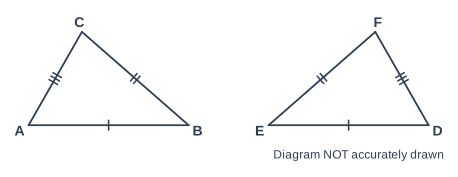
Geometry diagram, marked "Diagram NOT accurately drawn". Triangle ABC. Triangle DEF. AB and DE are each marked with one short dash (equal lengths). BC and EF are each marked with two short dashes (equal lengths). CA and FD are each marked with three short dashes (equal lengths).

Model answer

AB = DE, BC = EF and CA = FD, so all three pairs of sides are equal.
SSS

Explanation

The dashes show which sides are equal: one dash on AB and DE, two dashes on BC and EF, three dashes on CA and FD. When all three sides of one triangle are equal to the three sides of another, the triangles are congruent by SSS (side, side, side).

Mark scheme
  1. 1 mark

    B1 for SSS

    accept 'side, side, side' or 'all three pairs of sides are equal'
Question 2

2 marks

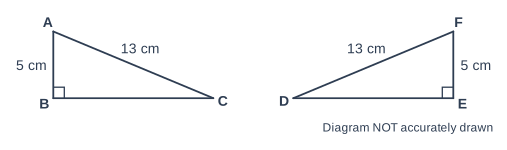
The diagram shows two right-angled triangles, ABC and DEF.

Explain why the two triangles are congruent.

Geometry diagram, marked "Diagram NOT accurately drawn". Triangle ABC. Triangle DEF. Angle ABC is marked as a right angle (90°). Angle DEF is marked as a right angle (90°). Side AB is labelled 5 cm. Side AC is labelled 13 cm. Side EF is labelled 5 cm. Side DF is labelled 13 cm.

Model answer

Both triangles have a right angle.
The hypotenuses are equal: AC = DF = 13 cm
Another pair of sides is equal: AB = EF = 5 cm
So the triangles are congruent (RHS).

Explanation

The hypotenuse is the longest side, opposite the right angle. When two right-angled triangles have equal hypotenuses and one other pair of equal sides, they are congruent by RHS (right angle, hypotenuse, side). Here the triangles are mirror images, which is allowed.

Mark scheme
  1. 1 mark

    B1 for identifying the equal parts: both have a right angle, the hypotenuses AC and DF are both 13 cm, and AB = EF = 5 cm

  2. 1 mark

    C1 for RHS

    accept 'right angle, hypotenuse, side'

Question 3

3 marks

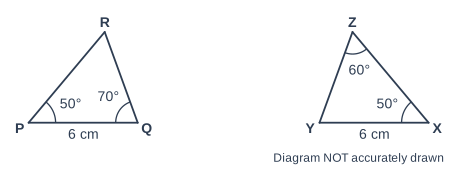
The diagram shows triangle PQR and triangle XYZ.

Are the two triangles congruent?
You must give a reason for your answer.

Geometry diagram, marked "Diagram NOT accurately drawn". Triangle PQR. Triangle XYZ. Angle RPQ is marked 50°. Angle PQR is marked 70°. Side PQ is labelled 6 cm. Angle YXZ is marked 50°. Angle XZY is marked 60°. Side XY is labelled 6 cm.

Model answer

Angle XYZ = 180° − 50° − 60° = 70° (angles in a triangle add up to 180°)
PQR: angle P = 50°, PQ = 6 cm, angle Q = 70°
XYZ: angle X = 50°, XY = 6 cm, angle Y = 70°
Yes, they are congruent: two angles and the side between them are equal (ASA).

Explanation

Triangle XYZ does not show the angle at Y, but the angles in a triangle add up to 180°, so it must be 70°. Now both triangles have angles of 50° and 70° with the 6 cm side between them, which is the condition ASA.

Mark scheme
  1. 1 mark

    M1 for 180 − 50 − 60 (= 70) for angle XYZ, or 180 − 50 − 70 (= 60) for angle PRQ

  2. 1 mark

    A1 for angle XYZ = 70° or angle PRQ = 60°

  3. 1 mark

    C1 for 'Yes' with ASA: two angles (50° and 70°) and the side between them (6 cm) are equal

    accept 'angle, side, angle' or AAS; the reason must refer to the side being between the angles or to matching angles and side

Question 4

3 marks

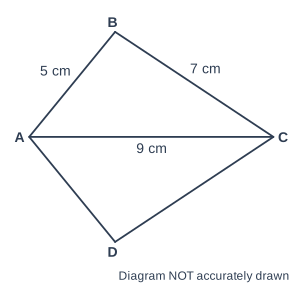
Two congruent triangles, ABC and ADC, are joined along AC to make the kite ABCD, as shown in the diagram.

AB = 5 cm, BC = 7 cm and AC = 9 cm

Lily says, 'Each triangle has a perimeter of 21 cm, so the perimeter of the kite is 42 cm.'

Is Lily correct?
You must show how you get your answer.

Geometry diagram, marked "Diagram NOT accurately drawn". Kite ABCD. Line segment AC is drawn. Side AB is labelled 5 cm. Side BC is labelled 7 cm. AC is labelled 9 cm.

Model answer

The triangles are congruent, so AD = AB = 5 cm and DC = BC = 7 cm.
The perimeter of the kite goes round the outside: AB + BC + CD + DA
= 5 + 7 + 7 + 5 = 24 cm
No, Lily is not correct. AC is inside the kite, so it is not part of the perimeter. The perimeter is 24 cm.

Explanation

The perimeter is the distance around the outside of a shape. When the triangles are joined, the shared side AC is inside the kite, so it must not be counted. Lily has counted the 9 cm side twice. Use the congruent triangles to find the two missing outside sides.

Mark scheme
  1. 1 mark

    P1 for AD = 5 cm and DC = 7 cm (from the congruent triangles)

    may be implied by a correct perimeter

  2. 1 mark

    P1 for 5 + 7 + 7 + 5 (= 24), or 42 − 2 × 9 (= 24)

  3. 1 mark

    C1 for 'No' with a perimeter of 24 cm, or with a correct explanation that AC is inside the kite and is not part of the perimeter

Ready to try the rest? Every answer you write is marked against the mark scheme, so you can see exactly where the marks are.

Study Helper Hints first, answers after you try

Stuck on this one? Ask for a hint and I’ll point you in the right direction, without giving the answer away. Once you’ve checked your answer, I’ll show you how the marks are awarded.