Practise 29 exam-style questions on Standard units and compound measures for Edexcel GCSE Maths (Foundation non-calculator). Write your answer as you would in the exam and get it marked in seconds against the mark scheme, point by point, with the Study Helper on hand if you get stuck.
29 questions
1–5 marks each
Instant marking
No sign-up needed
20 questions, marked as you go
Sample questions with model answers
Here are 4 of the questions in this topic, each with a model answer, an explanation of why it earns the marks and the mark scheme an examiner would use.
Question 1
1 mark
The diagram shows a ruler. Arrow A points to a length on the ruler.
Write down the length shown by arrow A. Give your answer in millimetres.
Model answer
Each small division on the ruler is 0.1 cm (1 mm). Arrow A is at 6.3 cm. 6.3 cm = 6.3 × 10 = 63 mm
Explanation
The numbers on the ruler are centimetres and there are 10 small divisions between each number, so each small division is 1 mm. Arrow A is 3 small divisions after 6 cm, which is 6.3 cm. There are 10 mm in 1 cm, so multiply by 10 to get 63 mm.
The 2 is 2 whole hours. The 0.4 is part of an hour, and an hour has 60 minutes, so 0.4 hours is 0.4 × 60 = 24 minutes. The common mistake is to read 0.4 as 40 minutes.
Mark scheme
1 mark
M1 for 0.4 × 60 (= 24) or 2.4 × 60 (= 144) oe
1 mark
A1 for 2 hours 24 minutes
correct answer with no working scores full marks; 2 hours 40 minutes scores 0
Question 3
3 marks
A block of metal has a mass of 540 g and a volume of 60 cm³.
Work out the density of the metal. Give the units of your answer.
Model answer
Density = mass ÷ volume Density = 540 ÷ 60 = 9 g/cm³
Explanation
Density is the mass of each cubic centimetre, so divide the mass by the volume. The units come from the units used: grams divided by cubic centimetres gives g/cm³. 540 ÷ 60 is the same as 54 ÷ 6 = 9.
Mark scheme
1 mark
M1 for 540 ÷ 60
1 mark
A1 for 9
correct answer with no working scores M1 A1
1 mark
B1 for g/cm³
independent mark; accept grams per cubic centimetre or g per cm³; do not accept g/cm or g
Question 4
4 marks
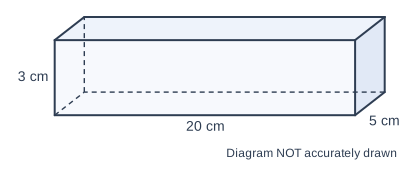
The diagram shows a metal bar in the shape of a cuboid.
The metal has a density of 7.5 g/cm³. The metal costs £4 per kilogram.
Work out the cost of the metal in the bar.
Model answer
Volume = 20 × 5 × 3 = 300 cm³ Mass = density × volume = 7.5 × 300 = 2250 g 2250 g = 2.25 kg Cost = 2.25 × £4 = £9
Explanation
First find the volume of the cuboid (length × width × height). Mass = density × volume gives the mass in grams. The price is per kilogram, so divide the grams by 1000 before multiplying by £4.
Mark scheme
1 mark
P1 for the volume, 20 × 5 × 3 (= 300 cm³)
1 mark
P1 for their 300 × 7.5 (= 2250 g)
1 mark
P1 for changing their mass to kilograms and multiplying by 4, e.g. 2.25 × 4, or for 2250 × 0.4 (pence per gram)
1 mark
A1 for £9
accept £9.00 or 900p; correct answer with no working scores full marks
Ready to try the rest? Every answer you write is marked against the mark scheme, so you can see exactly where the marks are.
Ctrl + Enter to check
Study HelperHints first, answers after you try
Stuck on this one? Ask for a hint and I’ll point you in the right direction, without giving the answer away. Once you’ve checked your answer, I’ll show you how the marks are awarded.