Level:
Correct: 0
Incorrect: 0
Marks: 0/0
Exam Practice
Course:
Topics:
Edexcel GCSE Maths (Foundation non-calculator) Smart practice A mixed round aimed at your weak spots
Unit 1
Number
Unit 2
Algebra
Unit 3
Ratio, proportion and rates of change
Unit 4
Geometry and measures
Unit 5
Probability
Unit 6
Statistics
Avg
score:
–
Topics
done:
0/86

Comparing lengths, areas and volumes with ratio

Practise 30 exam-style questions on Comparing lengths, areas and volumes with ratio for Edexcel GCSE Maths (Foundation non-calculator). Write your answer as you would in the exam and get it marked in seconds against the mark scheme, point by point, with the Study Helper on hand if you get stuck.

  • 30 questions
  • 1–5 marks each
  • Instant marking
  • No sign-up needed
20 questions, marked as you go

Sample questions with model answers

Here are 4 of the questions in this topic, each with a model answer, an explanation of why it earns the marks and the mark scheme an examiner would use.

Question 1

1 mark

The diagram shows triangle ABC and triangle PQR.
Triangle PQR is an enlargement of triangle ABC with scale factor 2

Write down the value of x.
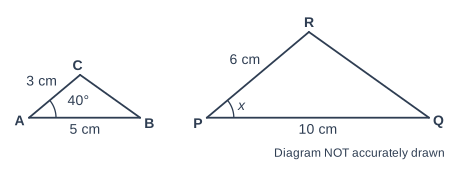
Geometry diagram, marked "Diagram NOT accurately drawn". Triangle ABC. Triangle PQR. Angle CAB is marked 40°. Angle RPQ is marked x. Side AB is labelled 5 cm. Side PQ is labelled 10 cm. Side AC is labelled 3 cm. Side PR is labelled 6 cm.

Model answer

x = 40°
An enlargement does not change the size of the angles.

Explanation

In an enlargement every length is multiplied by the scale factor, but the angles stay the same. Angle P matches angle A, so x = 40°. Do not multiply the angle by 2.

Mark scheme
  1. 1 mark

    B1 for 40

    accept 40°

Question 2

2 marks

Rectangle A is 4 cm wide and 6 cm long.
Rectangle B is 6 cm wide and 9 cm long.

Are rectangles A and B similar?
Give a reason for your answer.

Model answer

Widths: 6 ÷ 4 = 1.5
Lengths: 9 ÷ 6 = 1.5
Yes, they are similar: every side of B is 1.5 times the matching side of A.

Explanation

Shapes are similar if one is an enlargement of the other, so all matching lengths must be multiplied by the same scale factor. Here both the widths and the lengths are multiplied by 1.5. Another way: the ratio width : length is 2 : 3 for both rectangles.

Mark scheme
  1. 1 mark

    M1 for 6 ÷ 4 (= 1.5) and 9 ÷ 6 (= 1.5), or 4 : 6 = 2 : 3 and 6 : 9 = 2 : 3

  2. 1 mark

    C1 for Yes, with a reason, e.g. both pairs of matching sides are multiplied by 1.5

Question 3

3 marks

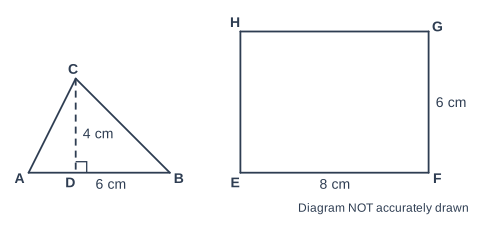
The diagram shows triangle ABC and rectangle EFGH.

Work out the ratio area of triangle ABC : area of rectangle EFGH.
Give your answer in its simplest form.

Geometry diagram, marked "Diagram NOT accurately drawn". Triangle ABC. Dashed line segment CD is drawn. Rectangle EFGH. D lies on side AB. Angle CDB is marked as a right angle (90°). Side AB is labelled 6 cm. CD is labelled 4 cm. Side EF is labelled 8 cm. Side FG is labelled 6 cm.

Model answer

Area of triangle ABC: \(\frac{1}{2} \times 6 \times 4 = 12\) cm²
Area of rectangle EFGH: 8 × 6 = 48 cm²
12 : 48 = 1 : 4

Explanation

The area of a triangle is half × base × perpendicular height, so use the dashed height of 4 cm. The area of the rectangle is length × width. Then simplify 12 : 48 by dividing both parts by 12.

Mark scheme
  1. 1 mark

    M1 for \(\frac{1}{2} \times 6 \times 4\) (= 12)

    correct answer with no working scores full marks

  2. 1 mark

    M1 for 8 × 6 (= 48)

  3. 1 mark

    A1 for 1 : 4

    cao

Question 4

4 marks

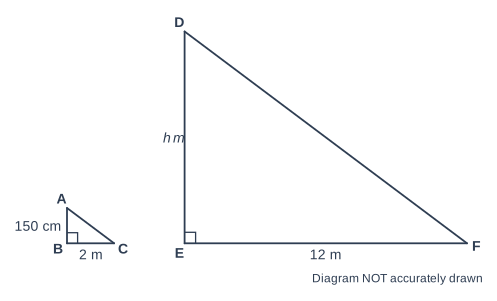
The diagram shows a vertical pole AB and its shadow BC on level ground.
It also shows a vertical tree DE and its shadow EF.
The sun's rays make the same angle with the ground at the pole and at the tree, so triangles ABC and DEF are similar.

Work out the height, h m, of the tree.

Geometry diagram, marked "Diagram NOT accurately drawn". Triangle ABC. Triangle DEF. Angle ABC is marked as a right angle (90°). Angle DEF is marked as a right angle (90°). Side AB is labelled 150 cm. Side BC is labelled 2 m. Side EF is labelled 12 m. Side DE is labelled h m.

Model answer

Pole height: 150 cm = 1.5 m
Shadows: 12 ÷ 2 = 6, so triangle DEF is 6 times as big as triangle ABC.
h = 1.5 × 6 = 9 m

Explanation

Because the triangles are similar, the tree's shadow is 6 times as long as the pole's shadow, so the tree is 6 times as tall as the pole. Change 150 cm into 1.5 m first so all lengths are in metres. Multiplying 150 by 6 without changing units gives 900 cm, which is also 9 m.

Mark scheme
  1. 1 mark

    P1 for 150 cm = 1.5 m (or 2 m = 200 cm and 12 m = 1200 cm)

    correct answer with no working scores full marks

  2. 1 mark

    P1 for the scale factor 12 ÷ 2 (= 6), or the ratio 1.5 ÷ 2 (= 0.75)

  3. 1 mark

    P1 for 1.5 × 6 or 12 × 0.75 oe

  4. 1 mark

    A1 for 9

    accept 9 m or 900 cm

Ready to try the rest? Every answer you write is marked against the mark scheme, so you can see exactly where the marks are.

Study Helper Hints first, answers after you try

Stuck on this one? Ask for a hint and I’ll point you in the right direction, without giving the answer away. Once you’ve checked your answer, I’ll show you how the marks are awarded.