Practise 36 exam-style questions on Fractions and percentages as operators for Edexcel GCSE Maths (Foundation non-calculator). Write your answer as you would in the exam and get it marked in seconds against the mark scheme, point by point, with the Study Helper on hand if you get stuck.
36 questions
1–5 marks each
Instant marking
No sign-up needed
20 questions, marked as you go
Sample questions with model answers
Here are 4 of the questions in this topic, each with a model answer, an explanation of why it earns the marks and the mark scheme an examiner would use.
Question 1
1 mark
Work out \(\dfrac{2}{3}\) of £27
Model answer
27 ÷ 3 = 9 9 × 2 = £18
Explanation
Find one third by dividing by 3 (£9), then multiply by 2 to find two thirds. Check: £18 is more than half of £27, as it should be.
Mark scheme
1 mark
B1 for £18
cao
Question 2
2 marks
In a sale, all prices are reduced by \(\frac{1}{3}\). A coat normally costs £72
Work out the sale price of the coat.
Model answer
\(\frac{1}{3}\) of £72 = 72 ÷ 3 = £24 Sale price: £72 − £24 = £48
Explanation
The reduction is \(\frac{1}{3}\) of £72, which is £24. Subtract it from the normal price. Or, after taking away \(\frac{1}{3}\), \(\frac{2}{3}\) of the price is left: \(\frac{2}{3}\) of £72 is £48.
Mark scheme
1 mark
M1 for \(\frac{1}{3}\) × 72 (= 24), or \(\frac{2}{3}\) × 72
1 mark
A1 for £48
cao; correct answer with no working scores full marks
Question 3
3 marks
Jen spends \(\frac{1}{2}\) of her money on clothes. She spends \(\frac{1}{3}\) of the money she has left on food.
What fraction of her money does Jen have left now?
Model answer
After clothes, \(\frac{1}{2}\) of her money is left. Food: \(\frac{1}{3}\) of \(\frac{1}{2} = \frac{1}{6}\) Left: 1 − \(\frac{1}{2} - \frac{1}{6} = \frac{6}{6} - \frac{3}{6} - \frac{1}{6} = \frac{2}{6} = \frac{1}{3}\)
Explanation
The food money is \(\frac{1}{3}\) of what is left, not \(\frac{1}{3}\) of all her money. "Of" means multiply, so food is \(\frac{1}{3} \times \frac{1}{2} = \frac{1}{6}\). Trying it with an amount, such as £60, is a good check: £30 on clothes, £10 on food, £20 left, which is \(\frac{1}{3}\).
Mark scheme
1 mark
M1 for \(\frac{1}{3}\) of \(\frac{1}{2}\) (= \(\frac{1}{6}\)) spent on food
or using an amount, e.g. £60: £30 on clothes, £10 on food
1 mark
M1 for 1 − \(\frac{1}{2} - \frac{1}{6}\) oe, or \(\frac{2}{3}\) of \(\frac{1}{2}\)
or £20 left out of £60
1 mark
A1 for \(\frac{1}{3}\)
oe; correct answer with no working scores full marks
Question 4
4 marks
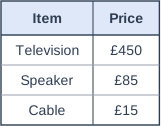
The table shows the prices of three items in a shop.
Ella buys one of each item. She pays \(\frac{2}{5}\) of the total cost straight away. She pays the rest in 6 equal monthly payments.
Add the prices to find the total. Work out \(\frac{2}{5}\) of the total, then find what is left (\(\frac{3}{5}\) of the total). Share what is left equally between the 6 payments.
Mark scheme
1 mark
P1 for the total cost 450 + 85 + 15 (= £550)
1 mark
P1 for \(\frac{2}{5}\) × their 550 (= 220), or \(\frac{3}{5}\) × their 550 (= 330)
1 mark
P1 for (their 550 − their 220) ÷ 6, or their 330 ÷ 6
1 mark
A1 for £55
cao; correct answer with no working scores full marks
Ready to try the rest? Every answer you write is marked against the mark scheme, so you can see exactly where the marks are.
Ctrl + Enter to check
Study HelperHints first, answers after you try
Stuck on this one? Ask for a hint and I’ll point you in the right direction, without giving the answer away. Once you’ve checked your answer, I’ll show you how the marks are awarded.