Practise 19 exam-style questions on Ratios, fractions and linear functions for Edexcel GCSE Maths (Foundation non-calculator). Write your answer as you would in the exam and get it marked in seconds against the mark scheme, point by point, with the Study Helper on hand if you get stuck.
19 questions
1–5 marks each
Instant marking
No sign-up needed
19 questions, marked as you go
Sample questions with model answers
Here are 4 of the questions in this topic, each with a model answer, an explanation of why it earns the marks and the mark scheme an examiner would use.
Question 1
1 mark
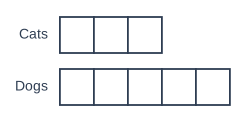
The bar model shows the ratio of the number of cats to the number of dogs treated at a vet one week.
What fraction of these animals were dogs?
Model answer
Cats: 3 parts, dogs: 5 parts Total = 3 + 5 = 8 parts Dogs = \(\dfrac{5}{8}\)
Explanation
Each box is the same size, so the ratio of cats to dogs is 3 : 5. Altogether there are 8 boxes, and 5 of them are dogs, so the fraction is \(\dfrac{5}{8}\). The bottom of the fraction must be the total number of parts.
Mark scheme
1 mark
B1 for \(\dfrac{5}{8}\)
oe; do not accept \(\dfrac{5}{3}\) or \(\dfrac{3}{5}\)
Question 2
2 marks
At a party, the ratio of the number of adults to the number of children is 3 : 7
What percentage of the people at the party are children?
Model answer
Total parts = 3 + 7 = 10 Children = \(\dfrac{7}{10}\) of the people \(\dfrac{7}{10}\) = 70%
Explanation
First change the ratio into a fraction of the whole: children are 7 parts out of 10. Then change the fraction into a percentage: \(\dfrac{7}{10} = \dfrac{70}{100}\) = 70%.
Mark scheme
1 mark
M1 for \(\dfrac{7}{10}\) or \(\dfrac{7}{3 + 7}\) oe
1 mark
A1 for 70(%)
cao; correct answer with no working scores full marks
Question 3
2 marks
The ratio of the length of a rectangle to its width is 5 : 2 The length is L cm and the width is W cm.
Write a formula for L in terms of W.
Model answer
L : W = 5 : 2, so L is 5 ÷ 2 = 2.5 times W. \(L = 2.5W\)
Explanation
For every 2 cm of width there are 5 cm of length, so the length is \(\dfrac{5}{2}\) of the width. That gives \(L = 2.5W\). Check with numbers: if W = 4, then L = 10, and 10 : 4 = 5 : 2.
Mark scheme
1 mark
M1 for \(\dfrac{L}{W} = \dfrac{5}{2}\) or \(2L = 5W\) oe, or a correct statement such as "L is 2.5 times W"
correct answer with no working scores full marks
1 mark
A1 for \(L = 2.5W\)
oe, e.g. \(L = \dfrac{5W}{2}\) or \(L = \dfrac{5}{2}W\); do not accept \(W = 2.5L\)
Question 4
4 marks
In a school, \(\dfrac{3}{5}\) of the students are girls and the rest are boys. \(\dfrac{1}{4}\) of the girls walk to school. \(\dfrac{1}{3}\) of the boys walk to school.
Work out the ratio of the number of girls who walk to school to the number of boys who walk to school. Give your ratio in its simplest form.
Model answer
Choose a total that 5, 4 and 3 work with, e.g. 60 students. Girls = \(\dfrac{3}{5}\) × 60 = 36, boys = 60 − 36 = 24 Girls who walk = \(\dfrac{1}{4}\) × 36 = 9 Boys who walk = \(\dfrac{1}{3}\) × 24 = 8 Ratio = 9 : 8
Explanation
Picking a convenient total, such as 60 students, makes the fractions easy to work with. Find the numbers of girls and boys, then the numbers who walk from each group. The answer is the same for any total, because every number scales in the same way.
Mark scheme
1 mark
P1 for boys = \(\dfrac{2}{5}\) of the students, or for choosing a total and finding the numbers of girls and boys, e.g. 60 students: 36 girls and 24 boys
correct answer with no working scores full marks
1 mark
P1 for girls who walk = \(\dfrac{1}{4}\) × \(\dfrac{3}{5}\) (= \(\dfrac{3}{20}\)) of the students, or 9 from 36 girls
1 mark
P1 for boys who walk = \(\dfrac{1}{3}\) × \(\dfrac{2}{5}\) (= \(\dfrac{2}{15}\)) of the students, or 8 from 24 boys
1 mark
A1 for 9 : 8
cao
Ready to try the rest? Every answer you write is marked against the mark scheme, so you can see exactly where the marks are.
Ctrl + Enter to check
Study HelperHints first, answers after you try
Stuck on this one? Ask for a hint and I’ll point you in the right direction, without giving the answer away. Once you’ve checked your answer, I’ll show you how the marks are awarded.