Practise 36 exam-style questions on Angles, parallel lines and polygons for Edexcel GCSE Maths (Foundation non-calculator). Write your answer as you would in the exam and get it marked in seconds against the mark scheme, point by point, with the Study Helper on hand if you get stuck.
36 questions
1–5 marks each
Instant marking
No sign-up needed
20 questions, marked as you go
Sample questions with model answers
Here are 4 of the questions in this topic, each with a model answer, an explanation of why it earns the marks and the mark scheme an examiner would use.
Question 1
1 mark
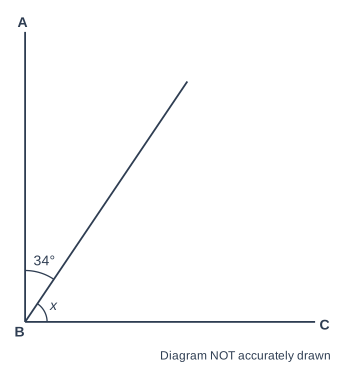
In the diagram, angle ABC is a right angle.
Work out the size of the angle marked x.
Model answer
A right angle is 90°. x = 90° − 34° = 56°
Explanation
The two angles together make the right angle ABC, so they add up to 90°. Subtract 34° from 90°.
Mark scheme
1 mark
B1 for 56(°)
cao
Question 2
2 marks
Work out the size of each exterior angle of a regular pentagon.
Model answer
The exterior angles of any polygon add up to 360°. A regular pentagon has 5 equal exterior angles. 360° ÷ 5 = 72°
Explanation
The exterior angles of a polygon always add up to 360°, and in a regular polygon they are all equal. So divide 360° by the number of sides.
Mark scheme
1 mark
M1 for 360 ÷ 5
1 mark
A1 for 72(°)
cao; correct answer with no working scores full marks
Question 3
3 marks
Work out the size of each interior angle of a regular decagon (a polygon with 10 sides).
Model answer
Each exterior angle = 360° ÷ 10 = 36° Each interior angle = 180° − 36° = 144°
Explanation
Find the exterior angle first: the exterior angles add up to 360° and are all equal in a regular polygon. The interior and exterior angles at each vertex add up to 180°. Another method is (10 − 2) × 180° = 1440° for the total, then 1440° ÷ 10.
Mark scheme
1 mark
M1 for 360 ÷ 10 (= 36), or (10 − 2) × 180 (= 1440)
1 mark
M1 for 180 − 36, or 1440 ÷ 10
1 mark
A1 for 144(°)
cao; correct answer with no working scores full marks
Question 4
4 marks
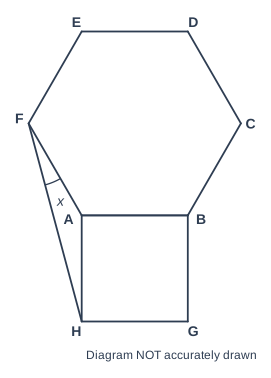
The diagram shows a regular hexagon ABCDEF and a square ABGH. The line FH is drawn.
Work out the size of angle AFH.
Model answer
Interior angle of a regular hexagon = 180° − 360° ÷ 6 = 120° Angle FAH = 360° − 120° − 90° = 150° (angles at a point) AF = AB = AH, so triangle AFH is isosceles. Angle AFH = (180° − 150°) ÷ 2 = 15°
Explanation
Around the point A there are three angles: the hexagon's 120°, the square's 90° and angle FAH, which together make 360°. The hexagon and the square share side AB, so AF and AH are the same length, which makes triangle AFH isosceles with equal angles at F and H.
Mark scheme
1 mark
P1 for the interior angle of the hexagon: 120°
e.g. 180 − 360 ÷ 6 or 720 ÷ 6; correct answer with no working scores full marks
1 mark
P1 for angle FAH = 360 − 120 − 90 (= 150)
1 mark
P1 for (180 − 150) ÷ 2, using AF = AH
1 mark
A1 for 15(°)
cao
Ready to try the rest? Every answer you write is marked against the mark scheme, so you can see exactly where the marks are.
Ctrl + Enter to check
Study HelperHints first, answers after you try
Stuck on this one? Ask for a hint and I’ll point you in the right direction, without giving the answer away. Once you’ve checked your answer, I’ll show you how the marks are awarded.