
Level:
Correct: 0
Incorrect: 0
Marks: 0/0
Exam Practice
Course:
Topics:
Edexcel GCSE Maths (Foundation non-calculator) Smart practice A mixed round aimed at your weak spots
Unit 1
Number
Unit 2
Algebra
Unit 3
Ratio, proportion and rates of change
Unit 4
Geometry and measures
Unit 5
Probability
Unit 6
Statistics
Avg
score:
–
Topics
done:
0/86

Equations for direct and inverse proportion

Practise 19 exam-style questions on Equations for direct and inverse proportion for Edexcel GCSE Maths (Foundation non-calculator). Write your answer as you would in the exam and get it marked in seconds against the mark scheme, point by point, with the Study Helper on hand if you get stuck.

  • 19 questions
  • 1–4 marks each
  • Instant marking
  • No sign-up needed
19 questions, marked as you go

Sample questions with model answers

Here are 4 of the questions in this topic, each with a model answer, an explanation of why it earns the marks and the mark scheme an examiner would use.

Question 1

1 mark

\(y = 5x\)

The value of \(x\) is multiplied by 3

What happens to the value of \(y\)?

Model answer

\(y\) is multiplied by 3.
For example, when \(x = 1\), \(y = 5\); when \(x = 3\), \(y = 15\).

Explanation

y = 5x shows that y is directly proportional to x. In direct proportion, whatever you multiply x by, y is multiplied by the same number. Trying two values of x is a quick way to check.

Mark scheme
  1. 1 mark

    B1 for y is multiplied by 3

    accept 'y is 3 times as big' or 'y trebles'; do not accept 'y increases by 3'
Question 2

2 marks

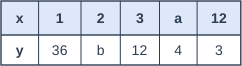
The table shows some values of \(x\) and \(y\), where \(y = \dfrac{36}{x}\)

Work out the values of a and b.

Table with columns "x", "1", "2", "3", "a", "12". x: y; 1: 36; 2: b; 3: 12; a: 4; 12: 3.

Model answer

b: when \(x = 2\), \(y = 36 \div 2 = 18\)
a: when \(y = 4\), \(x = 36 \div 4 = 9\)
b = 18, a = 9

Explanation

Substitute into the formula: b is the value of y when x = 2. For a, you know y = 4, so you need the value of x that makes 36 ÷ x = 4. Because x × y is always 36, divide 36 by 4.

Mark scheme
  1. 1 mark

    B1 for b = 18

    cao; correct answer with no working scores full marks

  2. 1 mark

    B1 for a = 9

    cao

Question 3

2 marks

Here are four statements about the equation \(y = \dfrac{12}{x}\)

A \(y\) is directly proportional to \(x\)
B \(y\) is directly proportional to \(\dfrac{1}{x}\)
C When \(x\) is multiplied by 4, \(y\) is divided by 4
D When \(x = 3\), \(y = 36\)

Which two statements are true?

Model answer

B is true: \(y = 12 \times \dfrac{1}{x}\), so \(y\) is proportional to \(\dfrac{1}{x}\).
C is true: \(y\) is inversely proportional to \(x\), so multiplying \(x\) by 4 divides \(y\) by 4.
A is false (it is inverse, not direct, proportion).
D is false: when \(x = 3\), \(y = 12 \div 3 = 4\).
The true statements are B and C.

Explanation

y = 12/x means y is inversely proportional to x, which is exactly the same as y being directly proportional to 1/x, because 12/x = 12 × 1/x. Check D by substituting: 12 ÷ 3 = 4, not 12 × 3.

Mark scheme
  1. 2 marks

    B2 for B and C only

    B1 for B or C, with no more than one other letter given

Question 4

3 marks

The extension, \(e\) cm, of a spring when a weight of \(W\) newtons hangs from it is given by

\(e = 0.4W\)

The spring is damaged if the extension is more than 10 cm.

Ruby hangs a 15 newton weight and a 12 newton weight from the spring together.

Will the spring be damaged?
You must show your working.

Model answer

Total weight: 15 + 12 = 27 N
Extension: \(e = 0.4 \times 27 = 10.8\) cm
10.8 cm is more than 10 cm, so yes, the spring will be damaged.

Explanation

The extension is directly proportional to the weight, with 0.4 cm of stretch for every newton. Add the weights first, then substitute into the formula. 0.4 × 27 can be worked out as 27 × 4 ÷ 10 = 108 ÷ 10 = 10.8.

Mark scheme
  1. 1 mark

    M1 for 15 + 12 (= 27)

  2. 1 mark

    M1 for 0.4 × 27 (= 10.8), or 10 ÷ 0.4 (= 25 N as the greatest weight)

  3. 1 mark

    C1 for Yes, with 10.8 cm compared with 10 cm (or 27 N compared with 25 N)

Ready to try the rest? Every answer you write is marked against the mark scheme, so you can see exactly where the marks are.

Study Helper Hints first, answers after you try

Stuck on this one? Ask for a hint and I’ll point you in the right direction, without giving the answer away. Once you’ve checked your answer, I’ll show you how the marks are awarded.