Practise 19 exam-style questions on Parts of a circle for Edexcel GCSE Maths (Foundation non-calculator). Write your answer as you would in the exam and get it marked in seconds against the mark scheme, point by point, with the Study Helper on hand if you get stuck.
19 questions
1–5 marks each
Instant marking
No sign-up needed
19 questions, marked as you go
Sample questions with model answers
Here are 4 of the questions in this topic, each with a model answer, an explanation of why it earns the marks and the mark scheme an examiner would use.
Question 1
1 mark
A circle has a radius of 6.5 cm.
Write down the length of the diameter of the circle.
Model answer
Diameter = 2 × radius = 2 × 6.5 = 13 cm
Explanation
The diameter goes from one side of the circle to the other through the centre, so it is made of two radii. Double the radius to get the diameter. A common mistake is to halve the radius instead.
Mark scheme
1 mark
B1 for 13 (cm)
cao
Question 2
2 marks
The longest chord that can be drawn in a circle is 18 cm long.
Work out the radius of the circle.
Model answer
The longest chord in a circle is the diameter. Diameter = 18 cm Radius = 18 ÷ 2 = 9 cm
Explanation
A chord joins two points on the circle. The longest possible chord goes through the centre, so it is the diameter. The radius is half of the diameter.
Mark scheme
1 mark
M1 for recognising that the longest chord is a diameter, e.g. diameter = 18 or 18 ÷ 2
1 mark
A1 for 9 (cm)
cao; correct answer with no working scores full marks
Question 3
2 marks
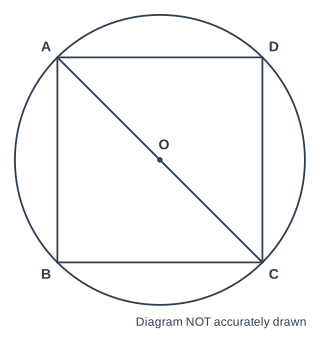
The diagram shows a square ABCD. The corners of the square lie on a circle with centre O. The diagonal AC passes through O. The radius of the circle is 8 cm.
Work out the length of AC. Give a reason for your answer.
Model answer
A and C are on the circle and AC passes through the centre O. So AC is a diameter of the circle. AC = 2 × 8 = 16 cm
Explanation
A straight line through the centre that joins two points on the circle is a diameter. A diameter is made of two radii (OA and OC here), so it is twice the radius.
Mark scheme
1 mark
B1 for 16 (cm)
cao; correct values with no working score the calculation marks
1 mark
C1 for a correct reason, e.g. AC is a diameter of the circle because it passes through the centre and joins two points on the circle, and a diameter is twice the radius
accept 'AC is made of two radii, OA and OC'
Question 4
4 marks
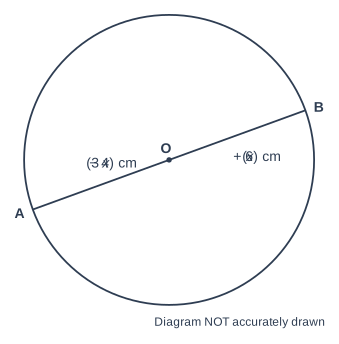
The diagram shows a circle with centre O. AB is a diameter of the circle.
OA = (3x − 4) cm OB = (x + 6) cm
Work out the length of the diameter AB.
Model answer
OA and OB are both radii, so they are equal. 3x − 4 = x + 6 2x − 4 = 6 2x = 10 x = 5 OA = 3 × 5 − 4 = 11 cm (check: OB = 5 + 6 = 11 cm) AB = 11 + 11 = 22 cm
Explanation
OA and OB are both radii, and all radii of a circle are equal, so you can make an equation and solve it. Finding x is not the end: substitute x = 5 to get the radius, then double it because the diameter is made of two radii.
Mark scheme
1 mark
M1 for 3x − 4 = x + 6 (OA = OB as both are radii)
1 mark
M1 for a correct rearrangement with the x terms on one side and the numbers on the other, e.g. 2x = 10
1 mark
A1 for x = 5 or radius = 11
1 mark
A1 for 22 (cm)
cao; do not accept 5 or 11 as the final answer; correct answer with no working scores full marks
Ready to try the rest? Every answer you write is marked against the mark scheme, so you can see exactly where the marks are.
Ctrl + Enter to check
Study HelperHints first, answers after you try
Stuck on this one? Ask for a hint and I’ll point you in the right direction, without giving the answer away. Once you’ve checked your answer, I’ll show you how the marks are awarded.