
Level:
Correct: 0
Incorrect: 0
Marks: 0/0
Exam Practice
Course:
Topics:
Edexcel GCSE Maths (Foundation non-calculator) Smart practice A mixed round aimed at your weak spots
Unit 1
Number
Unit 2
Algebra
Unit 3
Ratio, proportion and rates of change
Unit 4
Geometry and measures
Unit 5
Probability
Unit 6
Statistics
Avg
score:
–
Topics
done:
0/86

Equations, identities and algebraic arguments

Practise 30 exam-style questions on Equations, identities and algebraic arguments for Edexcel GCSE Maths (Foundation non-calculator). Write your answer as you would in the exam and get it marked in seconds against the mark scheme, point by point, with the Study Helper on hand if you get stuck.

  • 30 questions
  • 1–5 marks each
  • Instant marking
  • No sign-up needed
20 questions, marked as you go

Sample questions with model answers

Here are 4 of the questions in this topic, each with a model answer, an explanation of why it earns the marks and the mark scheme an examiner would use.

Question 1

1 mark

Sam says,

"When you add two odd numbers together, the answer is always an odd number."

Give an example to show that Sam is wrong.

Model answer

3 + 5 = 8
8 is an even number, so Sam is wrong.

Explanation

To show that a statement is wrong you only need one example where it fails (a counter-example). In fact the sum of two odd numbers is always even: each odd number has one left over when you make pairs, and the two left-over ones make another pair.

Mark scheme
  1. 1 mark

    B1 for an example of two odd numbers with an even total, e.g. 3 + 5 = 8

    the total must be shown (or the answer stated to be even); accept any correct example
Question 2

2 marks

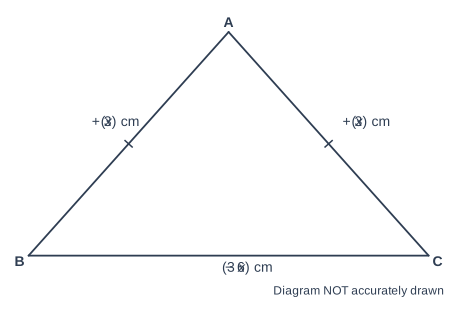
The diagram shows an isosceles triangle.
The lengths of the sides are in centimetres.

Show that the perimeter of the triangle is \(5x\) cm.

Geometry diagram, marked "Diagram NOT accurately drawn". Triangle ABC. Side AB is labelled (x + 3) cm. Side AC is labelled (x + 3) cm. Side BC is labelled (3x − 6) cm. AB and AC are each marked with one short dash (equal lengths).

Model answer

Perimeter \(= (x + 3) + (x + 3) + (3x - 6)\)
\(= x + x + 3x + 3 + 3 - 6\)
\(= 5x\) cm

Explanation

The perimeter is the total distance round the outside, so add all three sides. Remember the triangle is isosceles, so \(x + 3\) appears twice. Collect the \(x\) terms (\(x + x + 3x = 5x\)) and the numbers (\(3 + 3 - 6 = 0\)).

Mark scheme
  1. 1 mark

    M1 for adding all three sides, e.g. \((x + 3) + (x + 3) + (3x - 6)\) or \(2(x + 3) + 3x - 6\)

    M0 if only two sides are added

  2. 1 mark

    A1 for correct simplification to \(5x\) with working shown

Question 3

3 marks

A pen costs \(x\) pence.
A ruler costs 15 pence more than a pen.

Lee buys 4 pens and 2 rulers.
He says the total cost, in pence, is \(6x + 15\)

Is Lee correct?
You must show your working.

Model answer

Cost of one ruler \(= x + 15\) pence
Total \(= 4x + 2(x + 15) = 4x + 2x + 30 = 6x + 30\)
No, Lee is not correct. The total cost is \(6x + 30\) pence, not \(6x + 15\).

Explanation

Write the cost of one ruler first, \(x + 15\), then multiply by 2 because there are 2 rulers. The 15 must be doubled as well as the \(x\). Lee has forgotten to multiply the 15 by 2.

Mark scheme
  1. 1 mark

    M1 for \(x + 15\) as the cost of one ruler (or \(2(x + 15)\) seen)

  2. 1 mark

    M1 for \(4x + 2(x + 15)\) oe

  3. 1 mark

    C1 for No, with a correct total of \(6x + 30\) shown

    do not award for "No" without the correct expression

Question 4

4 marks

Ann is \(n\) years old.
Ben is 4 years older than Ann.
Cara is twice as old as Ben.

Show that in 5 years' time the total of their three ages will be \(4n + 27\)

Model answer

Now: Ann \(n\), Ben \(n + 4\), Cara \(2(n + 4) = 2n + 8\)
In 5 years: Ann \(n + 5\), Ben \(n + 9\), Cara \(2n + 13\)
Total \(= (n + 5) + (n + 9) + (2n + 13) = 4n + 27\)

Explanation

Write each age now as an expression, then add 5 to each person's age (so the total goes up by 15). A common mistake is to double Ben's age in 5 years for Cara: Cara is twice Ben's age now, and in 5 years she is just 5 years older.

Mark scheme
  1. 1 mark

    P1 for Ben's age \(n + 4\)

  2. 1 mark

    P1 for Cara's age \(2(n + 4)\) or \(2n + 8\)

  3. 1 mark

    P1 for adding 5 to each age (e.g. \(n + 5\), \(n + 9\), \(2n + 13\)) or adding 15 to the total \(4n + 12\)

  4. 1 mark

    A1 for complete correct working leading to \(4n + 27\)

    do not accept \(2(n + 9)\) for Cara's age in 5 years

Ready to try the rest? Every answer you write is marked against the mark scheme, so you can see exactly where the marks are.

Study Helper Hints first, answers after you try

Stuck on this one? Ask for a hint and I’ll point you in the right direction, without giving the answer away. Once you’ve checked your answer, I’ll show you how the marks are awarded.