Multiplicative relationships as ratios and fractions
Practise 19 exam-style questions on Multiplicative relationships as ratios and fractions for Edexcel GCSE Maths (Foundation non-calculator). Write your answer as you would in the exam and get it marked in seconds against the mark scheme, point by point, with the Study Helper on hand if you get stuck.
19 questions
1–5 marks each
Instant marking
No sign-up needed
19 questions, marked as you go
Sample questions with model answers
Here are 4 of the questions in this topic, each with a model answer, an explanation of why it earns the marks and the mark scheme an examiner would use.
Question 1
1 mark
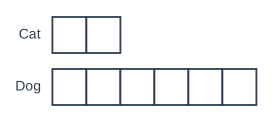
The bar model shows the mass of a cat and the mass of a dog.
Write the mass of the cat as a fraction of the mass of the dog. Give your fraction in its simplest form.
All the boxes are the same size, so the cat is 2 parts and the dog is 6 parts. The cat's mass is \(\dfrac{2}{6}\) of the dog's mass, which simplifies to \(\dfrac{1}{3}\). This also means the dog is 3 times as heavy as the cat.
Mark scheme
1 mark
B1 for \(\dfrac{1}{3}\)
cao; \(\dfrac{2}{6}\) not simplified scores 0
Question 2
2 marks
In a sale, the price of a coat is 0.8 times its original price.
Write down the ratio of the sale price to the original price. Give your ratio in its simplest form.
Model answer
sale price : original price = 0.8 : 1 Multiply by 10: 8 : 10 Divide by 2: 4 : 5
Explanation
"0.8 times the original price" means that for every £1 of the original price, the sale price is £0.80. So the ratio is 0.8 : 1. Multiply by 10 to remove the decimal, then simplify 8 : 10 to 4 : 5.
Mark scheme
1 mark
M1 for 0.8 : 1 or 8 : 10 oe
correct answer with no working scores full marks
1 mark
A1 for 4 : 5
cao
Question 3
2 marks
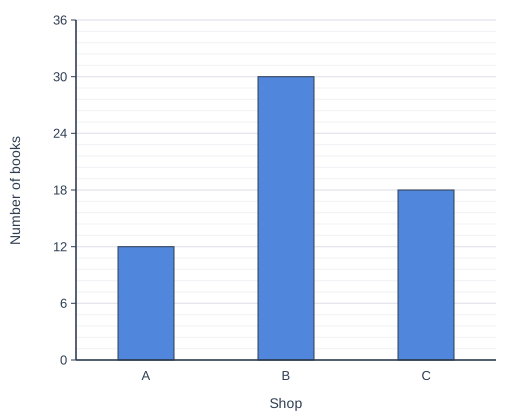
The bar chart shows the numbers of books sold by three shops on one day.
Write the number of books sold by Shop A as a fraction of the number sold by Shop B. Give your fraction in its simplest form.
Model answer
Shop A sold 12 books and Shop B sold 30 books. \(\dfrac{12}{30} = \dfrac{2}{5}\)
Explanation
Read the two bars from the scale: Shop A is 12 and Shop B is 30. Shop A goes on top because it is the fraction "of" Shop B. Divide the top and bottom by 6 to simplify.
Mark scheme
1 mark
M1 for \(\dfrac{12}{30}\) oe
1 mark
A1 for \(\dfrac{2}{5}\)
cao; correct answer with no working scores full marks
Question 4
4 marks
The length of a rectangle is 3 times its width. The perimeter of the rectangle is 64 cm.
Work out the area of the rectangle.
Model answer
The perimeter is width + length + width + length = 1 + 3 + 1 + 3 = 8 widths. 64 ÷ 8 = 8, so the width is 8 cm Length = 3 × 8 = 24 cm Area = 24 × 8 = 192 cm²
Explanation
The length is 3 widths, so going all the way round the rectangle is 8 widths. Dividing the perimeter by 8 gives the width. Then find the length and multiply to get the area. Sharing 64 in the ratio 1 : 3 is a common mistake: 64 is two widths and two lengths, so you could share half of it, 32, in the ratio 1 : 3 instead.
Mark scheme
1 mark
P1 for width : length = 1 : 3, or for the perimeter as 1 + 3 + 1 + 3 = 8 widths
1 mark
P1 for 64 ÷ 8 (= 8 cm, the width)
1 mark
P1 for length = 3 × 8 (= 24 cm)
ft their width
1 mark
A1 for 192 (cm²)
cao; correct answer with no working scores full marks
Ready to try the rest? Every answer you write is marked against the mark scheme, so you can see exactly where the marks are.
Ctrl + Enter to check
Study HelperHints first, answers after you try
Stuck on this one? Ask for a hint and I’ll point you in the right direction, without giving the answer away. Once you’ve checked your answer, I’ll show you how the marks are awarded.